
Other approved peptide drugs
Octreotide
Also called Sandostatin, Sandostatin LAR, octreotide acetate, somatostatin analog
- US status
- Approved
- DEA
- Not a controlled substance
- WADA
- Not listed as prohibited
- Class
- Other approved peptide drugs
Jump to doses reported ↓ Dose math calculator
What it is
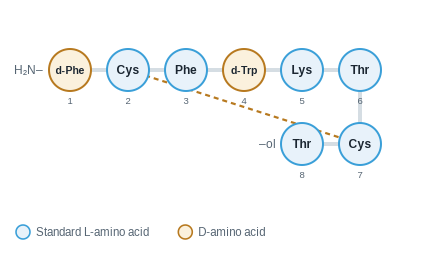
Octreotide is a synthetic analog of somatostatin, a natural regulatory hormone. As an approved prescription drug (Sandostatin), it is used to control acromegaly (too much growth hormone), carcinoid syndrome, and severe diarrhea from certain hormone-secreting tumors. It comes as a short-acting injection and a once-monthly long-acting depot given by a clinician S1.
How it works
Octreotide is a synthetic analog of somatostatin, the body's inhibitory hormone. It binds somatostatin receptors (mainly subtype 2) and shuts down the release of several hormones — most importantly growth hormone, which is how it controls acromegaly and lowers IGF-1 S1S2. On hormone-secreting gut tumors the same receptor binding curbs the excess serotonin and vasoactive peptides that cause carcinoid syndrome and secretory diarrhea S1. The long-acting depot releases drug slowly for about a month S1.
Legal status
- FDA: Approved for acromegaly, carcinoid syndrome, and VIPoma-associated diarrhea S1.
- Compounding: an approved drug substance dispensed as a prescription product.
- DEA: Not a controlled substance.
- "Research use only" labels: not relevant; this is a prescription drug.
- WADA (sport): Not listed as prohibited.
- International (short): Not reviewed for this page yet.
What the research actually shows
Evidence: A. Octreotide is an approved drug with decades of trial and registry data.
| Study | Design | People | Dose studied | Result |
|---|---|---|---|---|
| Freda 2005 S2 | Meta-analysis | People with acromegaly | Long-acting somatostatin analogs | Normalized growth hormone and IGF-1 in a large share of patients |
| Label S1 | Approved indications | Acromegaly, carcinoid, VIPoma | SC and depot regimens | Basis of approval |
What we don't know for this page: nothing unusual for a well-characterized approved drug.
Reported benefits
Lowers growth hormone and IGF-1 in acromegaly, controls flushing and diarrhea in carcinoid syndrome, and reduces secretory diarrhea from VIPomas S1S2.
Side effects
Common: gallstones or gallbladder sludge, diarrhea or loose stools, abdominal pain, nausea, and changes in blood sugar S1. Serious: the label notes gallbladder problems, abnormal blood sugar (high or low), slow heart rate, and thyroid changes with long-term use S1.
Dangers and red flags
- Gallstones. Common with long-term use; clinicians monitor for them S1.
- Blood sugar swings. Can raise or lower glucose; relevant in people with diabetes S1.
- Who should avoid it: used with caution in people with gallbladder disease or diabetes per the label S1.
Doses reported
We don't recommend sh*t. These are the doses studies, labels and harm-reduction sources report. That's information, not advice. Talk to a licensed clinician.
The short-acting form is a ready-to-use solution and the depot is mixed and given by a clinician, so the reconstitution calculator does not apply.
| Source | Dose | Unit / route | Frequency | Timing | Duration | Titration / escalation | Context |
|---|---|---|---|---|---|---|---|
| S1 Label (short-acting) | 50–500 mcg | mcg, SC | Two to three times daily | — | Ongoing | Titrated to response | Acromegaly, carcinoid, VIPoma |
| S1 Label (depot) | 10–40 mg | mg, IM depot | Once every 4 weeks | By a clinician | Ongoing | Titrated to hormone levels | Long-term control |
Monitoring a doctor would order
Growth hormone and IGF-1 (acromegaly), gallbladder imaging over time, blood sugar, thyroid function, and vitamin B12 with long-term use S1.
Bottom line
Octreotide is an approved, well-studied somatostatin analog that controls acromegaly and hormone-secreting tumor symptoms, in short-acting and monthly depot forms. Its main long-term risks are gallstones and blood-sugar changes. It is a prescription medicine.