
SARMs & adjacent non-peptides
Ostarine (enobosarm, MK-2866)
Also called enobosarm, MK-2866, GTx-024, S-22, selective androgen receptor modulator
- US status
- Not approved
- DEA
- Not a federally scheduled controlled substance; sale as a dietary supplement is illegal and SARMs are widely banned at the state level and by trade rules
- WADA
- S1.2 Other anabolic agents (SARMs); prohibited at all times
- Class
- SARMs & adjacent non-peptides
Jump to doses reported ↓ Dose math calculator
What it is
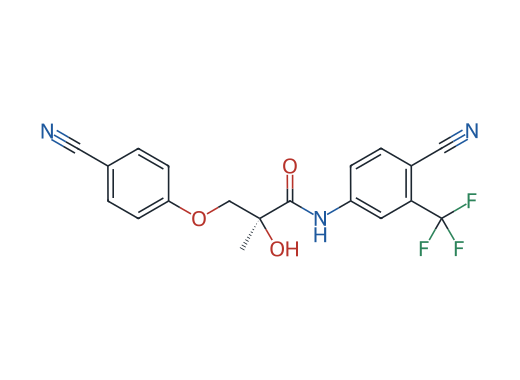
Ostarine, developed as enobosarm (GTx-024, MK-2866), is a selective androgen receptor modulator (SARM), a non-steroidal compound. It was studied as a drug for muscle wasting and reached phase 3, but it has never been approved for any use. It is sold in the grey market, often falsely as a "dietary supplement," for muscle growth and fat loss.
How it works
Ostarine binds the androgen receptor, the same receptor testosterone uses, and switches on the genes that drive muscle protein building and bone maintenance. It was designed to be tissue-selective: a full-strength signal in muscle and bone, and a weaker one in the prostate, skin and hair follicles than testosterone gives. That selectivity was shown mainly in animal and lab models; in humans the trials measured lean mass and function, not how selective the drug really is across tissues S2S3.
Because it is not a steroid, ostarine is not converted to estrogen (no aromatization) and is not a substrate for 5-alpha reductase, so it does not make DHT. The brain and pituitary still read it as an androgen and cut back LH and FSH, which lowers the body's own testosterone production (HPTA suppression). The downstream effects seen in trials fit this picture: modest gains in lean body mass, along with lower HDL cholesterol and lower sex-hormone levels S2S3. It is processed by the liver, and SARMs including ostarine are linked to drug-induced liver injury S4.
Legal status
- FDA: Not approved. FDA has warned consumers against SARM body-building products and sent warning letters to sellers, noting links to serious harm including liver injury S1.
- Dietary-supplement status: SARMs are not lawful dietary ingredients; selling ostarine as a supplement is illegal S1.
- DEA: Not currently a federally scheduled controlled substance. (Legislation to schedule SARMs has been proposed in the past; this should be checked against current law.)
- "Research use only" products: much ostarine is sold as research powder or capsules of unverified content. See our explainer.
- WADA: Prohibited at all times under S1.2; ostarine is one of the most common causes of SARM anti-doping violations S5.
- International (short): Not reviewed for this page yet.
What the research actually shows
Evidence: C. Ostarine is among the better-studied SARMs, with real randomized human trials, but they were for medical muscle wasting, not the physique and performance uses it is sold for, and it never cleared phase 3 to approval.
| Study | Design | People | Dose studied | Result |
|---|---|---|---|---|
| Dalton 2011 S2 | Double-blind, placebo-controlled phase 2 | Healthy elderly men and postmenopausal women | 3 mg/day oral | Increased lean body mass and improved stair-climb power versus placebo |
| Dobs 2013 (POWER) S3 | Double-blind, randomized phase 2 | Patients with cancer and weight loss | 1 mg and 3 mg/day oral | Increased lean body mass versus placebo; mixed effect on physical function |
| Mohideen 2023 S4 | Review of case reports | SARM users with liver injury | — | Describes SARM-associated drug-induced liver injury, including cholestatic patterns |
What we don't know: whether ostarine is safe over the long term (the liver-injury signal is the main concern), and whether a grey-market product actually contains ostarine at the stated amount and nothing else.
Reported benefits
In trials: modest gains in lean body mass and some physical-function measures, at low oral doses, in people with or at risk of muscle wasting S2S3. These are real but modest medical findings; they are not evidence for the larger physique changes ostarine is marketed for, and they came with safety questions that stopped its development.
Side effects
Common: suppression of the body's own testosterone and sex-hormone levels, and reductions in HDL ("good") cholesterol are typical of androgenic compounds and were seen with SARMs S2S3. Serious: drug-induced liver injury, including cholestatic injury that can be severe, has been repeatedly reported with SARMs including ostarine S4. Hormonal suppression can persist after stopping.
Dangers and red flags
- Liver injury. SARMs, ostarine among them, are an established cause of drug-induced liver injury S1S4.
- Sold illegally as a supplement. Products are unapproved and often sold with no warnings on the label; what is in the bottle can't be confirmed S1.
- Hormone suppression. Ostarine suppresses natural testosterone, which may not fully recover S3.
- Marketed beyond the evidence. The trials were for medical muscle wasting, not bodybuilding S2S3.
- Sport: prohibited at all times and a frequent cause of positive tests S5.
Doses reported
We don't recommend sh*t. These are the doses studies, labels and harm-reduction sources report. That's information, not advice. Talk to a licensed clinician.
There is no FDA label (never approved), so there is no label dose. The rows below are oral study doses, all once daily. Ostarine is taken by mouth, so the reconstitution calculator does not apply.
| Source | Dose | Unit / route | Frequency | Timing | Duration | Titration / escalation | Context |
|---|---|---|---|---|---|---|---|
| S2 Dalton 2011 | 3 mg | mg, oral | Once daily | — | ~12 weeks (86 days) | Fixed dose; no escalation | Healthy elderly men and postmenopausal women |
| S3 Dobs 2013 | 1 mg and 3 mg | mg, oral | Once daily | — | Up to 113 days | Two fixed dose arms | Patients with cancer and weight loss |
No validated survey or harm-reduction source with citable numbers for physique or performance use of ostarine was found that we could cite; we will not fill that gap with forum or vendor numbers.
Monitoring a doctor would order
There is no guideline for this unapproved drug. Given the trial findings, the relevant checks would be liver enzymes and bilirubin (for the drug-induced liver injury risk), a lipid panel (for HDL suppression), and testosterone and other sex hormones (for suppression) S3S4. No ostarine-specific monitoring standard exists.
Bottom line
Ostarine (enobosarm) is a never-approved SARM with genuine phase 2 evidence for modest lean-mass gains in medical muscle wasting, but it failed to reach approval and carries a real, sometimes severe liver-injury risk. It is sold illegally as a supplement or research chemical of unverified content, suppresses natural testosterone, and is a leading cause of anti-doping violations.
Sources
- [S1] U.S. FDA. Consumer Update: FDA Warns of Use of Selective Androgen Receptor Modulators (SARMs) Among Teens, Young Adults (SARMs are unapproved drugs, cannot be legally marketed as dietary supplements, and are linked to liver injury, heart attack and stroke). (regulator)
- [S2] Dalton JT, et al. The selective androgen receptor modulator GTx-024 (enobosarm) improves lean body mass and physical function in healthy elderly men and postmenopausal women: results of a double-blind, placebo-controlled phase II trial. J Cachexia Sarcopenia Muscle. 2011;2:153-161. PMID 22031847. (rct)
- [S3] Dobs AS, et al. Effects of enobosarm on muscle wasting and physical function in patients with cancer: a double-blind, randomised controlled phase 2 trial (POWER). Lancet Oncol. 2013;14:335-345. PMID 23499390. (rct)
- [S4] Mohideen H, et al. Selective Androgen Receptor Modulators: An Emerging Liver Toxin. J Clin Transl Hepatol. 2023;11:724-730. PMID 36479151. (review)
- [S5] World Anti-Doping Agency. 2026 Prohibited List, section S1.2 (other anabolic agents, SARMs). (regulator)