
Skin, tanning & sexual-health peptides
Oxytocin
Also called Pitocin, nasal oxytocin, oxytocin nasal spray, OXT, love hormone
- US status
- Approved (Pitocin and generics): IV/IM injection to start or strengthen labor for medical reasons and to control bleeding after delivery
- DEA
- Not a controlled substance
- WADA
- Not named
- Class
- Skin, tanning & sexual-health peptides
Jump to doses reported ↓ Dose math calculator
What it is
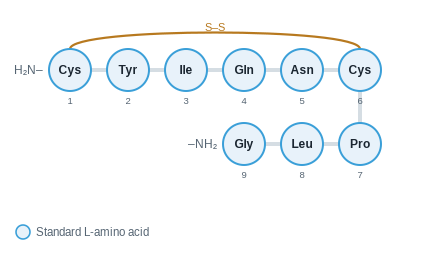
Oxytocin is a small peptide hormone made in the brain and released by the pituitary gland. It makes the uterus contract during labor S1 and also acts as a signal in the brain S4. As Pitocin and generic versions, it is a standard hospital drug: given by IV drip to start or strengthen labor when there is a medical reason, and after delivery to control bleeding S1.
Outside the hospital, oxytocin is sold as compounded nasal sprays and under-the-tongue troches, and as grey-market powder vials, marketed for sex, intimacy, mood and social anxiety. None of those forms is FDA-approved, and the best trials of nasal oxytocin found no benefit over placebo S2S3.
How it works
- Uterine contractions. Oxytocin binds its own receptors in the uterine muscle and raises calcium inside the muscle cells, which makes them contract. The number of receptors climbs sharply during pregnancy and peaks in early labor at term, so the same dose has very different effects at different times S1.
- Very short-lived. In the blood it lasts only about 1 to 6 minutes. IV, the uterus responds almost at once and the effect fades within an hour; IM, it starts in 3 to 5 minutes and lasts 2 to 3 hours S1.
- A cousin of the water hormone. Oxytocin differs from vasopressin, the body's water-retention hormone, in only two amino acids. At large doses it can act like vasopressin, holding on to water and raising blood pressure, which is how dangerous water intoxication happens S1.
- Brain and behavior. Oxytocin is also a brain signal (neuropeptide), and researchers hoped nasal sprays could improve social behavior in autism and sexual function S2S4. The largest trials found little or no effect S2S3.
Legal status
- FDA: Approved as an injection (10 units per mL) for medically indicated labor induction, strengthening labor, and controlling bleeding after delivery. The label says Pitocin "is not indicated for elective induction of labor," and that for labor it should be given "only by the intravenous route and with adequate medical supervision in a hospital" S1.
- Compounded nasal sprays and troches: prescribed off-label in the US. Compounded drugs are not FDA-approved, which "means FDA does not review their safety, effectiveness, or quality before they are marketed" S5.
- DEA: Not a controlled substance.
- "Research use only" vials: see our explainer.
- WADA: Not named on the 2026 List S6.
What the research actually shows
Evidence: A for labor and after-delivery bleeding (FDA-approved label). For nasal use, randomized trials are mostly negative.
| Study | Design | People | Dose studied | Result |
|---|---|---|---|---|
| Pitocin label S1 | FDA-approved prescribing information | Pregnant and postpartum patients | IV drip from 0.5–1 mU/min; 10 units IM after the placenta | Approved uses: medically indicated induction or strengthening of labor; bleeding control after delivery |
| Sikich et al 2021 S2 | Randomized, placebo-controlled phase 2 | 290 children and teens (3–17) with autism | Nasal, target 48 IU a day | No difference: social withdrawal score −3.7 vs −3.5 with placebo over 24 weeks |
| Muin et al 2015 S3 | Randomized, double-blind, placebo-controlled crossover | 30 women with sexual dysfunction | Nasal 32 IU within 50 minutes before sex | Both oxytocin and placebo improved sexual function scores by similar amounts; no treatment effect |
| Behnia et al 2014 S4 | Randomized, placebo-controlled | 29 healthy couples (58 people) | Nasal 24 IU before sex | No change in desire, arousal, erection or lubrication; slightly more intense orgasm and contentment afterward (small to moderate effects) |
What we don't know: whether nasal or under-the-tongue oxytocin reliably reaches the brain in useful amounts, long-term effects of daily use, and what grey-market vials contain.
Reported benefits
- Approved uses: stronger contractions when labor needs to be started or helped for medical reasons; less bleeding after delivery S1.
- In trials of nasal spray: small boosts in orgasm intensity and post-sex contentment in one couples study S4; no benefit over placebo for female sexual dysfunction S3 or for social withdrawal in autism S2.
- User-reported, not proven: more closeness, better sex, less social anxiety.
Side effects
Common (label, IV/IM in obstetrics): nausea and vomiting S1. Serious (label): allergic reactions including anaphylaxis, irregular heartbeat, high blood pressure episodes, bleeding after delivery, bleeding in the brain (subarachnoid hemorrhage), uterine rupture, fatal loss of clotting factor (afibrinogenemia), and severe water intoxication with seizures and coma; maternal death from oxytocin-induced water intoxication has been reported. Babies can have slow heart rate, jaundice, retinal bleeding, seizures, brain damage or death from overly strong contractions S1.
Dangers and red flags
- Water intoxication. Oxytocin holds water like vasopressin. The label warns that large doses (40 to 50 mU/min) for long periods can cause water intoxication with seizures, and it has happened even with a slow 24-hour drip S1.
- Pregnancy. Oxytocin makes the uterus contract. Using it outside medical care while pregnant could trigger contractions; the label requires continuous monitoring and a qualified physician on hand S1.
- Units vs milligrams. The approved drug is dosed in units (10 units/mL). Grey-market vials are labeled in milligrams, and we found no regulator or label source giving a units-per-milligram conversion to use. A mistake here could be large.
- Product quality. Even the approved product may contain up to 16% total impurities by its label S1; grey-market vials are not tested for identity, dose, sterility or endotoxin.
- Who should avoid it: anyone pregnant outside medical supervision; people with heart rhythm problems, low sodium or conditions that cause water retention.
Doses reported
We don't recommend sh*t. These are the doses studies, labels and harm-reduction sources report. That's information, not advice. Talk to a licensed clinician.
| Source | Population | Dose | Route | Frequency and timing | Duration | Titration or escalation | Cite |
|---|---|---|---|---|---|---|---|
| Pitocin label: labor | Pregnant patients with a medical reason for induction or augmentation, in hospital | Start 0.5–1 mU/min (standard mix: 10 units in 1,000 mL = 10 mU/mL) | IV infusion by pump (the only acceptable route for labor) | Continuous | Until the desired contraction pattern; may be reduced once labor reaches 5–6 cm | Increase by 1–2 mU/min every 30–60 minutes; rates above 9–10 mU/min are rarely required at term | S1 |
| Pitocin label: after delivery | Postpartum patients | 10–40 units added to a running IV infusion (maximum 40 units per 1,000 mL) | IV infusion | Rate adjusted to keep the uterus contracted | As needed | Adjusted to response | S1 |
| Pitocin label: after delivery | Postpartum patients | 10 units (1 mL) | IM | Once, after delivery of the placenta | Single dose | None | S1 |
| Sikich et al 2021 | Children and teens with autism | Target total 48 IU a day | Nasal spray | Daily | 24 weeks | Not stated in the abstract | S2 |
| Muin et al 2015 | Women with sexual dysfunction | 32 IU | Nasal spray | Within 50 minutes before sex | 8 weeks per arm (crossover) | None | S3 |
| Behnia et al 2014 | Healthy couples | 24 IU | Nasal spray | Before sex | Single sessions | None | S4 |
The nasal studies used international units (IU); the label uses units and milliunits (mU). Grey-market vials sold in milligrams cannot be matched to these doses without a lab-tested potency, which no regulator source we found provides. The calculator below does milligram and volume math only.
Open the dose math calculator →
Monitoring a doctor would order
Per the label, during IV use for labor: continuous electronic monitoring of contractions and fetal heart rate, with the infusion stopped at once for overly strong contractions or fetal distress, by trained staff with a qualified physician immediately available S1. Outside obstetrics, we found no source naming a monitoring standard for nasal use.
Bottom line
Oxytocin is a real, essential hospital drug: an IV drip that starts or strengthens labor and a shot that controls bleeding after birth, given under close monitoring because it can rupture the uterus or cause dangerous water retention. Nasal and troche versions for sex, bonding or anxiety are not FDA-approved, and the largest trials found them no better than placebo. Grey-market vials come in milligrams that don't map cleanly to the units used in medicine.
Sources
- [S1] PITOCIN (oxytocin injection, USP) prescribing information (DailyMed set ID 6e5a66fc-e507-497c-b5ce-44a8c95898ad). (label)
- [S2] Sikich L, et al. Intranasal Oxytocin in Children and Adolescents with Autism Spectrum Disorder. N Engl J Med. 2021;385(16):1462-1473. PMID 34644471. (rct)
- [S3] Muin DA, et al. Effect of long-term intranasal oxytocin on sexual dysfunction in premenopausal and postmenopausal women: a randomized trial. Fertil Steril. 2015;104(3):715-23.e4. PMID 26151620. (rct)
- [S4] Behnia B, et al. Differential effects of intranasal oxytocin on sexual experiences and partner interactions in couples. Horm Behav. 2014;65(3):308-18. PMID 24503174. (rct)
- [S5] HHS. Enforcement Discretion Policy Regarding 503A Compounding Using Certain Peptide Bulk Drug Substances (draft). FR Doc 2026-22192, Oct 30 2026 (background on compounded drugs not being FDA-approved). (regulator)
- [S6] World Anti-Doping Agency. 2026 Prohibited List (oxytocin not named). (regulator)