
Cosmetic peptides (topical)
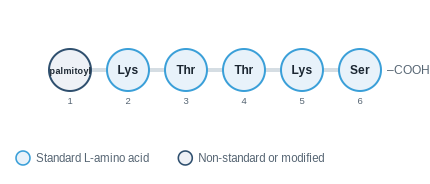
Palmitoyl pentapeptide-4 (pal-KTTKS)
Also called pal-KTTKS, palmitoyl-lysyl-threonyl-threonyl-lysyl-serine, Matrixyl (ingredient trade name)
- US status
- Not approved as a drug
- DEA
- Not a controlled substance
- WADA
- Not named
- Class
- Cosmetic peptides (topical)
Jump to doses reported ↓ Dose math calculator
What it is
Palmitoyl pentapeptide-4 is a five-amino-acid peptide (lysine-threonine-threonine-lysine-serine, or KTTKS) with a fatty acid (palmitic acid) attached to help it get into skin. It is one of the oldest and best-known "signal" peptides in anti-wrinkle creams, and its best-known ingredient trade name is Matrixyl S3. It is applied to the skin in tiny amounts; it is not a supplement or injectable.
How it works
- A piece of collagen's own blueprint. KTTKS matches part of the precursor of type I collagen. When collagen breaks down, fragments like this are thought to act as a signal telling skin cells (fibroblasts) to make more S3.
- Signal peptide. In lab work it has been reported to boost production of collagen types I, III and IV, elastin, fibronectin and glycosaminoglycans, the main building blocks of the skin's support layer S3. Reviews group it with "signal peptides" S5.
- The fatty tail matters. On its own, KTTKS was quickly broken down and did not get into mouse skin. With the palmitoyl tail, it was more stable and reached all skin layers, though very little reached the deeper dermis (0.3 µg/cm² vs 4.2 µg/cm² in the outer layer), and none passed all the way through S4.
Legal status
- FDA: Not a drug. Cosmetics and their ingredients, other than color additives, "do not require FDA approval before they go on the market" S7.
- The claim decides the category. FDA says that if a product is meant to make wrinkles less noticeable "simply by moisturizing the skin, it's a cosmetic," but if it is intended "to remove wrinkles or increase the skin's production of collagen, it's a drug or a medical device" S8. That is why creams with this peptide talk about the look of lines, not collagen building.
- DEA: Not a controlled substance.
- WADA: Not named on the 2026 List S10.
What the research actually shows
Evidence: C. One well-known controlled split-face trial of the peptide alone, a few multi-ingredient studies, and figures from patents and ingredient-maker data quoted in reviews. Reviewers note that clinical evidence for cosmetic peptides "is often weak" S6.
| Study | Design | People | Dose studied | Result |
|---|---|---|---|---|
| Robinson et al 2005 S1 | Randomized, double-blind, placebo-controlled split-face, 12 weeks | 93 women 35–55 | Moisturizer with 3 ppm (0.0003%) pal-KTTKS vs the same moisturizer without it | Fewer wrinkles and fine lines by image analysis and expert grading; well tolerated. Authors worked for a cosmetics manufacturer |
| Patent data cited by Schagen 2017 S3 | Placebo-controlled, double-blind | Not stated | 0.005% formula around the eye, twice daily for 28 days | Fold depth −18%, fold thickness −37%, skin stiffness −21%. Source is a patent, not a peer-reviewed trial |
| Kaczvinsky et al 2009 S2 | Two randomized, double-blind split-face studies, 4 weeks | 42 and 35 women 30–70 | Several products combining pal-KTTKS with another peptide, niacinamide and carnosine (amount not stated) | Smoother crow's-feet area with some products. Multi-ingredient, so the peptide's share can't be separated |
| Choi et al 2014 S4 | Lab skin-penetration study | Hairless mouse skin | — | Palmitoyl version more stable and reached skin layers; none passed through |
What we don't know: how much of the effect comes from the peptide rather than the moisturizer around it, whether higher concentrations work better, and long-term results. Most studies were run or funded by ingredient or product makers.
Reported benefits
- In trials: modestly fewer visible fine lines and wrinkles over 12 weeks S1.
- Marketed, not proven: "collagen boosting" and firming. Collagen production has been measured in lab work, not in the human trials cited here.
Side effects
Common: the 12-week trial reported it was well tolerated S1. Irritation from the cream base is possible with any skin product. Serious: none reported.
Dangers and red flags
- Overstated claims. Marketing that promises to rebuild collagen is a drug claim under FDA's definitions S8.
- Low exposure. Very little reaches the deeper skin S4, which limits both benefit and risk.
- Safety screening. An industry safety framework found its sequence resembles normal skin proteins without toxin or allergen flags S9.
- Injectable or "research" versions: no study supports injecting this peptide, and no safety data exist for that use.
Doses reported
We don't recommend sh*t. These are the doses studies, labels and harm-reduction sources report. That's information, not advice. Talk to a licensed clinician.
This is a topical ingredient, so studies report concentration in the product, not a dose in milligrams.
| Source | Population | Dose | Route | Frequency and timing | Duration | Titration or escalation | Cite |
|---|---|---|---|---|---|---|---|
| Robinson et al 2005 | Women 35–55 with facial photoaging | 3 ppm (0.0003%) in a moisturizer | Topical, half the face | As directed in the trial (not stated in the abstract) | 12 weeks | None | S1 |
| Patent data cited by Schagen 2017 | Adults with eye-area wrinkles | 0.005% | Topical, around one eye | Twice daily | 28 days | None | S3 |
| Kaczvinsky et al 2009 | Women 30–70 | 0.5 g of product (multi-ingredient; peptide amount not stated) | Topical, half the face | Twice daily | 4 weeks | None | S2 |
The inline calculator is not shown on this page because reconstitution and injection math do not apply to a cream ingredient.
Monitoring a doctor would order
None. This is a cosmetic ingredient. Stop using a product that causes redness, itching or rash.
Bottom line
Palmitoyl pentapeptide-4 is a collagen-fragment "signal" peptide with a fatty tail, used in anti-wrinkle creams. One industry-run 12-week split-face trial found modestly fewer fine lines at a tiny concentration; most other numbers come from patents or multi-ingredient products. It's a low-risk cosmetic ingredient with modest, mostly industry-backed evidence, not a collagen-rebuilding drug.
Sources
- [S1] Robinson LR, et al. Topical palmitoyl pentapeptide provides improvement in photoaged human facial skin. Int J Cosmet Sci. 2005;27(3):155-60. PMID 18492182. (rct)
- [S2] Kaczvinsky JR, et al. Efficacy of anti-aging products for periorbital wrinkles as measured by 3-D imaging. J Cosmet Dermatol. 2009;8(3):228-33. PMID 19735523. (rct)
- [S3] Schagen SK. Topical Peptide Treatments with Effective Anti-Aging Results. Cosmetics. 2017;4(2):16. doi:10.3390/cosmetics4020016. (review)
- [S4] Choi YL, et al. Dermal Stability and In Vitro Skin Permeation of Collagen Pentapeptides (KTTKS and palmitoyl-KTTKS). Biomol Ther (Seoul). 2014;22(4):321-7. PMID 25143811. (in-vitro)
- [S5] Gorouhi F, Maibach HI. Role of topical peptides in preventing or treating aged skin. Int J Cosmet Sci. 2009;31(5):327-45. PMID 19570099. (review)
- [S6] Pai VV, Bhandari P, Shukla P. Topical peptides as cosmeceuticals. Indian J Dermatol Venereol Leprol. 2017;83(1):9-18. PMID 27451932. (review)
- [S7] FDA. Is It a Cosmetic, a Drug, or Both? (Or Is It Soap?). Content current as of 09/11/2024. (regulator)
- [S8] FDA. Wrinkle Treatments and Other Anti-aging Products. Content current as of 02/25/2022. (regulator)
- [S9] Bjerke DL, et al. A framework for the safety evaluation of peptides in cosmetics. Curr Res Toxicol. 2026;10:100291. PMID 41953401. (review)
- [S10] World Anti-Doping Agency. 2026 Prohibited List (cosmetic peptides not named). (regulator)