
Other approved peptide drugs
Pasireotide
Also called Signifor, Signifor LAR, SOM230, multireceptor somatostatin analog
- US status
- Approved
- DEA
- Not a controlled substance
- WADA
- Not listed as prohibited
- Class
- Other approved peptide drugs
Jump to doses reported ↓ Dose math calculator
What it is
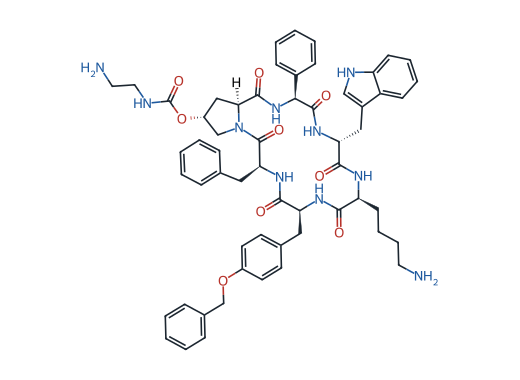
Pasireotide is a somatostatin analog. It is an approved prescription drug (Signifor) used for Cushing's disease, where the body makes too much cortisol, and for acromegaly. It is given as a twice-daily subcutaneous injection or a monthly long-acting depot S1.
How it works
Pasireotide is a somatostatin analog, but it binds a broader set of somatostatin receptor subtypes than octreotide or lanreotide, with particularly high affinity for subtype 5 S1. In Cushing's disease the tumor cells driving excess ACTH carry many subtype-5 receptors, so pasireotide suppresses ACTH release and lowers cortisol S1S2. In acromegaly it suppresses growth hormone and IGF-1 through the same receptor family S1. Its action on another receptor subtype also blunts insulin release, which is why it commonly raises blood sugar S1.
Legal status
- FDA: Approved for Cushing's disease and for acromegaly S1.
- Compounding: an approved drug substance dispensed as a prescription product.
- DEA: Not a controlled substance.
- "Research use only" labels: not relevant; this is a prescription drug.
- WADA (sport): Not listed as prohibited.
- International (short): Not reviewed for this page yet.
What the research actually shows
Evidence: A. Pasireotide is approved, with a pivotal Cushing's disease trial.
| Study | Design | People | Dose studied | Result |
|---|---|---|---|---|
| Colao 2012 S2 | Randomized phase 3 | 162 adults with Cushing's disease | 600 or 900 mcg SC twice daily | Lowered urinary cortisol, with a meaningful share reaching normal; frequent high blood sugar |
| Label S1 | Approved indications | Cushing's disease, acromegaly | SC and depot regimens | Basis of approval |
What we don't know for this page: nothing unusual for an approved drug; its stand-out feature is how often it raises blood sugar.
Reported benefits
Lowers cortisol in Cushing's disease and growth hormone/IGF-1 in acromegaly for people who cannot be controlled by surgery alone S1S2.
Side effects
Common: high blood sugar / new or worse diabetes (very common and often significant), diarrhea, nausea, abdominal pain, and gallstones S1S2. Serious: the label warns about marked hyperglycemia and diabetic complications, slow heart rate and QT prolongation, liver enzyme elevations, and gallbladder problems S1.
Dangers and red flags
- Hyperglycemia. The signature risk; blood sugar often rises sharply and may need treatment S1S2.
- Heart rhythm and liver changes require monitoring S1.
- Who should avoid it: used with caution in diabetes, liver disease, and heart-rhythm problems per the label S1.
Doses reported
We don't recommend sh*t. These are the doses studies, labels and harm-reduction sources report. That's information, not advice. Talk to a licensed clinician.
The short-acting form is a ready-to-use solution and the depot is given by a clinician, so the reconstitution calculator does not apply.
| Source | Dose | Unit / route | Frequency | Timing | Duration | Titration / escalation | Context |
|---|---|---|---|---|---|---|---|
| S1 Label (SC) | 300–900 mcg | mcg, SC | Twice daily | — | Ongoing | Titrated to response and tolerability | Cushing's disease |
| S1 Label (depot) | 10–60 mg | mg, IM depot | Every 4 weeks | By a clinician | Ongoing | Titrated to response | Acromegaly, Cushing's |
| S2 Colao 2012 | 600 or 900 mcg | mcg, SC | Twice daily | — | 12 months | Two fixed arms | Cushing's disease trial |
Monitoring a doctor would order
Blood sugar (closely, especially early), cortisol or IGF-1 by indication, liver enzymes, ECG for QT, gallbladder imaging, and thyroid function S1.
Bottom line
Pasireotide is an approved broad-spectrum somatostatin analog for Cushing's disease and acromegaly. It works where some other options fail but very often raises blood sugar, which is its defining risk and requires close monitoring. It is a prescription medicine.