
Healing / recovery research peptides
PE-22-28
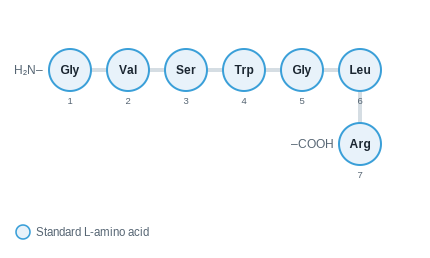
Also called PE 22-28, spadin analog, shortened spadin, GVSWGLR
- US status
- Not approved
- DEA
- Not a controlled substance
- WADA
- Not named; falls under the S0 catch-all if no health authority has approved it
- Class
- Healing / recovery research peptides
Jump to doses reported ↓ Dose math calculator
What it is
PE-22-28 is a lab-made chain of seven amino acids (G-V-S-W-G-L-R) that French researchers designed as a longer-lasting version of spadin, a natural peptide studied as a fast-acting antidepressant S1S2. It has been tested only in cells and mice. It is sold online as a powder, sometimes grouped with "healing" peptides, but every study of it is about mood and depression, not tissue repair.
How it works
- Where it comes from. Spadin is cut from the leftover piece of a nerve-cell receptor protein (sortilin) when the receptor matures S2. Researchers studied how spadin breaks down in blood and built PE-22-28 from one of its pieces S1.
- Blocks a potassium channel called TREK-1. TREK-1 acts like a brake on some brain cells. Mice bred without TREK-1 behave as if they were on antidepressants S2. In lab tests, PE-22-28 blocked human TREK-1 at a concentration hundreds of times lower than spadin (IC50 0.12 nM vs 40–60 nM) S1.
- Faster and longer. Spadin's effect in mice faded after about 7 hours; PE-22-28's lasted up to 23 hours. After 4 days of treatment, mice showed new nerve-cell growth in the brain, a marker linked to antidepressant action S1.
Legal status
- FDA: Not approved for any use. It has never been tested in people.
- Compounding: PE-22-28 does not appear on FDA's 503A Category 1, 2 or 3 lists S4 and is not in HHS's Oct 30 2026 draft enforcement-discretion policy. A pharmacy has no recognized basis to compound it.
- DEA: Not a controlled substance.
- "Research use only" vials: see our explainer.
- WADA: Not named. Section S0 covers pharmacological substances with no government approval for human therapeutic use, banned at all times S5.
What the research actually shows
Evidence: D. One original research paper on PE-22-28 itself, by the group that designed it, plus work on its parent peptide. No human data of any kind.
| Study | Design | Subjects | Dose studied | Result |
|---|---|---|---|---|
| Djillani et al 2017 S1 | Lab and mouse study | Human TREK-1 in cells; mice | Not stated in the abstract | Stronger TREK-1 blocking than spadin; less "despair" behavior in the forced-swim test; faster eating in a novelty test after 4 days; new brain-cell growth; effect lasted up to 23 h |
| Mazella et al 2010 S2 | Lab and mouse study of the parent peptide, spadin | Mice and cultured neurons | IV, 4 days (amount not stated in the abstract) | Antidepressant-like effects in five behavior tests, with signs of fast onset |
| Djillani et al 2019 S3 | Review by the same group | — | — | Summarizes TREK-1 blockers including spadin and its analogs |
What we don't know: whether it does anything in humans, a safe or effective human dose, whether it reaches the brain after a person injects it or sprays it in the nose, and its side effects. Blocking TREK-1 long term has not been studied in people.
Reported benefits
- In mice: antidepressant-like behavior and new brain-cell growth after a few days S1.
- User-reported, not tested: better mood, focus, or "healing". None of these has been tested in people.
Side effects
Common: unknown. No human data. Serious: unknown.
Dangers and red flags
- No human data at all. Every claim about how it feels comes from forums, not studies.
- Mood drugs need care. Anyone with depression, bipolar disorder or on antidepressants is mixing an untested brain-active compound with their treatment. No interaction data exist.
- Product quality. Grey-market vials are not tested for identity, dose, sterility or endotoxin.
- Who should avoid it: there is no evidence base for use in pregnancy, breastfeeding, children, or people with psychiatric conditions.
Doses reported
We don't recommend sh*t. These are the doses studies, labels and harm-reduction sources report. That's information, not advice. Talk to a licensed clinician.
No human dosing data found. There is no FDA label, no human study, and no peer-reviewed survey with dose numbers. The mouse doses are not in the paper's abstract, and mouse doses do not translate directly to people. Forum and vendor figures are not cited here.
Open the dose math calculator →
Monitoring a doctor would order
No guideline exists. We found no source naming specific monitoring. Anyone being treated for depression would need their prescriber to know.
Bottom line
PE-22-28 is a seven-amino-acid offshoot of spadin, a natural peptide that acted like a fast antidepressant in mice by blocking the TREK-1 brain channel. It worked longer than spadin in mice, and that is the whole evidence base: no human study, no human dose, no safety data. Despite sometimes being sold alongside healing peptides, it has never been studied for healing.
Sources
- [S1] Djillani A, et al. Shortened Spadin Analogs Display Better TREK-1 Inhibition, In Vivo Stability and Antidepressant Activity. Front Pharmacol. 2017;8:643. PMID 28955242. (animal)
- [S2] Mazella J, et al. Spadin, a sortilin-derived peptide, targeting rodent TREK-1 channels: a new concept in the antidepressant drug design. PLoS Biol. 2010;8(4):e1000355. PMID 20405001. (animal)
- [S3] Djillani A, et al. Fighting against depression with TREK-1 blockers: Past and future. A focus on spadin. Pharmacol Ther. 2019;194:185-198. PMID 30291907. (review)
- [S4] FDA. Bulk Drug Substances Nominated for Use in Compounding Under Section 503A of the FD&C Act (Category 1, 2 and 3 lists). Updated May 14, 2026. (regulator)
- [S5] World Anti-Doping Agency. 2026 Prohibited List, section S0 (Non-approved substances). (regulator)