
Immune peptides
PNC-27
Also called p53-derived anticancer peptide, HDM-2-targeting peptide, PNC-28 (shorter related peptide)
- US status
- Not approved
- DEA
- Not a controlled substance
- WADA
- Not named; falls under the S0 catch-all (never approved by any health authority)
- Class
- Immune peptides
Jump to doses reported ↓ Dose math calculator
What it is
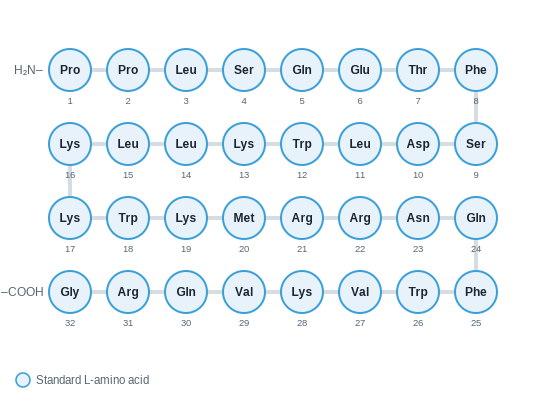
PNC-27 is a lab-made peptide of 32 amino acids S8. One half is a piece of the tumor-suppressor protein p53 (residues 12–26), the part that grips a protein called HDM-2; the other half is a "cell-penetrating" sequence that lets it cross cell membranes S3. It was developed in research labs as an experimental cancer-cell killer. It has never been tested in a registered human trial and has never been approved anywhere. It is nonetheless sold online and through some clinics, mainly to people with cancer, which has drawn FDA warnings and a federal criminal case S1S2.
How it works
In lab dishes, PNC-27 kills many types of cancer cells by punching holes in their outer membrane, so the cell bursts (membranolysis) S3S4. The proposed reason it spares normal cells: many cancer cells carry HDM-2 on their surface, while the normal cell lines tested did not, and PNC-27 latches onto that surface HDM-2 S3. When researchers forced normal breast cells to display HDM-2 on their surface, those cells became vulnerable too S3. The peptide works as the whole molecule, not as broken-down fragments S4.
Legal status
- FDA: Not approved. FDA lists PNC-27 as an unapproved drug promoted as a treatment or cure for cancer, and an FDA laboratory found the bacterium Variovorax paradoxus in a sample in January 2017 S1.
- Criminal case: a 2020 federal indictment in Alabama charged a seller with making, labeling and distributing PNC-27 drug products as a cancer treatment, including suppositories alleged to have been made in a home kitchen and to have been contaminated with bacteria S2. An indictment contains allegations, not findings of guilt.
- DEA: Not a controlled substance.
- WADA: Not named, but it falls under the S0 catch-all for substances not approved by any health authority S7.
What the research actually shows
Evidence: D. Cell and mouse studies only. We found no registered human trial on ClinicalTrials.gov.
| Study / source | Design | People | Dose studied | Result |
|---|---|---|---|---|
| Sarafraz-Yazdi 2010 S3 | Cell studies | Cancer and normal human cell lines | Not stated in the abstract | Killed cancer cells by binding surface HDM-2 and bursting the membrane; normal cells without surface HDM-2 were spared |
| Sookraj 2010 S4 | Cell studies | Breast cancer (MCF-7) vs normal breast cells | Not stated in the abstract | Intact peptide formed pores in cancer cell membranes; normal cells stayed alive and broke the peptide down |
| Michl 2006 S5 | Mouse study (related peptide PNC-28) | Nude mice with transplanted rat pancreatic cancer | Not stated in the abstract; 2 weeks | Destroyed tumors when given into the belly cavity alongside them; only slowed tumors at a distant site, which then grew back slowly |
| Wang 2020 S6 | Cell and mouse studies | Human and mouse acute myeloid leukemia (AML) models | Not stated in the abstract | Killed AML cells, including leukemia stem cells, while sparing normal blood stem cells in mice |
What we don't know: whether it reaches tumors or does anything in people, what dose would be safe, how long it lasts in the body, or what it does to human organs. None of these questions has been studied in humans.
Reported benefits
None demonstrated in people. All reported anticancer effects come from cell cultures and mice S3S4S5S6. Claims that it treats or cures cancer in humans are unsupported, and FDA has called such marketing illegal S1.
Side effects
Unknown in humans. There are no human trials. In mice, the leukemia study reported minimal toxicity to normal blood-forming cells S6.
Dangers and red flags
- Delaying real treatment. FDA warns that illegally sold cancer products can cause harm by delaying or interfering with proven treatments S1. This is the biggest risk for anyone with cancer.
- Contamination. An FDA lab found bacteria in a PNC-27 sample S1; the 2020 indictment alleged products made in insanitary conditions and contaminated with bacteria S2.
- Membrane-bursting drug, untested in people. It works by tearing cell membranes S3; whether normal human tissues stay safe at any dose is unknown.
- No quality control. No approved, inspected manufacturing exists for any PNC-27 product.
- Sport. Falls under WADA's S0 catch-all S7.
Doses reported
We don't recommend sh*t. These are the doses studies, labels and harm-reduction sources report. That's information, not advice. Talk to a licensed clinician.
There is no human dose data of any kind: no trial, no label and no peer-reviewed report. The animal studies' doses are not stated in their abstracts S5S6. We report none, and there is no inline calculator on this page.
Open the dose math calculator →
Monitoring a doctor would order
None established. Anyone with cancer considering PNC-27 should talk to their oncologist; a clinical trial is the only legitimate way to get an experimental cancer drug.
Bottom line
PNC-27 is an experimental p53-based peptide that bursts cancer cells in lab dishes and slowed or destroyed tumors in mice. It has never been tested in a human trial. It is sold illegally to people with cancer, FDA has found bacteria in a sample, and a seller was indicted for making and selling it as a cancer treatment. There is no evidence it helps people, and relying on it can delay treatment that works.
Sources
- [S1] U.S. FDA. Questions and Answers: FDA alerts companies to stop illegal sale of products claiming to treat cancer (Variovorax paradoxus found in a sample of PNC-27, January 2017). (regulator)
- [S2] United States v. [defendant], Indictment, Case 2:20-cr-00258, U.S. District Court, Northern District of Alabama, filed August 25, 2020 (charges involving PNC-27 drug products sold as a cancer treatment; allegations, not findings). (regulator)
- [S3] Sarafraz-Yazdi E, et al. Anticancer peptide PNC-27 adopts an HDM-2-binding conformation and kills cancer cells by binding to HDM-2 in their membranes. Proc Natl Acad Sci U S A. 2010;107:1918-1923. PMID 20080680. (in-vitro)
- [S4] Sookraj KA, et al. The anti-cancer peptide, PNC-27, induces tumor cell lysis as the intact peptide. Cancer Chemother Pharmacol. 2010;66:325-331. PMID 20182728. (in-vitro)
- [S5] Michl J, et al. PNC-28, a p53-derived peptide that is cytotoxic to cancer cells, blocks pancreatic cancer cell growth in vivo. Int J Cancer. 2006;119:1577-1585. PMID 16688716. (animal)
- [S6] Wang H, et al. Targeting cell membrane HDM2: a novel therapeutic approach for acute myeloid leukemia. Leukemia. 2020;34:75-86. PMID 31337857. (animal)
- [S7] World Anti-Doping Agency. 2026 Prohibited List, section S0 (Non-approved substances). (regulator)
- [S8] PubChem. PNC-27, CID 16201774 (32-residue sequence PPLSQETFSDLWKLLKKWKMRRNQFWVKVQRG). (database)