
Amylin analogs
Pramlintide
Also called Symlin, SymlinPen, pramlintide acetate, amylin analog
- US status
- Approved
- DEA
- Not a controlled substance
- WADA
- Not on the 2026 Prohibited List
- Class
- Amylin analogs
Jump to doses reported ↓ Dose math calculator
What it is
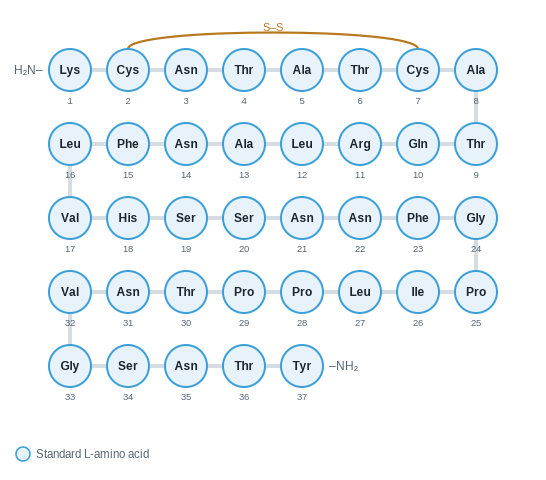
Pramlintide is a synthetic, 37-amino-acid copy of amylin, a hormone the pancreas releases together with insulin at meals S1. It is sold as Symlin in the SymlinPen and is approved only as an add-on for people with type 1 or type 2 diabetes who already take mealtime insulin S1. Newer amylin-based drugs now in weight-loss trials, such as amycretin and eloralintide, build on the same hormone.
How it works
Amylin is co-secreted with insulin by the same pancreatic beta cells at every meal, so in type 1 diabetes — and in advanced type 2 — the body is short of both hormones, not just insulin. Pramlintide is a synthetic amylin analog; three proline substitutions stop the natural hormone's tendency to clump, which is what makes it usable as a medicine.
Acting through amylin receptors, largely in the hindbrain, it does three things after a meal S1:
- slows gastric emptying, so glucose arrives in the bloodstream more gradually;
- suppresses glucagon release, so the liver stops pouring out sugar at a time when there is already food coming in;
- increases satiety, so meals end sooner and intake falls.
Together these flatten the after-meal glucose spike that mealtime insulin alone handles poorly, and they address it from a different direction than insulin does — pramlintide moves no glucose into cells itself S1.
That is also the source of its danger. Because it is added on top of mealtime insulin while slowing the arrival of glucose, the insulin dose that was correct before is now too large for the glucose actually appearing, and severe low blood sugar follows. The label's boxed warning and the requirement to reduce mealtime insulin when starting both come straight from this mechanism S1. The slowed gastric emptying also explains the nausea, and the caution around other drugs whose absorption depends on stomach timing S1.
Legal status
- FDA: Approved in 2005 as an add-on treatment for type 1 or type 2 diabetes in people who use mealtime insulin and have not reached their glucose goals S1S2. Drugs@FDA lists a SYMLIN entry under NDA 021332 as discontinued, while the SymlinPen label is still posted on DailyMed S1S2. Whether it is easy to get at a pharmacy is a question for the pharmacist.
- Not approved for: weight loss (studied in phase 2 only S5), people not on mealtime insulin, or children.
- DEA: Not a controlled substance.
- "Research use only" powder: not the approved product; nobody checks content or sterility. See our explainer.
- WADA: Not on the 2026 Prohibited List S6.
What the research actually shows
Evidence: A. Year-long placebo-controlled trials in more than 1,300 people with diabetes, plus a phase 2 obesity trial S3S4S5.
| Study | Design | People | Dose studied | Result |
|---|---|---|---|---|
| Ratner et al 2004 S3 | Double-blind RCT, 52 weeks | 651 adults with type 1 diabetes | 60 mcg 3 or 4 times daily at meals + insulin vs placebo | HbA1c −0.29% and −0.34% vs −0.04%. Weight −0.4 kg vs +0.8 kg. Main side effect: mild-to-moderate nausea that faded |
| Hollander et al 2003 S4 | Double-blind RCT, 52 weeks | 656 adults with type 2 diabetes on insulin | 60 mcg 3×/day, 90 mcg 2×/day or 120 mcg 2×/day vs placebo | 120 mcg twice daily: HbA1c −0.62% at 52 weeks; weight −1.4 kg vs +0.7 kg; no overall rise in severe low blood sugar |
| Aronne et al 2007 S5 | Double-blind phase 2 RCT, 16 weeks | 204 adults with obesity not on insulin (with or without type 2 diabetes) | Escalation up to 240 mcg 3 times daily before meals | Placebo-corrected weight loss 3.7% (3.6 kg). 31% lost 5% or more vs 2%. 88% reached 240 mcg. Main side effect: mild, short-lived nausea |
| Label pooled trials S1 | Placebo-controlled, 26–52 weeks | 716 (type 1) and 292 (type 2) on Symlin | 30–60 mcg 3×/day (type 1); 120 mcg 2×/day (type 2) | Nausea 48% vs 17% (type 1) and 28% vs 12% (type 2) |
What we don't know: long-term weight-loss data in people without diabetes; pramlintide was never developed to approval for that.
Reported benefits
In trials: lower HbA1c and smaller after-meal glucose spikes on top of insulin, plus small weight loss instead of the weight gain that usually comes with insulin S1S3S4. In the obesity trial, people reported better appetite control S5.
Side effects
Common (label, ≥5% and more than placebo): type 1 diabetes: nausea (48%), loss of appetite (17%), injuries (14%, such as bruises and falls), vomiting (11%), joint pain, fatigue, allergic reaction and dizziness. Type 2 diabetes: nausea (28%), headache (13%), loss of appetite (9%) and vomiting (8%) S1. Serious (label): severe low blood sugar when used with insulin, especially in type 1 diabetes (boxed warning) S1.
Dangers and red flags
- Severe low blood sugar (boxed warning). It usually shows up within 3 hours of the injection. Serious injuries can happen if it strikes while driving or operating machinery S1. The label requires a 50% cut in mealtime insulin when starting S1.
- Who should not use it (label): hypoglycemia unawareness, confirmed gastroparesis, or a prior serious allergy to pramlintide S1. Not recommended with other drugs that change gut movement S1.
- Never mix it with insulin in the same syringe; mixing changes how both act S1.
- Never share a pen, even with a new needle S1.
- Other pills: take pills that need to work fast (such as pain relievers or antibiotics) at least 1 hour before or 2 hours after a dose S1.
- Sport: not prohibited S6.
Doses reported
We don't recommend sh*t. These are the doses studies, labels and harm-reduction sources report. That's information, not advice. Talk to a licensed clinician.
FDA label (Symlin), as written S1: - First: reduce mealtime insulin (including premixed insulin) by 50%. - Type 2 diabetes: 60 mcg under the skin right before each major meal (250 kcal or more, or 30 g of carbohydrate or more). Go to 120 mcg once there has been no significant nausea for at least 3 days. If nausea persists at 120 mcg, go back to 60 mcg. - Type 1 diabetes: 15 mcg right before each major meal. Step up by 15 mcg (to 30, 45 or 60 mcg) after at least 3 days without significant nausea. If nausea persists at 45 or 60 mcg, go back to 30 mcg; if 30 mcg is not tolerated, consider stopping. - Pens: SymlinPen 60 (1.5 mL) and SymlinPen 120 (2.7 mL), both 1000 mcg/mL. Always inject separately from insulin.
| Source | Population | Dose | Route | Frequency and timing | Duration | Titration or escalation | Cite |
|---|---|---|---|---|---|---|---|
| Symlin label | Type 2 diabetes on mealtime insulin | 60 mcg, then 120 mcg | Subcutaneous pen | Right before each major meal | Ongoing | 60 → 120 mcg after ≥3 days without significant nausea; cut mealtime insulin 50% first | S1 |
| Symlin label | Type 1 diabetes on mealtime insulin | 15 mcg, up to 30–60 mcg | Subcutaneous pen | Right before each major meal | Ongoing | +15 mcg steps every ≥3 days without significant nausea; cut mealtime insulin 50% first | S1 |
| Ratner et al | 651 adults with type 1 diabetes | 60 mcg | Subcutaneous | 3 or 4 times daily at meals | 52 weeks | Per trial design | S3 |
| Hollander et al | 656 adults with type 2 diabetes on insulin | 60 mcg 3×/day, 90 mcg 2×/day, 120 mcg 2×/day | Subcutaneous | Before meals | 52 weeks | Per trial design | S4 |
| Aronne et al | 204 adults with obesity, not on insulin | Up to 240 mcg | Subcutaneous | 3 times daily before meals | 16 weeks | Non-forced escalation to 240 mcg | S5 |
No harm-reduction or user-reported dose data were found that we could cite. We have not filled the gap.
Doses are in micrograms (mcg), not insulin units. The pen dials micrograms directly, so don't read pramlintide doses off insulin-unit markings. The calculator below does arithmetic only; inputs start blank. Open the full calculator →
Monitoring a doctor would order
Per the label: before starting, HbA1c, recent glucose logs, history of insulin-induced lows, current insulin doses and weight. After starting, frequent glucose checks before and after meals and at bedtime, especially at the start and with each dose increase. Insulin adjustments only under a clinician skilled in insulin use, with diabetes-educator support S1.
Bottom line
Pramlintide is the original amylin drug. On top of mealtime insulin it smooths after-meal glucose and trims a little weight, at the price of frequent nausea and a real risk of severe low blood sugar unless insulin is cut first. In a phase 2 trial it caused modest weight loss in people with obesity. Newer amylin drugs now in weight-loss trials build on the same idea.
Sources
- [S1] SYMLIN (pramlintide acetate) injection, SymlinPen. US prescribing information (DailyMed, AstraZeneca, version published Aug 20 2024). Set ID 4aea30ff-eb0d-45c1-b114-3127966328ff. (label)
- [S2] Drugs@FDA. SYMLIN (pramlintide acetate), NDA 021332: approval history and marketing status. (regulator)
- [S3] Ratner RE, et al. Amylin replacement with pramlintide as an adjunct to insulin therapy improves long-term glycaemic and weight control in Type 1 diabetes mellitus: a 1-year, randomized controlled trial. Diabet Med. 2004;21:1204-1212. PMID 15498087. (rct)
- [S4] Hollander PA, et al. Pramlintide as an adjunct to insulin therapy improves long-term glycemic and weight control in patients with type 2 diabetes: a 1-year randomized controlled trial. Diabetes Care. 2003;26:784-790. PMID 12610038. (rct)
- [S5] Aronne L, et al. Progressive reduction in body weight after treatment with the amylin analog pramlintide in obese subjects: a phase 2, randomized, placebo-controlled, dose-escalation study. J Clin Endocrinol Metab. 2007;92:2977-2983. PMID 17504894. (rct)
- [S6] World Anti-Doping Agency. 2026 Prohibited List (in force Jan 1 2026). (regulator)