
AAS ancillaries & fertility drugs
Raloxifene
Also called Evista, raloxifene hydrochloride, LY156758, SERM
- US status
- Approved
- DEA
- Not a controlled substance
- WADA
- S4.2 Anti-estrogenic substances (SERMs); prohibited at all times (named)
- Class
- AAS ancillaries & fertility drugs
Jump to doses reported ↓ Dose math calculator
What it is
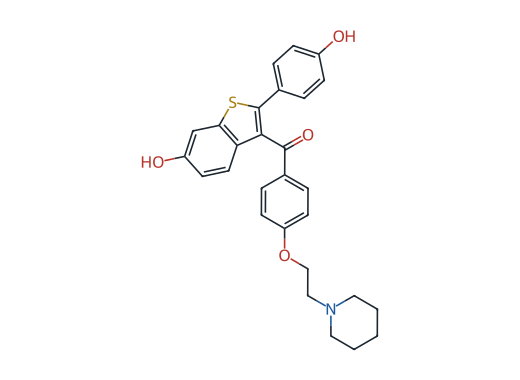
Raloxifene (Evista) is a selective estrogen receptor modulator (SERM) of the benzothiophene class: an oral drug that acts like estrogen in some tissues and blocks estrogen in others S1. It is an approved prescription drug for postmenopausal women, to treat and prevent osteoporosis and to lower the risk of invasive breast cancer, taken as one 60 mg tablet a day S1S6. It carries a boxed warning for blood clots and death from stroke S1. It appears on this reference because it is used off-label to shrink gynecomastia (male breast tissue), including by anabolic-steroid users; it is not approved for any use in men.
How it works
Estrogen acts through estrogen receptors present in bone, breast, uterus, liver, blood vessels and brain. A SERM binds those receptors, but the shape the receptor takes with raloxifene bound recruits different helper proteins in different tissues, so the same molecule switches the signal on in some places and off in others: - Bone: estrogen-like. It slows bone breakdown, raising spine and hip bone density and cutting vertebral fractures S2. - Breast: estrogen-blocking. It reduces estrogen-receptor-positive invasive breast cancers S3S4, and is why it is tried against estrogen-driven breast tissue growth in males S5. - Uterus: largely neutral. Unlike tamoxifen, it did not raise uterine cancer in head-to-head comparison (23 vs 36 cases, not statistically different) S4. - Liver and blood: estrogen-like. It increases clotting tendency, which is where the clot and stroke risks come from S1S3.
Raloxifene does not stop estrogen being made; it changes how tissues respond to it. That is the basic difference from aromatase inhibitors like letrozole. It is heavily processed on first pass through the gut and liver into glucuronides, and recycling between the gut and liver gives it a plasma half-life of about 28 hours S1.
Legal status
- FDA: Approved (NDA 020815) for treatment and prevention of osteoporosis in postmenopausal women, and to reduce the risk of invasive breast cancer in postmenopausal women with osteoporosis or at high risk S1S6. Not indicated to treat breast cancer, prevent its recurrence, or reduce noninvasive breast cancer S1. Not recommended in premenopausal women; any use in men is off-label S1.
- DEA: Not a controlled substance.
- Prescription drug: raloxifene needs a prescription. Grey-market "research chemical" raloxifene is an unapproved product of unknown content and strength.
- WADA: Named under S4.2 (anti-estrogenic substances, including SERMs), prohibited at all times, in and out of competition; it is a Specified Substance S7.
- International (short): Not reviewed for this page yet.
What the research actually shows
Evidence: A for its approved uses. Three very large randomized trials define raloxifene's benefits and risks in postmenopausal women. Data in males are limited to a small retrospective chart review in teenage boys.
| Study | Design | People | Dose studied | Result |
|---|---|---|---|---|
| MORE (Ettinger 1999) S2 | Randomized, placebo-controlled, 3 years | 7,705 postmenopausal women with osteoporosis | 60 or 120 mg/day oral | New vertebral fracture 6.6% (60 mg) and 5.4% (120 mg) vs 10.1% placebo (RR 0.7 and 0.5); no effect on nonvertebral fractures; spine density +2.6%; clots RR 3.1 |
| RUTH (Barrett-Connor 2006) S3 | Randomized, placebo-controlled, median 5.6 years | 10,101 postmenopausal women with or at high risk of heart disease | 60 mg/day oral | No effect on coronary events (HR 0.95); invasive breast cancer down (HR 0.56); fatal stroke up (HR 1.49) and clots up (HR 1.44); clinical vertebral fractures down (HR 0.65) |
| STAR P-2 (Vogel 2006) S4 | Randomized, double-blind vs tamoxifen | 19,747 postmenopausal women at raised breast-cancer risk | 60 mg/day vs tamoxifen 20 mg/day, 5 years | Invasive breast cancer equal (RR 1.02); fewer clots (RR 0.70) and cataracts on raloxifene; uterine cancer 23 vs 36 (not significant) |
| Lawrence 2004 S5 | Retrospective chart review | 38 boys with persistent pubertal gynecomastia (mean age 14.6) | Raloxifene or tamoxifen for 3-9 months (dose not stated in abstract) | Breast nodule shrank a mean 2.5 cm on raloxifene; over 50% reduction in 86% on raloxifene vs 41% on tamoxifen; authors say a true treatment effect is unproven |
What we don't know: raloxifene's safety and effect in adult men, including steroid users; whether the clot and stroke risk seen in women applies similarly to men. No controlled adult male trial is cited here because we did not find one to cite.
Reported benefits
- Osteoporosis (approved): fewer vertebral fractures and higher spine and hip bone density S2S3.
- Breast-cancer risk (approved): fewer invasive, estrogen-receptor-positive breast cancers, matching tamoxifen with fewer clots and cataracts S3S4.
- Gynecomastia (off-label): shrinkage of persistent pubertal gynecomastia in a small uncontrolled series S5. Steroid users take it for steroid-related breast tissue growth; that use has no controlled data.
Side effects
Common (label; more than 2% and more often than placebo): hot flashes, leg cramps, peripheral swelling, flu-like symptoms, joint pain and sweating S1. Serious: deep vein thrombosis, pulmonary embolism and retinal vein thrombosis; death from stroke in women with heart disease or high coronary risk S1S3. In MORE, clot risk was about three times placebo S2.
Dangers and red flags
- Boxed warning: blood clots and fatal stroke S1. In RUTH, about 1.2 extra clots and 0.7 extra fatal strokes per 1,000 woman-years S3. Anabolic steroids raise red-cell counts and clot risk on their own, which is a reason for extra caution in that population.
- Do not use with a history of clots (DVT, pulmonary embolism, retinal vein thrombosis); the label contraindicates it S1.
- Immobility. The label says to stop it 72 hours before and during prolonged immobilization, such as surgery or long bed rest S1.
- Not heart protection. It should not be used to prevent cardiovascular disease S1S3.
- Interactions: cholestyramine and similar resins block absorption; warfarin effect needs monitoring S1.
- Pregnancy: contraindicated S1.
- Sport: named and prohibited at all times S7.
Doses reported
We don't recommend sh*t. These are the doses studies, labels and harm-reduction sources report. That's information, not advice. Talk to a licensed clinician.
The first row is the FDA label dosing. The others are doses used in trials, in their source units. We list no adult male dose because no controlled study supports one, and the one male study we cite does not state a dose in its abstract. Raloxifene is a fixed-dose tablet, so the reconstitution calculator does not apply.
| Source | Population | Dose | Unit / route | Frequency | Timing | Duration | Titration / escalation |
|---|---|---|---|---|---|---|---|
| S1 Evista label | Postmenopausal women (osteoporosis; breast-cancer risk reduction) | 60 mg | mg, oral tablet | Once daily | Any time of day, with or without food | Ongoing; optimal duration for breast-cancer risk reduction not known | Fixed dose; add calcium and vitamin D if intake is low |
| S2 MORE | Postmenopausal osteoporosis | 60 mg or 120 mg | mg, oral | Once daily | With calcium and vitamin D | 36 months | Two fixed arms; 120 mg is not a label dose |
| S3 RUTH | Postmenopausal women with heart disease or risk | 60 mg | mg, oral | Once daily | — | Median 5.6 years | None |
| S4 STAR P-2 | Postmenopausal women at raised breast-cancer risk | 60 mg | mg, oral | Once daily | — | 5 years | None |
| S5 Lawrence 2004 (off-label) | Boys with pubertal gynecomastia | Not stated in abstract | Oral | — | — | 3-9 months | Not stated |
Open the dose math calculator →
Monitoring a doctor would order
- Clot and stroke risk assessment before starting and watching for leg swelling or pain, sudden breathlessness, or vision loss S1.
- Bone mineral density (DXA) for osteoporosis use S1S2.
- Triglycerides in women whose triglycerides rose on estrogen therapy before S1.
- INR if taken with warfarin S1.
- Liver function if there is liver impairment; the label advises caution S1.
- Males (off-label): clinical breast examination and hematocrit if anabolic steroids are involved; no male-specific monitoring standard exists.
Bottom line
Raloxifene (Evista) is an approved SERM that acts like estrogen in bone and blocks it in breast tissue. Huge trials show it cuts vertebral fractures and invasive breast cancer in postmenopausal women, but it carries a boxed warning for blood clots and fatal stroke. Off-label use for gynecomastia rests on a small, uncontrolled study in teenage boys; there are no adult male trials to cite. Prescription only; named and banned in sport at all times.
Sources
- [S1] EVISTA (raloxifene hydrochloride) tablets. US prescribing information (DailyMed), including boxed warning: increased risk of venous thromboembolism and death from stroke. Label dose 60 mg once daily. Set ID fcaaa6dc-74e8-4fb8-800c-5574bf0f8de9. (label)
- [S2] Ettinger B, et al. Reduction of vertebral fracture risk in postmenopausal women with osteoporosis treated with raloxifene: results from a 3-year randomized clinical trial (MORE). JAMA. 1999;282:637-45. PMID 10517716. (rct)
- [S3] Barrett-Connor E, et al. Effects of raloxifene on cardiovascular events and breast cancer in postmenopausal women (RUTH). N Engl J Med. 2006;355:125-37. PMID 16837676. NCT00190593. (rct)
- [S4] Vogel VG, et al. Effects of tamoxifen vs raloxifene on the risk of developing invasive breast cancer and other disease outcomes: the NSABP Study of Tamoxifen and Raloxifene (STAR) P-2 trial. JAMA. 2006;295:2727-41. PMID 16754727. (rct)
- [S5] Lawrence SE, et al. Beneficial effects of raloxifene and tamoxifen in the treatment of pubertal gynecomastia. J Pediatr. 2004;145:71-6. PMID 15238910. (human-observational)
- [S6] US FDA, Drugs@FDA. EVISTA (raloxifene hydrochloride), NDA 020815; original approval 1997. (regulator)
- [S7] World Anti-Doping Agency. 2026 Prohibited List, section S4.2 (anti-estrogenic substances [anti-estrogens and selective estrogen receptor modulators (SERMs)]; raloxifene named). Classes S4.1 and S4.2 are Specified Substances. (regulator)