
Investigational weight-loss peptides
Retatrutide
Also called LY3437943, reta, GGG triple agonist
- US status
- Investigational
- DEA
- Not a controlled substance
- WADA
- S0 Non-approved substances; prohibited at all times
- Class
- Investigational weight-loss peptides
Jump to doses reported ↓ Dose math calculator
What it is
Retatrutide is an investigational once-weekly injected peptide that activates three receptors at once: GIP, GLP-1 and glucagon (hence the "triple agonist" nickname). The added glucagon action raises energy expenditure on top of the appetite and blood-sugar effects of GLP-1 drugs. It is made by Eli Lilly, studied under the code LY3437943, and is not approved anywhere in the world S2. It is heavily sold on the grey market as "research" powder, which FDA says cannot legally be compounded or sold for human use S1.
How it works
Retatrutide is a single peptide that activates three receptors: GIP, GLP-1 and glucagon S3.
- The GLP-1 arm reproduces what semaglutide does: it tells the pancreas to release insulin when glucose is high, holds back glucagon release, slows stomach emptying and acts on appetite centres in the hypothalamus and hindbrain, so people feel full and eat less.
- The GIP arm is the second incretin signal, adding to the insulin response after meals and, on current thinking, contributing to the appetite effect as well — the same pairing used by tirzepatide.
- The glucagon arm is the part that distinguishes it. Glucagon acts on the liver to mobilize stored fuel and raises whole-body energy expenditure, so weight is lost by burning more as well as eating less, and liver fat falls S3S8. Its blood-sugar-raising effect is offset by the two incretin arms.
In phase 2 and phase 3 trials this three-way design produced larger weight reductions than single-receptor drugs, along with the heavy gastrointestinal effects that follow from slowed gastric emptying, which is why trials raise the dose in steps S3S4S5. It is not approved anywhere, so everything known about it in humans comes from those trials, not from a label S1S2.
Legal status
- FDA: Not approved for any use. Lilly describes it as investigational and says it plans to submit a Biologics License Application in the first quarter of 2027 S2.
- Compounding: FDA states plainly that "retatrutide and cagrilintide cannot be used in compounding under federal law," that they are not components of approved drugs, and that it has warned telehealth firms, active-ingredient distributors and outsourcing facilities over retatrutide S1.
- DEA: Not a controlled substance.
- "Research use only" powder: FDA has warned companies selling unapproved retatrutide falsely labeled "for research purposes" or "not for human consumption" with dosing instructions, and urges consumers not to buy them S1. See our explainer.
- WADA: As a non-approved substance it falls under S0 and is prohibited at all times in sport S9.
- International (short): Not reviewed for this page yet.
What the research actually shows
Evidence: B. Randomized human trials exist, including phase 3, but there is no approval and no label. Trials are run by the manufacturer.
| Study | Design | People | Dose studied | Result |
|---|---|---|---|---|
| Phase 2 obesity S3 | Double-blind RCT, 48 weeks | 338 adults with obesity | 1, 4, 8, 12 mg weekly vs placebo | Weight −8.7% to −24.2% vs −2.1% at 48 weeks |
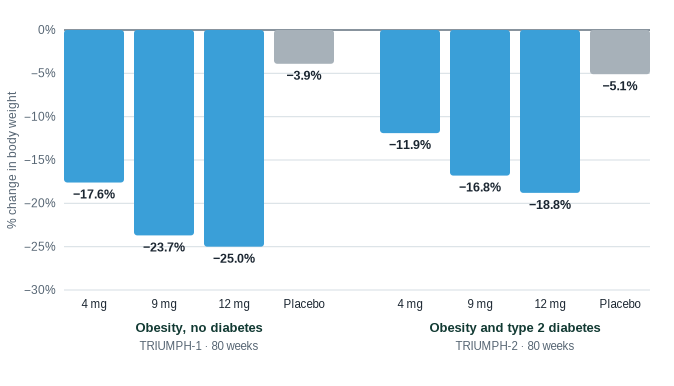
| TRIUMPH-1 S4 | Phase 3 RCT, 80 weeks | 2,339 adults with obesity, no diabetes | 4, 9, 12 mg weekly vs placebo | Weight −17.6% / −23.7% / −25.0% vs −3.9% |
| TRIUMPH-2 S5 | Phase 3 RCT, 80 weeks | 1,152 adults with obesity and T2D | 4, 9, 12 mg weekly vs placebo | Weight −11.9% / −16.8% / −18.8% vs −5.1%; better glucose control |
| TRIUMPH-1/2-OSA S6 | Two phase 3 RCTs, 80 weeks | 243 and 448 adults with OSA + obesity | 4, 9, 12 mg weekly vs placebo | Apnea-hypopnea index fell far more than placebo at all doses |
| TRIUMPH-4 / 1-OA S7 | Two phase 3 RCTs | 445 and 574 adults with knee osteoarthritis + obesity | 4/9/12 mg weekly vs placebo | Greater pain reduction and weight loss than placebo |
| Phase 2 T2D S8 | Phase 2 RCT | 281 adults with T2D | 0.5–12 mg weekly (various escalations) vs dulaglutide/placebo | Lower HbA1c and weight vs comparators |
What we don't know: everything that a label and post-approval monitoring normally settle: long-term safety, the final approved dosing, and, critically for grey-market buyers, whether a "research" vial contains retatrutide at the stated amount S1. Dose-dependent heart-rate increases were seen in the phase 2 trial S3.
Retatrutide phase 3: mean body-weight change at 80 weeks
Reported benefits
In trials: the largest average weight loss reported for any incretin drug to date (up to about 25% at 48–80 weeks), plus improved blood sugar, fewer sleep-apnea events, and reduced knee-osteoarthritis pain S3S4S6S7. These are trial findings for an unapproved drug, not an approval for any of these uses.
Side effects
Common: gastrointestinal — nausea, diarrhea, vomiting, constipation — dose-related, mostly mild to moderate, and reduced by a lower starting dose S3S4S5. Serious / notable: dose-dependent increases in heart rate S3; in TRIUMPH-2, hypotension and dysesthesia were more frequent on retatrutide, and treatment discontinuation for adverse events rose at higher doses S5. Deaths occurred in the phase 3 trials but were judged by investigators to be unrelated to the drug S4S5. Because there is no label, there is no boxed-warning or contraindication list for consumers to rely on.
Dangers and red flags
- Unknown product quality. Almost all consumer supply is "research" powder of unverified identity, strength and sterility; FDA warns against buying it S1.
- No label, no dosing safeguards. Trial arms escalate gradually under medical supervision; a grey-market vial of unknown strength removes every check the trials built in.
- Glucagon activity raises the stakes for people with diabetes or heart disease; trial dosing was slow and monitored S3S5.
- Sport: prohibited at all times under S0 S9.
- Who should avoid it: with no approval, there is no established use in pregnancy, breastfeeding, children, or anyone, outside a clinical trial.
Doses reported
We don't recommend sh*t. These are the doses studies, labels and harm-reduction sources report. That's information, not advice. Talk to a licensed clinician.
There is no FDA-labeled dose because there is no approved product. The rows below are clinical-trial arms only, all once-weekly subcutaneous injections. They are study designs run under medical supervision, not a schedule for self-use.
| Source | Dose | Unit / route | Frequency | Duration | Titration / escalation (as studied) | Context |
|---|---|---|---|---|---|---|
| S3 Phase 2 obesity | 1, 4, 8, 12 mg | mg, subcutaneous | Once weekly | 48 weeks | Starting doses 2 or 4 mg with 4-weekly steps to the target; a 2 mg start reduced GI effects | Adults with obesity |
| S4 TRIUMPH-1 | 4, 9, 12 mg | mg, subcutaneous | Once weekly | 80 weeks | Gradual escalation to the assigned dose | Obesity, no diabetes |
| S5 TRIUMPH-2 | 4, 9, 12 mg | mg, subcutaneous | Once weekly | 80 weeks | Gradual escalation to the assigned dose | Obesity with T2D |
| S6 TRIUMPH-1/2-OSA | 4, 9, 12 mg | mg, subcutaneous | Once weekly | 80 weeks | Gradual escalation | OSA + obesity |
| S8 Phase 2 T2D | 0.5, 4, 8, 12 mg | mg, subcutaneous | Once weekly | 24–36 weeks | Several starting doses (2 or 4 mg) and escalation speeds compared | T2D |
No survey or harm-reduction source with numbers for non-pharmacy retatrutide use was found that we could cite.
Open the dose math calculator →
Monitoring a doctor would order
There is no approved-use guideline. In the trials, participants were monitored for heart rate, blood pressure, blood glucose and gastrointestinal tolerance during supervised escalation S3S5.
Bottom line
Retatrutide produced the largest average weight loss of any incretin drug in trials so far, and phase 3 results are in for obesity, diabetes, sleep apnea and knee-osteoarthritis pain. But it is not approved anywhere, has no label, and cannot legally be compounded or sold for human use; FDA has warned the firms selling "research" versions. The trial numbers come from slow, supervised escalation, which a grey-market vial of unknown strength cannot reproduce.
Sources
- [S1] FDA. FDA's Concerns with Unapproved GLP-1 Drugs Used for Weight Loss. Content current as of 10/01/2026. (regulator)
- [S2] Eli Lilly. Lilly's triple agonist, retatrutide, delivered substantial weight loss and A1C reduction (TRIUMPH-2 detailed results). Press release, Sep 29 2026 (states plan to submit a BLA in Q1 2027; retatrutide is investigational and cannot be legally sold for human use). (regulator)
- [S3] Jastreboff AM, et al. Triple-Hormone-Receptor Agonist Retatrutide for Obesity - A Phase 2 Trial. N Engl J Med. 2023;389:514-526. PMID 37366315. (rct)
- [S4] Jastreboff AM, et al. Retatrutide, a Triple Hormone Receptor Agonist, for Treatment of Obesity (TRIUMPH-1). N Engl J Med. 2026;395:1781-1793. PMID 42814954. (rct)
- [S5] Bellido V, et al. Retatrutide in adults with obesity and type 2 diabetes (TRIUMPH-2): a phase 3 trial. Lancet. 2026;408:1455-1472. PMID 42810372. (rct)
- [S6] Grunstein RR, et al. Retatrutide Once Weekly for Treatment of Obstructive Sleep Apnea (TRIUMPH-1-OSA and TRIUMPH-2-OSA). N Engl J Med. 2026. PMID 42904878. doi:10.1056/NEJMoa2611477. (rct)
- [S7] Schnitzer TJ, et al. Retatrutide Once Weekly in Adults with Knee Osteoarthritis Pain and Obesity (TRIUMPH-4 and TRIUMPH-1-OA). N Engl J Med. 2026. PMID 43001755. doi:10.1056/NEJMoa2610676. (rct)
- [S8] Rosenstock J, et al. Retatrutide, a GIP, GLP-1 and glucagon receptor agonist, for people with type 2 diabetes: a phase 2 trial. Lancet. 2023;402:529-544. PMID 37385280. (rct)
- [S9] World Anti-Doping Agency. 2026 Prohibited List, section S0. (regulator)