
SARMs & adjacent non-peptides
S-23
Also called S23, selective androgen receptor modulator
- US status
- Not approved
- DEA
- Not a federally scheduled controlled substance; sale as a dietary supplement is illegal and SARMs are widely banned at the state level and by trade rules
- WADA
- S1.2 Other anabolic agents (SARMs); prohibited at all times
- Class
- SARMs & adjacent non-peptides
Jump to doses reported ↓ Dose math calculator
What it is
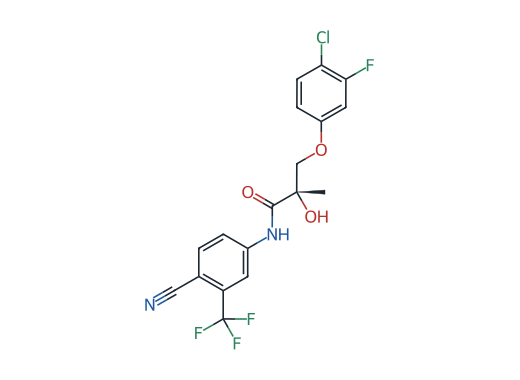
S-23 is a non-steroidal selective androgen receptor modulator (SARM): a small molecule that binds the androgen receptor, the same receptor testosterone works through, but was designed to act more on muscle and bone than on the prostate. In the published laboratory work it bound the receptor tightly and behaved as a full agonist, meaning it switches the receptor on as strongly as a natural androgen does S2. It was built for a specific purpose that has nothing to do with bodybuilding: an oral hormonal male contraceptive, because shutting down the brain's signals to the testicles stops sperm production S2. It has never been approved anywhere, has never been through a published human trial, and reaches people only through the grey market, where it is sold as a "research chemical" or mislabeled as a supplement.
How it works
S-23 binds the androgen receptor — the same intracellular receptor testosterone works through — and in the published preclinical work it bound tightly and behaved as a full agonist, switching the receptor on as strongly as a natural androgen S2. Once occupied, the receptor moves into the nucleus and turns on the genes that drive muscle and bone protein synthesis.
As a non-steroidal molecule it is not converted by aromatase to estrogen or by 5α-reductase to DHT, which is the basis of the claim that SARMs spare the prostate relative to their effect on muscle. In the animal work S-23 was still androgenic enough to be developed as a male contraceptive: the androgen receptor in the hypothalamus and pituitary reads the drug as a hormone signal, so LH and FSH fall, the testes stop making testosterone and sperm production stops. Fertility returned after the animals were taken off it S2. Suppression of the body's own hormone production is therefore not a side effect of S-23 — it is the effect it was built for.
No published human trial exists, so the mechanism in people is inferred from this animal and in-vitro work; what is documented in humans is detection in doping samples and the general safety signals reported for SARMs, including liver injury S3S4S1. Grey-market products sold under the name frequently do not contain what the label says S5.
Legal status
- FDA: Not approved for any use. FDA warns against SARM body-building products and has acted against the companies selling them S1.
- Dietary-supplement status: SARMs are not lawful dietary ingredients; selling S-23 as a supplement is illegal S1.
- DEA: Not currently a federally scheduled controlled substance (any newer SARM scheduling legislation should be checked against current law).
- "Research use only" products: S-23 is sold as research powder or liquid of unverified content. See our explainer.
- WADA: Prohibited at all times under S1.2 S6. S-23 has been identified in the hair of an athlete in a doping case, alongside two other SARMs S3.
- International (short): Not reviewed for this page yet.
What the research actually shows
Evidence: D. The entire efficacy record for S-23 is one preclinical rat study S2. There is no human efficacy trial, no human pharmacokinetic study, and no human safety study. The only human-sample literature is forensic: proof that it can be detected in hair after someone has taken it S3.
| Study | Design | Subject | Dose studied | Result |
|---|---|---|---|---|
| Jones 2009 S2 | Preclinical pharmacology, castrated and intact male rats | Rats | 0.01-1 mg/day by the study's dosing schedule | Receptor binding constant 1.7 nM, full agonist in vitro; ED50 0.079 mg/day for the levator ani muscle and 0.43 mg/day for the prostate; doses above 0.1 mg/day suppressed luteinizing hormone by more than 50%; raised bone mineral density and lean mass, reduced fat mass |
| Jones 2009, contraception arm S2 | Intact male rats given S-23 plus estradiol benzoate for up to 10 weeks | Rats | 0.1 mg/day S-23 plus estradiol benzoate | Four of six rats had no sperm in the testis and no pregnancies resulted in mating trials; fertility returned fully, with a 100% pregnancy rate, 100 days after treatment stopped |
| Gheddar 2021 S3 | Forensic hair analysis, doping case | One adult male | Not known | S-23 measured at 0.6-16 pg/mg across six hair segments, together with andarine and ostarine: the first identification of S-23 in authentic human hair |
| Vignali 2023 S4 | Systematic review of SARM safety in healthy adults | SARM users and trial participants | — | Finds the safety record for recreational SARM use thin and dominated by harm reports, including liver injury and hormonal suppression |
What we don't know: everything that matters for a person. No published study has measured what dose of S-23 does what in a human body, how long it stays there, or what it does to the liver, lipids or fertility over time. The rat data say it is a potent androgen that suppresses the hormonal axis at low doses S2; it does not tell you a human dose, and nobody has established one.
Reported benefits
Nothing is established in people. In rats, S-23 increased lean mass and bone mineral density and reduced fat mass S2. Those are animal findings in a study designed to test contraception, not performance, and they are the whole basis for how S-23 is marketed.
Side effects
Common: by its pharmacology, suppression of the body's own testosterone is expected: in rats, doses above 0.1 mg/day cut luteinizing hormone by more than half and shrank the prostate S2. For SARMs as a group, reduced HDL ("good") cholesterol and suppressed sex hormones are the typical findings in people S4. Serious: no human safety data exist for S-23 specifically. Across SARMs, drug-induced liver injury, including severe cholestatic injury, is the most serious documented human harm S1S4.
Dangers and red flags
- Designed to stop sperm production. Suppressing sperm was the point of the one study that exists, and at a dose far below what grey-market products contain S2. In rats it reversed; in humans nobody has tested it.
- No human data at all. No trial has measured a dose, an effect, or a harm in a person S2S3.
- Liver injury across the class. SARM-associated liver injury is well documented, and products often contain more than one SARM S1S4.
- What is in the bottle is unknown. When researchers bought SARM products sold online and analyzed them, only a minority contained what the label said; some contained other unapproved drugs and some contained no active drug at all S5.
- Sport: prohibited at all times, and detectable in hair as well as urine S3S6.
Doses reported
We don't recommend sh*t. These are the doses studies, labels and harm-reduction sources report. That's information, not advice. Talk to a licensed clinician.
There is no human dosing data for S-23. It has no FDA label (never approved) and no published human trial, so there is no label dose and no trial arm to quote. The only published doses are from the rat study and are reported here as what that study administered to rats: they are not a human dose and cannot be converted into one. We will not fill the gap with forum or vendor numbers. S-23 is taken by mouth, so the reconstitution calculator does not apply.
| Source | Dose | Unit / route | Frequency | Timing | Duration | Titration / escalation | Context |
|---|---|---|---|---|---|---|---|
| S2 Jones 2009, intact rats | Above 0.1 mg per day suppressed LH by more than 50% | mg/day, oral, rats | Daily | — | 14 days | Fixed dose groups | Animal pharmacology, not a human dose |
| S2 Jones 2009, contraception arm | 0.1 mg per day with estradiol benzoate | mg/day, oral, rats | Daily | — | Up to 10 weeks | Fixed dose | Animal contraception model, not a human dose |
Monitoring a doctor would order
No guideline exists for an unapproved drug with no human studies. Given the class, a clinician looking at someone who had taken a SARM would check liver enzymes and bilirubin, a lipid panel, and testosterone and the pituitary hormones LH and FSH S1S4. For S-23 specifically, there is no monitoring standard because there is no human research.
Bottom line
S-23 is a potent, never-approved SARM whose entire efficacy record is a single rat study, and that study was about making male rats temporarily infertile. There is no human trial, no human dose, and no human safety data; what exists in people is a forensic hair result from a doping case. It suppresses the hormonal axis at very low doses in animals, belongs to a class with documented severe liver injury, is sold in products that frequently do not contain what they claim, and is banned in sport at all times.
Sources
- [S1] U.S. FDA. FDA Warns of Use of Selective Androgen Receptor Modulators (SARMs) Among Teens, Young Adults (consumer update). SARMs are unapproved drugs that cannot be legally marketed in the US as a dietary supplement or a drug; FDA has issued warning letters to sellers and pursued criminal actions, and lists liver injury and acute liver failure, heart attack or stroke risk, psychosis, sexual dysfunction, infertility and testicular shrinkage among reported harms. (regulator)
- [S2] Jones A, Chen J, Hwang DJ, Miller DD, Dalton JT. Preclinical characterization of a (S)-N-(4-cyano-3-trifluoromethyl-phenyl)-3-(3-fluoro, 4-chlorophenoxy)-2-hydroxy-2-methyl-propanamide: a selective androgen receptor modulator for hormonal male contraception. Endocrinology. 2009;150(1):385-395. PMID 18772237. (animal)
- [S3] Gheddar L, Raul JS, Kintz P. Development and validation of SARMs and metabolic modulators screening in hair using UHPLC-MS/MS: Application to a doping case and first identification of S23 in authentic human hair. J Chromatogr B. 2021;1187:123048. PMID 34814052. (human-case-series)
- [S4] Vignali JD, et al. Systematic Review of Safety of Selective Androgen Receptor Modulators in Healthy Adults: Implications for Recreational Users. J Xenobiot. 2023;13(2):218-236. PMID 37218811. (review)
- [S5] Van Wagoner RM, Eichner A, Bhasin S, Deuster PA, Eichner D. Chemical Composition and Labeling of Substances Marketed as Selective Androgen Receptor Modulators and Sold via the Internet. JAMA. 2017;318(20):2004-2010. PMID 29183075. (human-observational)
- [S6] World Anti-Doping Agency. 2026 Prohibited List, section S1.2 (other anabolic agents, SARMs). (regulator)