
GLP-1 & incretin drugs (approved)
Semaglutide
Also called Ozempic, Wegovy, Wegovy tablets, Rybelsus, sema, compounded semaglutide
- US status
- Approved
- DEA
- Not a controlled substance
- WADA
- Not on the 2026 Prohibited List
- Class
- GLP-1 & incretin drugs (approved)
Jump to doses reported ↓ Dose math calculator
What it is
Semaglutide is a GLP-1 receptor agonist: a modified copy of a gut hormone that slows stomach emptying, lowers appetite and helps the pancreas release insulin when blood sugar is high. It is sold as Ozempic (weekly injection for type 2 diabetes), Wegovy (weekly injection or daily tablet for weight reduction and heart-risk reduction) and Rybelsus (daily tablet for diabetes) S1S2. Outside the pharmacy, "semaglutide" is also sold as compounded vials and as powder labeled "research use only". Those are not the same as the approved products.
How it works
Semaglutide is a modified copy of GLP-1, a hormone released by the gut after eating. The modifications — an amino-acid substitution that resists the DPP-4 enzyme, plus a fatty-acid chain that binds albumin in blood — are what stretch its action from minutes to about a week S1.
Activating the GLP-1 receptor does four things that matter:
- Pancreas: it increases insulin release and suppresses glucagon, but only when glucose is high, which is why it lowers blood sugar without the low-sugar risk insulin carries on its own S1S2.
- Stomach: it slows gastric emptying, so food leaves the stomach more gradually. That blunts after-meal glucose peaks and is the direct cause of the nausea, fullness and vomiting that dominate its side effects S1.
- Brain: GLP-1 receptors in the hypothalamus and hindbrain reduce hunger and food-reward signalling, so people eat less without consciously restricting S1S3.
- Vessels and heart: the cardiovascular benefit seen in outcome trials is attributed to the combination of weight, glucose, blood pressure and inflammation effects rather than to one pathway S4S5.
Because the drug acts through a hormone system rather than replacing a missing one, the effects fade when it is stopped and appetite returns. Rodent studies showed thyroid C-cell tumors with this drug class, the basis of the boxed warning, with the human relevance unresolved S1.
Legal status
- FDA: Approved. Wegovy injection is approved, with diet and exercise, to reduce major cardiovascular events in adults with heart disease and obesity or overweight; for long-term weight reduction in adults and children 12 and older with obesity (and adults with overweight plus a weight-related condition); and, under accelerated approval, for noncirrhotic MASH with moderate to advanced fibrosis. Wegovy tablets are approved for CV risk reduction and weight reduction in adults S1. Ozempic is approved for glucose control in type 2 diabetes, CV risk reduction in T2D with heart disease, and kidney-outcome risk reduction in T2D with chronic kidney disease S2.
- Compounding: FDA declared the semaglutide injection shortage resolved on Feb 21 2025. The grace period for 503A pharmacies ended Apr 22 2025 and for 503B outsourcing facilities May 22 2025 S9. FDA says salt forms (semaglutide sodium, semaglutide acetate) are different active ingredients from the approved drug and it knows of no lawful basis for compounding with them S8.
- DEA: Not a controlled substance.
- "Research use only" powder: a label that says "not for human use" does not make a product legal to sell for people to inject. It means no one has checked it for human use. See our explainer.
- WADA: Not on the 2026 Prohibited List S10.
- International (short): Not reviewed for this page yet.
What the research actually shows
Evidence: A. Several large randomized trials, run for one to three years, measured hard outcomes.
| Study | Design | People | Dose studied | Result |
|---|---|---|---|---|
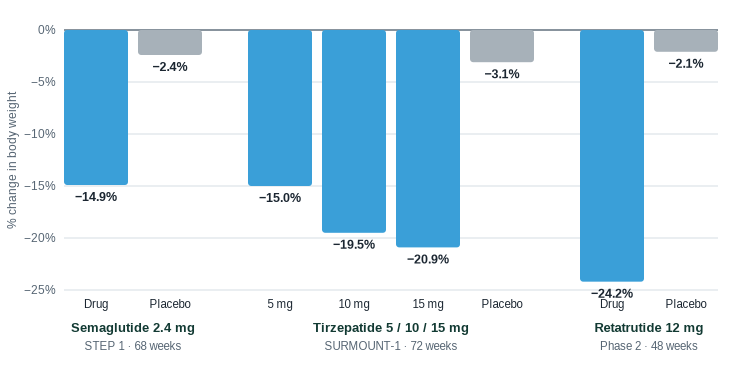
| STEP 1 S3 | Double-blind RCT, 68 weeks | 1,961 adults with obesity or overweight, no diabetes | 2.4 mg weekly vs placebo, plus lifestyle program | Weight change −14.9% vs −2.4% (difference −12.4 points); 50.5% lost ≥15% vs 4.9% |
| SELECT S4 | Double-blind RCT, event-driven | 17,604 adults ≥45 with heart disease and BMI ≥27, no diabetes | 2.4 mg weekly vs placebo | Heart attack, stroke or CV death: 6.5% vs 8.0% (hazard ratio 0.80). Stopped drug for side effects: 16.6% vs 8.2% |
| SUSTAIN-6 S5 | RCT, 104 weeks | 3,297 adults with type 2 diabetes, mostly with heart or kidney disease | 0.5 or 1.0 mg weekly vs placebo | Major CV events 6.6% vs 8.9% (HR 0.74). Diabetic eye complications higher: HR 1.76 |
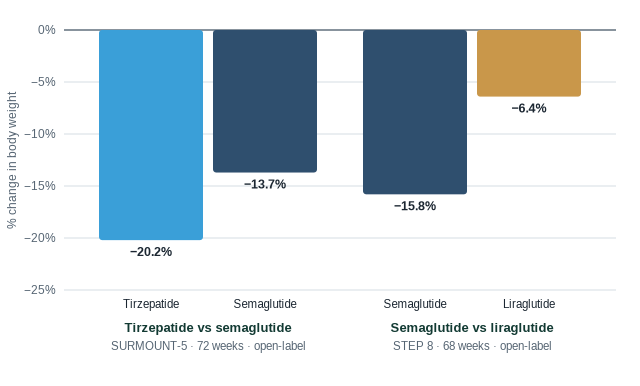
| SURMOUNT-5 S6 | Open-label RCT, 72 weeks | 751 adults with obesity, no diabetes | Max tolerated semaglutide 1.7/2.4 mg vs tirzepatide 10/15 mg | Weight change −13.7% (semaglutide) vs −20.2% (tirzepatide) |
What we don't know: long-term effects beyond a few years of use; how much weight comes back after stopping in everyday practice; whether compounded or "research" semaglutide behaves like the approved drug (it has not been tested that way) S8.
Mean body-weight change in the pivotal placebo-controlled trials
Head-to-head trials: mean body-weight change
Reported benefits
In trials: weight loss, fewer heart attacks, strokes and CV deaths in people with heart disease (SELECT) or diabetes (SUSTAIN-6), better blood sugar control in type 2 diabetes S3S4S5. Wegovy is also approved for a form of fatty-liver disease with fibrosis S1.
Side effects
Common (≥5% in Wegovy trials): nausea, diarrhea, vomiting, constipation, belly pain, abnormal skin sensations (dysesthesia), headache, fatigue, indigestion, dizziness, bloating, burping, low blood sugar in people with type 2 diabetes, gas, stomach flu, reflux, hair loss S1. Serious (label warnings): thyroid C-cell tumors in rodents (boxed warning; human risk unknown), acute pancreatitis, gallbladder disease, low blood sugar with insulin or sulfonylureas, kidney injury from dehydration, severe GI reactions, allergic reactions including anaphylaxis, diabetic eye complications in people with T2D, faster heart rate, and inhaling stomach contents during anesthesia or sedation S1. In SUSTAIN-6, diabetic retinopathy complications were more frequent on semaglutide S5.
Dangers and red flags
- Dosing mistakes with vials. FDA has received reports of adverse events, some needing hospital care, from overdoses with compounded semaglutide: patients and even prescribers mixing up milliliters, milligrams and syringe "units" S7.
- Counterfeits and fake pharmacies. FDA is aware of counterfeit Ozempic in the US, and of compounded-looking products labeled with pharmacies that don't exist or never made them S8.
- Salt forms. "Semaglutide sodium" or "acetate" is not the ingredient in the approved drug S8.
- Who should not use it (label): people with a personal or family history of medullary thyroid carcinoma or MEN 2; anyone with a serious allergy to semaglutide S1. Wegovy is not recommended in severe gastroparesis S1.
- Pregnancy: the label says to stop Wegovy at least 2 months before a planned pregnancy because semaglutide stays in the body a long time S1.
- Don't share pens. Never share a pen between people, even with a new needle S1.
Doses reported
We don't recommend sh*t. These are the doses studies, labels and harm-reduction sources report. That's information, not advice. Talk to a licensed clinician.
| Source | Dose | Frequency | Duration | Context |
|---|---|---|---|---|
| S1 Wegovy label | 0.25 mg → 0.5 → 1 → 1.7 mg, then maintenance 2.4 mg (or 1.7 mg) | Once weekly, subcutaneous | 4 weeks at each step; maintenance from week 17 | Label escalation schedule for all Wegovy injection uses |
| S1 Wegovy label | Up to 7.2 mg | Once weekly | After ≥4 weeks at 2.4 mg | Label maximum for weight reduction in adults when more loss is clinically indicated |
| S1 Wegovy tablets label | 1.5 mg → 4 mg → 9 mg → 25 mg | Once daily, oral, empty stomach | 30 days per step; 25 mg maintenance | Label schedule for weight and CV risk reduction |
| S2 Ozempic label | 0.25 mg → 0.5 mg; may increase to 1 mg, then 2 mg | Once weekly | ≥4 weeks per step; max 2 mg | Type 2 diabetes |
| S3 STEP 1 | 2.4 mg | Once weekly | 68 weeks | Adults with obesity/overweight, no diabetes |
| S4 SELECT | 2.4 mg | Once weekly | Mean exposure 34 months | Adults with heart disease, no diabetes |
| S5 SUSTAIN-6 | 0.5 mg or 1.0 mg | Once weekly | 104 weeks | Type 2 diabetes |
No survey or harm-reduction source with numbers for grey-market semaglutide use was found that we could cite. We have not filled the gap.
Open the dose math calculator: pen mode →
Monitoring a doctor would order
From the label: blood glucose before and during treatment in people with diabetes; kidney function if vomiting or diarrhea cause dehydration; heart rate at regular intervals; eye monitoring if there is a history of diabetic retinopathy; gallbladder tests if gallstones are suspected; telling the anesthesia team before procedures S1. The label says routine calcitonin or thyroid ultrasound is of uncertain value for early detection of thyroid cancer S1.
Bottom line
Semaglutide is one of the best-studied drugs on this site. Large trials show real weight loss and fewer heart events in the right patients, and the side effects are mostly stomach problems that are worst during dose increases. The biggest avoidable risks come from outside the pharmacy: counterfeit pens, salt-form or "research" powders, and dosing mistakes when people draw from vials. If you're considering it, the approved product through a licensed prescriber is the version the evidence is about.
Sources
- [S1] WEGOVY (semaglutide) injection and tablets. US prescribing information, revised 06/2026. DailyMed set ID ee06186f-2aa3-4990-a760-757579d8f77b. (label)
- [S2] OZEMPIC (semaglutide) injection. US prescribing information (DailyMed version published Jun 10 2026). Set ID adec4fd2-6858-4c99-91d4-531f5f2a2d79. (label)
- [S3] Wilding JPH, et al. Once-Weekly Semaglutide in Adults with Overweight or Obesity (STEP 1). N Engl J Med. 2021;384:989-1002. PMID 33567185. (rct)
- [S4] Lincoff AM, et al. Semaglutide and Cardiovascular Outcomes in Obesity without Diabetes (SELECT). N Engl J Med. 2023;389:2221-2232. PMID 37952131. (rct)
- [S5] Marso SP, et al. Semaglutide and Cardiovascular Outcomes in Patients with Type 2 Diabetes (SUSTAIN-6). N Engl J Med. 2016;375:1834-1844. PMID 27633186. (rct)
- [S6] Aronne LJ, et al. Tirzepatide as Compared with Semaglutide for the Treatment of Obesity (SURMOUNT-5). N Engl J Med. 2025;393:26-36. PMID 40353578. (rct)
- [S7] FDA. FDA alerts health care providers, compounders and patients of dosing errors associated with compounded injectable semaglutide products. Content current as of 07/26/2024. (regulator)
- [S8] FDA. FDA's Concerns with Unapproved GLP-1 Drugs Used for Weight Loss. Content current as of 10/01/2026. (regulator)
- [S9] FDA. FDA clarifies policies for compounders as national GLP-1 supply begins to stabilize. Content current as of 04/01/2026. (regulator)
- [S10] World Anti-Doping Agency. 2026 Prohibited List (in force Jan 1 2026). (regulator)