
Brain, sleep & 'longevity' research peptides
Semax
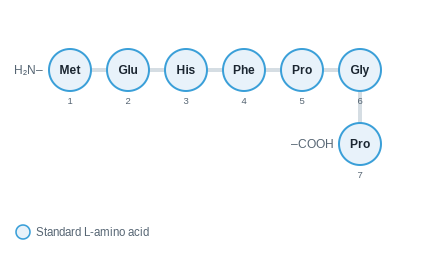
Also called ACTH(4-7)-PGP, ACTH(4-10) analogue, Met-Glu-His-Phe-Pro-Gly-Pro, N-acetyl semax (variant)
- US status
- Not approved
- DEA
- Not a controlled substance
- WADA
- Not named; S0 status depends on approval abroad, which we did not confirm
- Class
- Brain, sleep & 'longevity' research peptides
Jump to doses reported ↓ Dose math calculator
What it is
Semax is a seven-amino-acid peptide (Met-Glu-His-Phe-Pro-Gly-Pro) described as an analog of the 4-10 fragment of adrenocorticotropic hormone (ACTH), ending in a Pro-Gly-Pro tail S3S8. In rats, intranasal semax raised brain-derived neurotrophic factor (BDNF), a protein involved in learning and nerve repair, and affected dopamine and serotonin systems S8S10. In studies it is usually given as nose drops or spray S8. Nearly all human studies come from Russian research groups and were published in Russian journals S6S7. Online it is sold as a "nootropic" nasal spray or powder.
How it works
Semax is a seven-amino-acid peptide built on the 4-10 fragment of ACTH, the pituitary hormone, with a Pro-Gly-Pro tail added. ACTH(4-10) itself has behavioural activity in animals without the hormonal (cortisol-releasing) activity of the full molecule; the added tail resists enzyme breakdown, which is what allows a nasally applied dose to survive long enough to reach the brain S3S8.
The proposed mechanism is neurotrophic rather than receptor-blocking:
- BDNF. In rats, intranasal semax raised brain-derived neurotrophic factor and its receptor TrkB in the hippocampus. BDNF supports neuron survival, synapse formation and learning, which is the suggested basis for both the nootropic claims and the stroke-recovery research S8.
- Monoamines. In rodents it activated dopamine and serotonin systems in the brain S10.
- Enkephalin breakdown. In human serum it slowed the enzymes that degrade enkephalins, the body's own opioid peptides, prolonging their action S9.
The human studies in ischemic stroke come from Russian groups and were published in Russian S6S7. The mechanism in people is therefore inferred from animal and in-vitro work, not demonstrated in Western clinical research.
Legal status
- FDA: Not approved for any use in the US.
- Compounding: FDA had placed semax in Category 2, citing possible immune reactions from aggregation and impurities and "no, or limited, safety-related information for proposed routes of administration" S1. The nomination was withdrawn; FDA lists it under withdrawn nominations S1. FDA's compounding advisory committee reviewed semax on Jul 24 2026 for cerebral ischemia, migraine and trigeminal neuralgia S4; per HHS, the committee voted in favor while FDA's drug center had recommended against S3.
- HHS draft policy (Oct 30 2026): HHS does not intend to take enforcement action against state-licensed pharmacies or physicians compounding semax free base for intranasal use, under conditions including a lot-level certificate of analysis, a single active ingredient, and adverse-event reporting S2S3. HHS says the intranasal human record FDA compiled "covers several hundred subjects with no reported adverse outcome" S3. Injectable semax is not covered. This is a draft enforcement stance, not approval S2.
- DEA: Not a controlled substance.
- "Research use only" products: see our explainer.
- WADA: Not named on the 2026 List. Section S0 covers pharmacological substances with no current approval by any government health authority S5. Whether semax falls under S0 depends on its approval status outside the US, which we have not confirmed from a primary regulator source. Athletes should ask their anti-doping organization.
What the research actually shows
Evidence: C. Small, mostly unblinded clinical studies in stroke patients, all from Russian groups, plus animal and lab work. We found no randomized, placebo-controlled trial in English-language journals, and no study of healthy people using it to boost cognition.
| Study | Design | People | Dose studied | Result |
|---|---|---|---|---|
| Gusev et al 2018 S6 | Clinical study with semax and no-semax subgroups (allocation not described in the abstract) | 110 patients recovering from ischemic stroke | 6,000 mcg per day in two 10-day courses, 20 days apart | Higher blood BDNF levels and faster improvement on a daily-function scale (Barthel index) with semax |
| Gusev et al 1997 S7 | Controlled clinical study vs conventional therapy | 30 patients with acute ischemic stroke vs 80 controls | 12 mg per day (moderate stroke) or 18 mg per day (severe stroke) | Authors report faster recovery of neurological, especially motor, function |
| Dolotov et al 2006 S8 | Animal study | Rats | 50 and 250 µg/kg intranasal | BDNF rose in the basal forebrain within 3 hours |
| Kost et al 2001 S9 | Lab study, human serum | — | IC50 about 10 µM | Semax inhibited enzymes that break down enkephalins (natural opioid peptides) |
What we don't know: whether it improves memory or focus in healthy people (no trial found), whether the stroke results hold up in a blinded, placebo-controlled trial, and what long-term use does.
Reported benefits
- In Russian stroke studies: faster functional recovery and higher BDNF levels, in small studies without clear blinding S6S7.
- In animals: more BDNF and changes in dopamine and serotonin systems S8S10.
- "Nootropic" use in healthy people: not tested in any study we found.
Side effects
Common: the abstracts we read do not report side-effect rates S6S7. HHS says the intranasal record "covers several hundred subjects with no reported adverse outcome" S3; that is a summary of poorly reported studies, not proof of safety. Serious: none documented in the sources we found. FDA cited possible immune reactions for some routes and limited safety information S1. HHS says FDA reviewers' concerns were "mechanistic rather than observed" and that the "bleeding and abuse-potential signals have no clinical counterpart" in the human record S3.
Dangers and red flags
- Thin, regional evidence. Almost all of it comes from a small set of research groups, published in Russian S6S7.
- Route matters. The only route HHS will tolerate in compounding is intranasal S3; injecting it has no supporting human data.
- Product quality. Grey-market sprays and vials are not checked for identity, dose, sterility or endotoxin. HHS named missing endotoxin testing as the principal deficiency FDA found for injectable use S3.
- Who should avoid it: there is no evidence base for use in pregnancy, breastfeeding, children, or people with bleeding disorders or on blood thinners, given the bleeding question FDA raised S3.
- Sport: status unclear; see WADA above S5.
Doses reported
We don't recommend sh*t. These are the doses studies, labels and harm-reduction sources report. That's information, not advice. Talk to a licensed clinician.
There is no FDA label. These are the only human doses we could tie to a checkable source. Both are stroke studies in hospital or rehabilitation settings, not "nootropic" use.
| Source | Population | Dose | Route | Frequency and timing | Duration | Titration or escalation | Cite |
|---|---|---|---|---|---|---|---|
| Gusev et al 2018 | 110 adults after ischemic stroke (early and late rehabilitation groups) | 6,000 mcg per day | Not stated in the abstract | Daily dose within each course; split not stated in the abstract | Two 10-day courses with a 20-day gap | None reported | S6 |
| Gusev et al 1997 | 30 adults in the acute period of hemispheric ischemic stroke | 12 mg per day (moderate stroke) or 18 mg per day (severe stroke) | Not stated in the abstract | Daily | 5 days (moderate) or 10 days (severe) | Dose set by stroke severity, not escalated | S7 |
We found no peer-reviewed survey or harm-reduction source with semax doses for healthy users, so we report none.
Open the dose math calculator →
Monitoring a doctor would order
No guideline exists. We found no source naming semax-specific monitoring.
Bottom line
Semax is a nasal-spray peptide derived from a fragment of ACTH. Small Russian stroke studies report faster recovery, and rats show more BDNF, but there is no blinded, placebo-controlled trial we could find and nothing at all in healthy people taking it for focus. HHS's October 2026 draft policy would tolerate pharmacy-compounded nasal semax; that is a regulatory stance, not proof that it works.
Sources
- [S1] FDA. Certain Bulk Drug Substances for Use in Compounding that May Present Significant Safety Risks (entry: Semax (heptapeptide), 'Bulk drug substances nominated but withdrawn'). Content current as of 04/22/2026. (regulator)
- [S2] HHS. Enforcement Discretion Policy Regarding 503A Compounding Using Certain Peptide Bulk Drug Substances (notice of availability, draft policy). Federal Register FR Doc 2026-22192, Oct 30 2026. (regulator)
- [S3] HHS. Enforcement Discretion Policy Regarding 503A Compounding Using Certain Peptide Bulk Drug Substances, Appendix A and Appendix B (semax identity, intranasal route, justification). Policy PDF linked from FR Doc 2026-22192. (regulator)
- [S4] FDA. July 23-24, 2026: Meeting of the Pharmacy Compounding Advisory Committee (Jul 24 agenda: semax reviewed for cerebral ischemia, migraine and trigeminal neuralgia). (regulator)
- [S5] World Anti-Doping Agency. 2026 Prohibited List, section S0 (Non-approved substances). (regulator)
- [S6] Gusev EI, et al. [The efficacy of semax in the treatment of patients at different stages of ischemic stroke]. Zh Nevrol Psikhiatr Im S S Korsakova. 2018;118(3 Vyp 2):61-68. PMID 29798983. (In Russian, English abstract.) (human-observational)
- [S7] Gusev EI, et al. [Effectiveness of semax in acute period of hemispheric ischemic stroke (a clinical and electrophysiological study)]. Zh Nevrol Psikhiatr Im S S Korsakova. 1997;97(6):26-34. PMID 11517472. (In Russian, English abstract.) (human-observational)
- [S8] Dolotov OV, et al. Semax, an analogue of adrenocorticotropin (4-10), binds specifically and increases levels of brain-derived neurotrophic factor protein in rat basal forebrain. J Neurochem. 2006;97 Suppl 1:82-6. PMID 16635254. (animal)
- [S9] Kost NV, et al. [Semax and selank inhibit the enkephalin-degrading enzymes from human serum]. Bioorg Khim. 2001;27(3):180-3. PMID 11443939. (in-vitro)
- [S10] Eremin KO, et al. Semax, an ACTH(4-10) analogue with nootropic properties, activates dopaminergic and serotoninergic brain systems in rodents. Neurochem Res. 2005;30(12):1493-500. PMID 16362768. (animal)