
Growth hormone & GH-axis peptides
Sermorelin
Also called Geref, GRF 1-29, GHRH(1-29), sermorelin acetate
- US status
- Withdrawn
- DEA
- Not a controlled substance
- WADA
- S2.2.4 Growth hormone releasing factors (GHRH analogues); prohibited at all times
- Class
- Growth hormone & GH-axis peptides
Jump to doses reported ↓ Dose math calculator
What it is
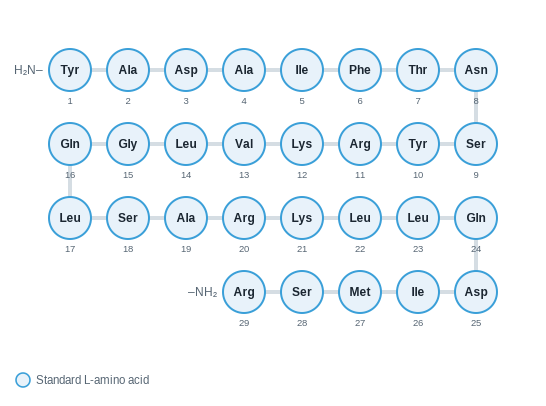
Sermorelin is a synthetic fragment of growth-hormone-releasing hormone, the first 29 amino acids (GHRH(1-29)), given by subcutaneous injection. Like tesamorelin, it nudges the pituitary to release its own growth hormone. It was once sold as Geref for diagnosing and treating growth hormone deficiency in children; that product is no longer marketed. Today sermorelin reaches people mainly through compounding pharmacies and the grey market, marketed for anti-aging and body composition, uses it was never approved for S1.
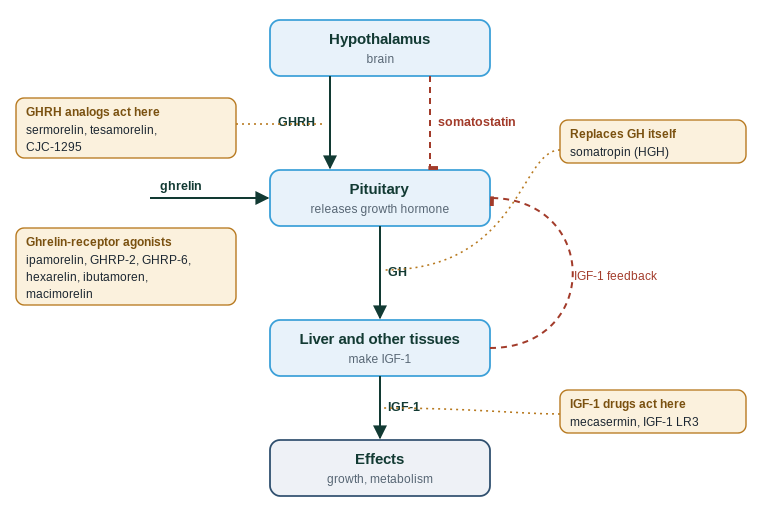
The growth-hormone axis, and where each drug class acts
How it works
Sermorelin is the first 29 amino acids of GHRH, the hypothalamic hormone that tells the pituitary to release growth hormone; those 29 residues carry essentially all of the biological activity of the full 44-amino-acid hormone. It binds GHRH receptors on pituitary somatotroph cells, which release stored growth hormone in a pulse. GH then acts on the liver and other tissues to raise IGF-1, the mediator of most of GH's growth and metabolic effects S3.
The practical consequence of working one step upstream is that the pituitary stays in charge. Release is pulsatile rather than continuous, and the body's own negative feedback — somatostatin, and IGF-1 feeding back on the pituitary — still applies, so a ceiling exists that does not exist when recombinant GH is injected directly. That also means it does nothing if the pituitary cannot respond, which is why it was used as a diagnostic agent: a GH rise after sermorelin points to the hypothalamus as the problem, no rise points to the pituitary S3.
In growth-hormone-deficient children, daily subcutaneous dosing accelerated growth S2. In older men, GHRH(1-29) analogue dosing raised GH and IGF-1 back toward younger levels, with body-composition changes but no demonstrated functional benefit S4S5. There is no approved sermorelin product marketed in the US today S1.
Legal status
- FDA: No sermorelin product is currently FDA-approved or on the market. The original Geref approval ended, and in 2013 FDA determined Geref had not been withdrawn for safety or effectiveness reasons, which lets a generic (ANDA) be approved if one is filed S1.
- Compounding: sermorelin is widely compounded under an interpretive "component of an approved drug" rationale. That rationale is unsettled; it should be confirmed with counsel and against current FDA policy, not assumed S6.
- DEA: Not a controlled substance.
- "Research use only" powder: grey-market sermorelin is an unapproved drug of unknown quality. See our explainer.
- WADA: Prohibited at all times under S2.2.4 as a GHRH analogue S7.
- International (short): Not reviewed for this page yet.
What the research actually shows
Evidence: C for current uses. The strongest data are decades old, in children with growth hormone deficiency (the original Geref use) and in small studies of older adults; there are no modern large trials for the anti-aging and body-composition claims.
| Study | Design | People | Dose studied | Result |
|---|---|---|---|---|
| Thorner 1996 S2 | Open-label, 1 year | 110 prepubertal GH-deficient children (86 analyzed) | 30 mcg/kg/day at bedtime | Height velocity rose from 4.1 to ~8.0 cm/yr at 6 months; well tolerated; no excess IGF-1 |
| Prakash 1999 review S3 | Review of sermorelin in children | — | — | Summarizes efficacy and diagnostic use in idiopathic GH deficiency |
| Khorram 1997 S4 | Single-blind RCT, 16 weeks | 10 women, 9 men aged 55–71 | 10 mcg/kg nightly (a GHRH(1-29) analog) | Raised nocturnal GH and IGF-1 within 2 weeks; body-composition and skin changes reported |
| Corpas 1992 S5 | Older men | — | 0.5 and 1 mg twice daily for 14 days | Dose-related rise in GH and IGF-1; the high dose normalized levels toward young-adult range |
What we don't know: whether sermorelin produces meaningful, durable benefits for healthy adults, and whether grey-market vials contain real, sterile peptide at the stated amount. Note S4 and S5 used closely related GHRH(1-29) analogs.
Reported benefits
In children with GH deficiency: increased growth velocity S2S3. In small older-adult studies: higher GH and IGF-1 levels, with some reported body-composition changes S4S5. There is no solid modern evidence for the anti-aging and performance uses sermorelin is now marketed for.
Side effects
Common: injection-site reactions (redness, swelling, pain) were the most frequent effect in the historical pediatric use; headache and flushing have been reported S2S3. Serious: no distinctive serious safety signal was established in the small studies, but there is no modern safety database for current off-label use, and GHRH analogs raise GH and IGF-1, which carry the same theoretical concerns as growth hormone itself (glucose effects, tissue growth) S4.
Dangers and red flags
- Unsettled legal basis. The "component of an approved drug" compounding rationale is interpretive and may not hold; this is a documented uncertainty, not a green light S6.
- Product quality. Grey-market and some compounded sermorelin is of unverified identity, dose and sterility.
- Raised IGF-1. As with any GH-axis drug, pushing GH and IGF-1 up has theoretical risks for glucose control and tissue growth S4.
- Thin modern evidence. The supporting trials are old and mostly in children or small older-adult groups, not healthy adults seeking anti-aging effects.
- Sport: prohibited at all times S7.
Doses reported
We don't recommend sh*t. These are the doses studies, labels and harm-reduction sources report. That's information, not advice. Talk to a licensed clinician.
There is no currently marketed FDA label, so there is no label dose to quote. The rows below are study doses, all subcutaneous. S4 and S5 used related GHRH(1-29) analogs, noted in context.
| Source | Dose | Unit / route | Frequency | Timing | Duration | Context |
|---|---|---|---|---|---|---|
| S2 Thorner 1996 | 30 mcg/kg | mcg per kg, subcutaneous | Once daily | At bedtime | Up to 1 year | GH-deficient children |
| S4 Khorram 1997 | 10 mcg/kg | mcg per kg, subcutaneous | Once nightly | Night (21:00) | 16 weeks | Older adults (GHRH(1-29) analog) |
| S5 Corpas 1992 | 0.5 mg and 1 mg | mg, subcutaneous | Twice daily | — | 14 days | Older men (GHRH(1-29)) |
No survey or harm-reduction source with numbers for non-pharmacy sermorelin use was found that we could cite.
Open the dose math calculator →
Monitoring a doctor would order
There is no current guideline for off-label use. In the historical pediatric use, clinicians monitored growth velocity, bone age and IGF-1 S2S3. By analogy to other GH-axis drugs, a clinician might check IGF-1 and glucose, but no sermorelin-specific monitoring standard exists for adults.
Bottom line
Sermorelin is an older GHRH fragment that once had an FDA-approved pediatric product (Geref) that is no longer marketed. Its best evidence is decades old, in children with growth hormone deficiency, and there is no solid modern support for the anti-aging and body-composition uses it is now compounded and sold for. Its compounding basis is interpretive and unsettled, and grey-market supply is of unknown quality. It is banned in sport at all times.
Sources
- [S1] FDA / Federal Register. Determination That GEREF (Sermorelin Acetate) Injection Was Not Withdrawn From Sale for Reasons of Safety or Effectiveness. 78 FR 14095, Mar 4 2013; Docket FDA-2012-P-1071. (regulator)
- [S2] Thorner M, et al. Once daily subcutaneous growth hormone-releasing hormone therapy accelerates growth in growth hormone-deficient children during the first year of therapy (Geref International Study Group). J Clin Endocrinol Metab. 1996;81:1189-1196. PMID 8772599. (rct)
- [S3] Prakash A, Goa KL. Sermorelin: a review of its use in the diagnosis and treatment of children with idiopathic growth hormone deficiency. BioDrugs. 1999;12:139-157. PMID 18031173. (review)
- [S4] Khorram O, et al. Endocrine and metabolic effects of long-term administration of [Nle27]growth hormone-releasing hormone-(1-29)-NH2 in age-advanced men and women. J Clin Endocrinol Metab. 1997;82:1472-1479. PMID 9141536. (rct)
- [S5] Corpas E, et al. Growth hormone (GH)-releasing hormone-(1-29) twice daily reverses the decreased GH and insulin-like growth factor-I levels in old men. J Clin Endocrinol Metab. 1992;75:530-535. PMID 1379256. (rct)
- [S6] FDA. Notice to Compounders: Changes that affect compounding as of March 23, 2020 (context on compounding and biologics). (regulator)
- [S7] World Anti-Doping Agency. 2026 Prohibited List, section S2.2.4. (regulator)