
Growth hormone & GH-axis peptides
Somatropin (HGH)
Also called human growth hormone, HGH, rhGH, Genotropin, Humatrope, Norditropin
- US status
- Approved
- DEA
- Not CSA-scheduled, but distribution for non-approved uses is a federal felony (21 USC 333(e))
- WADA
- S2.2.3 Growth hormone, its analogues and fragments; prohibited at all times
- Class
- Growth hormone & GH-axis peptides
Jump to doses reported ↓ Dose math calculator
What it is
Somatropin is recombinant human growth hormone (hGH), a 191-amino-acid protein made to match the hormone the pituitary produces. It is given by subcutaneous injection, usually daily, from pens and reconstituted vials, under brand names including Genotropin, Humatrope, Norditropin, Omnitrope, Saizen and Zomacton S1S2. It is approved for specific deficiency and growth disorders. It is also widely misused for anti-aging, bodybuilding and "performance," uses for which the evidence is weak and the distribution is a federal crime S5S6.
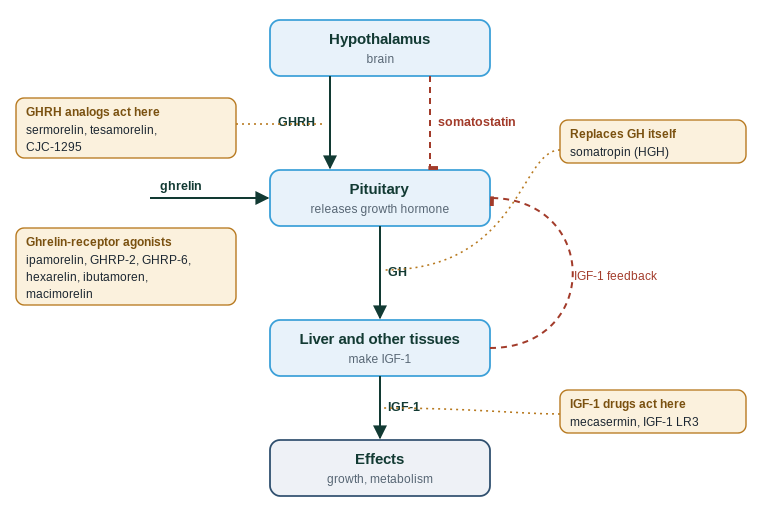
The growth-hormone axis, and where each drug class acts
How it works
Somatropin is recombinant human growth hormone, identical in sequence to the pituitary hormone. It binds the growth hormone receptor on cell surfaces, which pairs up and signals through the JAK2/STAT5 pathway. Two broad things follow S1S2:
- Indirect, through IGF-1. The liver responds by making insulin-like growth factor 1, which drives cartilage growth at the growth plates (the height effect in children) and protein synthesis in muscle and other tissue. Most of the growth-promoting action of GH is actually IGF-1's.
- Direct, on fuel handling. GH itself is lipolytic: it releases fat from fat cells and shifts the body toward burning fat rather than glucose. The flip side is insulin resistance, which is why glucose intolerance and diabetes appear on the label, and sodium and water retention, which is why swelling, joint pain and carpal tunnel symptoms are common S1S2.
That split explains the misuse pattern and its limits. Injected GH raises lean mass partly by adding water to tissue and increases fat loss, but controlled trials in healthy athletes found no improvement in strength, with increased lactate during exercise S6S7. Unlike GH-releasing agents, injected somatropin bypasses the pituitary's own feedback, so exogenous dosing suppresses natural release and continuous exposure replaces the normal pulsatile pattern — part of why acromegaly-like features appear with sustained high dosing S1.
Legal status
- FDA: Approved, by product, for conditions such as growth hormone deficiency (children and adults), Turner syndrome, Prader-Willi syndrome, children born small for gestational age, idiopathic short stature, and others S1S2.
- Biologic, not compoundable: since March 23, 2020, somatropin products are licensed biologics (their approvals were "deemed" to be BLAs), so they are not eligible for the 503A or 503B compounding exemptions S3S4.
- DEA: Human growth hormone is not scheduled under the Controlled Substances Act, but distributing it, or possessing it with intent to distribute, for any use other than an approved medical condition authorized by a physician, is a federal felony punishable by up to 5 years (10 if a minor is involved) under 21 USC 333(e) S5.
- "Research use only" / "HGH 191AA" vials: grey-market somatropin sold this way is an unapproved, unlicensed biologic of unknown quality. See our explainer.
- WADA: Prohibited at all times under S2.2.3 S8.
- International (short): Not reviewed for this page yet.
What the research actually shows
Evidence: A for the approved deficiency and growth uses (decades of trials behind the labels) S1S2. For healthy-adult "performance" and anti-aging use, the evidence is weak.
| Study | Design | People | Dose studied | Result |
|---|---|---|---|---|
| Approved uses S1S2 | Basis of the FDA labels | Children and adults with deficiency/growth disorders | Weight-based, individualized (see doses table) | Improved growth velocity and body composition in the labeled conditions |
| Liu 2008 systematic review S6 | 27 RCT samples, 303 GH recipients | Healthy, fit adults 13–45 | Mean ~36 mcg/kg/day for ~20 days | Lean body mass rose ~2.1 kg, but strength and exercise capacity did not improve; lactate during exercise rose; more soft-tissue edema and fatigue |
| Meinhardt 2010 S7 | RCT, 8 weeks + 6-week washout | 96 recreational athletes | 2 mg/day (±testosterone in men) | Cut fat mass, raised lean mass (mostly extracellular water); sprint capacity rose ~3.9% (more with testosterone) but faded after stopping; no change in other performance measures |
What we don't know for misuse: long-term safety at the doses used non-medically, and whether grey-market "191AA" vials contain real, sterile hGH at the stated amount.
Reported benefits
In the labeled conditions: restored growth in children and improved body composition and metabolic measures in deficiency S1S2. In healthy adults seeking performance: lean mass rises, largely as water, without a proven gain in strength or endurance; one trial found a small, short-lived sprint-capacity increase S6S7.
Side effects
Common (from the labels): fluid retention (edema, joint pain, carpal tunnel syndrome, muscle pain, especially in adults), injection-site reactions, headache S1S2. Serious (label warnings): in people with Prader-Willi syndrome who are severely obese or have severe breathing problems, sudden death has been reported (a contraindication); new or worsened diabetes and raised blood glucose; intracranial hypertension; slipped capital femoral epiphysis and worsening scoliosis in growing children; pancreatitis; an increased risk of a second tumor in childhood-cancer survivors treated with radiation; and contraindication in acute critical illness and active cancer S1.
Dangers and red flags
- Legal exposure. Distributing hGH for non-approved uses is a federal felony, and buying from a non-pharmacy source feeds that chain S5.
- Diabetes and acromegaly-type effects. GH lowers insulin sensitivity and can unmask diabetes; chronic excess causes the tissue overgrowth seen in acromegaly S1.
- Product quality. "191AA" and "research" vials are unlicensed biologics of unknown identity, dose and sterility S3S4.
- Performance claims oversold. The best evidence shows water-weight gains without real strength or endurance benefit, and more side effects S6S7.
- Sport: prohibited at all times S8.
- Who should never use it (label): acute critical illness; active cancer; severely obese or breathing-impaired Prader-Willi children; active proliferative/severe diabetic retinopathy; closed epiphyses (for growth uses) S1.
Doses reported
We don't recommend sh*t. These are the doses studies, labels and harm-reduction sources report. That's information, not advice. Talk to a licensed clinician.
Approved somatropin dosing is weight-based and individualized, titrated to response and IGF-1 levels, and differs by product and condition. The rows below quote the Genotropin and Humatrope labels and two studies of non-medical use. All are subcutaneous. The weekly dose is usually divided into 6–7 injections S1.
| Source | Dose | Unit / route | Frequency | Duration | Titration / adjustment | Context |
|---|---|---|---|---|---|---|
| S1 Genotropin label | 0.16–0.24 mg/kg/week | mg per kg, subcutaneous | Divided into 6–7 injections/week | Until epiphyses fuse | Individualized to growth response | Pediatric GH deficiency |
| S1 Genotropin label | 0.24 mg/kg/week | mg per kg, subcutaneous | 6–7 injections/week | Long term | Individualized | Prader-Willi syndrome |
| S1 Genotropin label | 0.33 mg/kg/week | mg per kg, subcutaneous | 6–7 injections/week | Until epiphyses fuse | Individualized | Turner syndrome |
| S1 Genotropin label | up to 0.47 mg/kg/week | mg per kg, subcutaneous | 6–7 injections/week | Until epiphyses fuse | Individualized | Idiopathic short stature |
| S1 Genotropin label | up to 0.48 mg/kg/week | mg per kg, subcutaneous | 6–7 injections/week | Until epiphyses fuse | May reduce toward 0.24 mg/kg/week as catch-up growth occurs | Small for gestational age |
| S1 Genotropin label | Non-weight-based: start ~0.2 mg/day (range 0.15–0.30) | mg, subcutaneous | Once daily | Long term | Increase by ~0.1–0.2 mg/day every 1–2 months, guided by IGF-1 and response | Adult GH deficiency |
| S1 Genotropin label | Weight-based: start ≤0.04 mg/kg/week | mg per kg, subcutaneous | Divided | Long term | Increase as tolerated to ≤0.08 mg/kg/week at 4–8 week intervals | Adult GH deficiency |
| S6 Liu 2008 (non-medical) | mean ~36 mcg/kg/day (0.036 mg/kg/day) | mcg per kg, subcutaneous | Daily (mean ~20 days) | Short | Study protocols, not a label; may not reflect covert doses | Healthy young adults, performance |
| S7 Meinhardt 2010 (non-medical) | 2 mg/day | mg, subcutaneous | Once daily | 8 weeks | Fixed study dose | Recreational athletes |
Monitoring a doctor would order
From the labels: IGF-1 levels to guide dosing and avoid overexposure; blood glucose and HbA1c; thyroid function; eye exams and prompt evaluation of headache or vision change (intracranial hypertension); growth and bone monitoring in children, including for scoliosis and hip (slipped epiphysis); and tumor surveillance where relevant S1S2.
Bottom line
Somatropin is a well-established, FDA-approved recombinant growth hormone for specific deficiency and growth disorders, dosed by weight and titrated to IGF-1. It is a licensed biologic that cannot be compounded, and distributing it for anti-aging, bodybuilding or "performance" is a federal felony. For healthy adults, the evidence shows mostly water-weight gains without proven strength or endurance benefit, more side effects, and real legal and health risks, especially from grey-market "191AA" vials of unknown quality.
Sources
- [S1] GENOTROPIN (somatropin) for injection. US prescribing information (DailyMed, Pfizer, published Aug 06 2026). Set ID ffebf88b-d257-4542-9808-74d9b7167765. (label)
- [S2] HUMATROPE (somatropin) for injection. US prescribing information (DailyMed, Eli Lilly, published Sep 02 2026). Set ID a774e1ae-3997-49ee-8b0e-99a2b315d409. (label)
- [S3] FDA. Revised Final List of Approved NDAs for Biological Products That Were Deemed to be BLAs on March 23, 2020 (lists somatropin products Genotropin, Humatrope, Norditropin, Omnitrope, Saizen, Zomacton and others). (regulator)
- [S4] FDA. Notice to Compounders: Changes that affect compounding as of March 23, 2020 (transitioned biological products are not eligible for the 503A/503B compounding exemptions). (regulator)
- [S5] 21 U.S.C. 333(e), Prohibited distribution of human growth hormone (Cornell LII). (regulator)
- [S6] Liu H, et al. Systematic review: the effects of growth hormone on athletic performance. Ann Intern Med. 2008;148:747-758. PMID 18347346. (review)
- [S7] Meinhardt U, et al. The effects of growth hormone on body composition and physical performance in recreational athletes: a randomized trial. Ann Intern Med. 2010;152:568-577. PMID 20439575. (rct)
- [S8] World Anti-Doping Agency. 2026 Prohibited List, section S2.2.3. (regulator)