
Brain, sleep & 'longevity' research peptides
SS-31 (elamipretide)
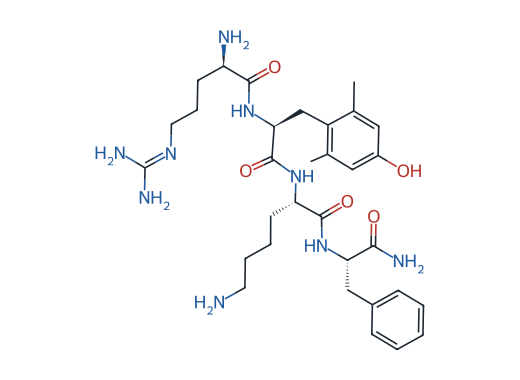
Also called elamipretide, Forzinity, SS31, D-Arg-2,6-dimethyl-Tyr-Lys-Phe-NH2
- US status
- Approved (Forzinity, 2025, accelerated approval): muscle strength in Barth syndrome, 30 kg and up
- DEA
- Not a controlled substance
- WADA
- Not named
- Class
- Brain, sleep & 'longevity' research peptides
Jump to doses reported ↓ Dose math calculator
What it is
SS-31, now called elamipretide, is a lab-made four-amino-acid peptide (D-Arg-2,6-dimethyl-Tyr-Lys-Phe-NH2) that binds cardiolipin, a fat in the inner membrane of mitochondria, the cell's energy factories S1. The approved product, Forzinity, is a ready-to-use solution (80 mg/mL in a 3.5 mL vial) injected under the skin once a day S1. It is approved for Barth syndrome, a rare genetic disease in which defects in the TAZ gene leave cardiolipin abnormal; patients have weak muscles, fatigue and heart problems S3S4. Online, grey-market "SS-31" powder is sold for energy, endurance and longevity, uses no trial has supported.
How it works
SS-31 (elamipretide) is a four-amino-acid peptide with an alternating positive-charge/aromatic pattern that lets it cross cell membranes and concentrate in the inner mitochondrial membrane without needing a transporter. There it binds cardiolipin, a phospholipid found almost exclusively in that membrane S1.
Cardiolipin is structural glue for the energy machinery: it holds the respiratory chain complexes in the folded cristae and keeps cytochrome c in place. When cardiolipin is abnormal or oxidized, the cristae flatten, electron transport leaks, ATP output falls and reactive oxygen species rise. By binding cardiolipin, SS-31 is proposed to stabilize that architecture, improve the efficiency of electron transport and reduce the leak, restoring ATP production rather than acting as a general antioxidant S1.
That mechanism maps directly onto its one approved use. In Barth syndrome a defect in the TAZ gene leaves cardiolipin immature and unremodelled, producing the muscle weakness, fatigue and cardiomyopathy of the disease S3S4. Where mitochondrial dysfunction was secondary rather than the primary defect, trials have been less convincing: primary mitochondrial myopathy, heart failure with reduced ejection fraction and macular degeneration studies did not establish benefit S5S6S7S8. The grey-market claims for energy, endurance and longevity extrapolate the Barth mechanism to healthy mitochondria, where no trial supports it.
Legal status
- FDA: Approved Sep 19 2025 S2 "to improve muscle strength in adult and pediatric patients with Barth syndrome weighing at least 30 kg" S1. This is an accelerated approval based on knee strength, an intermediate endpoint; "continued approval for this indication may be contingent upon verification and description of clinical benefit in a confirmatory trial" S1.
- Other uses: not approved. Trials in mitochondrial myopathy, heart failure and dry macular degeneration did not meet their main goals S5S7S8.
- DEA: Not a controlled substance.
- Grey-market "SS-31": sold as "research use only." See our explainer. It is not Forzinity, and nothing about its content or sterility is checked.
- WADA: Not named on the 2026 List S9. Because it has a government approval, it falls outside S0, which covers only substances with no current approval anywhere S9.
What the research actually shows
Evidence: B for Barth syndrome, and only that. The randomized Barth trial had 12 patients and missed both main goals; approval rests on strength gains seen later in an open-label extension with 8 to 10 patients S1S3S4. Larger randomized trials in other diseases missed their primary endpoints S5S7S8.
| Study | Design | People | Dose studied | Result |
|---|---|---|---|---|
| TAZPOWER, Reid Thompson et al 2021 S3; label S1 | Randomized, double-blind, placebo-controlled crossover (12 weeks each, 4-week washout), then open-label extension | 12 males with Barth syndrome, aged 12–35 | 40 mg SC once daily | Missed both primary endpoints (6-minute walk, fatigue). In the extension, at 36 weeks: 6-minute walk +95.9 m; knee strength median +57 newtons from baseline |
| TAZPOWER extension, Thompson et al 2024 S4 | Open-label extension, 168 weeks | 10 entered, 8 reached week 168 | 40 mg SC once daily | 6-minute walk +96.1 m at week 168; injection-site reactions most common side effect |
| MMPOWER-3, Karaa et al 2023 S5 | Randomized, double-blind, placebo-controlled phase 3, 24 weeks | 218 adults with primary mitochondrial myopathy | 40 mg SC once daily | Missed primary endpoints: 6-minute walk difference −3.2 m (95% CI −18.7 to 12.3) |
| Daubert et al 2017 S6 | Randomized, double-blind, placebo-controlled, ascending single dose | 36 adults with heart failure (ejection fraction ≤35%) | Single 4-hour IV infusion: 0.005, 0.05 or 0.25 mg/kg/hour | No serious adverse events; at the top dose, heart volumes fell at end of infusion |
| PROGRESS-HF, Butler et al 2020 S7 | Randomized, double-blind, placebo-controlled phase 2 | 71 adults with heart failure (ejection fraction ≤40%) | 4 mg or 40 mg SC once daily | No improvement in heart volume at 4 weeks |
| ReCLAIM-2, Ehlers et al 2025 S8 | Randomized, double-masked, placebo-controlled phase 2 | 176 adults 55+ with dry macular degeneration | 40 mg SC once daily | Missed primary endpoints; some secondary retinal measures favored the drug |
What we don't know: whether it does anything for healthy people or for aging (never tested), and whether the Barth strength gains, seen without a control group, hold up in the required confirmatory trial S1.
Reported benefits
- Barth syndrome: improved knee strength and walking distance over years in an open-label extension, after a negative randomized phase S1S3S4.
- Other diseases: no primary-endpoint benefit in mitochondrial myopathy, heart failure or dry macular degeneration S5S7S8.
- Energy, endurance, longevity: no trial in healthy people.
Side effects
Common (Barth crossover trial, Forzinity vs placebo, n=12) S1: any injection-site reaction 100% vs 67%; redness 100% vs 25%; pain 75% vs 42%; hardening 67% vs 17%; itching 67% vs 17%; bruising 25% vs 0%; hives at the site 25% vs 0%. In the macular degeneration trial, adverse events occurred in 86% on the drug vs 71% on placebo, mostly injection-site reactions S8. Eosinophilia: a rise in eosinophils, a type of white blood cell, was common with 30 days or more of use, peaking around 90 days and returning to baseline after 6 to 12 months or after stopping; it was not linked to symptoms S1.
Serious: - Hypersensitivity: serious allergic reactions "requiring emergency medical intervention" have been reported, including rash, eczema-like dermatitis and cough; they "may occur within minutes to months after treatment initiation" S1. Serious hypersensitivity is a contraindication S1. - Benzyl alcohol toxicity in newborns: the product contains benzyl alcohol (20 mg/mL) as a preservative and is not for use in neonates S1.
Dangers and red flags
- Grey-market powder is not Forzinity. The approved drug is a preserved, ready-to-use solution; powder from an unregulated source has no checked identity, purity or sterility.
- Allergic reactions can come late, up to months in S1.
- Kidneys: blood levels rise as kidney function falls; with severe impairment the label halves the dose and has no dosing schedule for people on dialysis S1.
- Who should avoid it: anyone with a prior serious reaction to it; newborns S1.
- Sport: not named on the 2026 List S9.
Doses reported
We don't recommend sh*t. These are the doses studies, labels and harm-reduction sources report. That's information, not advice. Talk to a licensed clinician.
FDA label (Forzinity), in full S1: - Weight 30 kg or more: 40 mg subcutaneously once daily, at the same time each day. 40 mg is 0.5 mL of the 80 mg/mL solution. - No titration. The label starts at the full dose. - Severe kidney impairment (eGFR under 30 mL/min, not on dialysis): 20 mg once daily. eGFR 30 or above: 40 mg. There is "insufficient information" for adults on dialysis and for children with kidney impairment. - Missed dose: skip it and take the next one at the usual time. Do not double up. - Where: abdomen (at least 2 inches from the navel) or outer thigh; rotate sites daily; avoid tender, bruised, red or hard skin, scars and stretch marks. - Vial: 280 mg/3.5 mL single-patient-use vial; discard 8 days after first opening. Not for IV use.
| Source | Population | Dose | Route | Frequency and timing | Duration | Titration or escalation | Cite |
|---|---|---|---|---|---|---|---|
| FDA label (Forzinity) | Barth syndrome, 30 kg or more | 40 mg (0.5 mL of 80 mg/mL) | Subcutaneous, abdomen or outer thigh | Once daily, same time each day | Ongoing; continued approval depends on a confirmatory trial | None; full dose from day 1 | S1 |
| FDA label, kidney adjustment | Adults with eGFR under 30 mL/min, not on dialysis | 20 mg | Subcutaneous | Once daily | Ongoing | Dose reduction, not escalation | S1 |
| TAZPOWER randomized phase | 12 males with Barth syndrome | 40 mg | Subcutaneous | Once daily | 12 weeks, crossover with 12 weeks placebo after 4-week washout | None | S3 |
| TAZPOWER extension | 10 males with Barth syndrome | 40 mg | Subcutaneous | Once daily | Up to 168 weeks (some to 192) | None | S1S4 |
| MMPOWER-3 | 218 adults with primary mitochondrial myopathy | 40 mg | Subcutaneous | Once daily | 24 weeks | None | S5 |
| PROGRESS-HF | 71 adults with heart failure | 4 mg or 40 mg (parallel arms) | Subcutaneous | Once daily | 28 consecutive days | None | S7 |
| ReCLAIM-2 | 176 adults with dry macular degeneration | 40 mg | Subcutaneous | Once daily | 48 weeks plus 4-week follow-up | None | S8 |
| Daubert et al | 36 adults with heart failure | 0.005, 0.05 or 0.25 mg/kg/hour | IV infusion | Single infusion over 4 hours | One day | Ascending dose cohorts (each cohort one dose level) | S6 |
We found no published survey of grey-market SS-31 use, so we report no community doses.
Open the dose math calculator →
Monitoring a doctor would order
Per the label: watch for hypersensitivity reactions throughout treatment; check kidney function to set the dose S1.
Bottom line
Elamipretide is a real, FDA-approved drug for Barth syndrome, a rare inherited disease, and the approval is provisional: the randomized trial missed its goals, and the case rests on strength gains in 8 to 10 patients without a control group. Bigger trials in other diseases came up empty. Nobody has tested it for energy or aging in healthy people, and grey-market "SS-31" powder is not the approved product.
Sources
- [S1] FORZINITY (elamipretide) injection prescribing information (DailyMed set ID 146bf34c-76f2-48db-ac07-fb29cce2cd75). (label)
- [S2] FDA. Drugs@FDA: NDA 215244, Forzinity (approved Sep 19, 2025; priority review, accelerated approval). (regulator)
- [S3] Reid Thompson W, et al. A phase 2/3 randomized clinical trial followed by an open-label extension to evaluate the effectiveness of elamipretide in Barth syndrome. Genet Med. 2021;23(3):471-478. PMID 33077895. (rct)
- [S4] Thompson WR, et al. Long-term efficacy and safety of elamipretide in patients with Barth syndrome: 168-week open-label extension results of TAZPOWER. Genet Med. 2024;26(7):101138. PMID 38602181. (human-observational)
- [S5] Karaa A, et al. Efficacy and Safety of Elamipretide in Individuals With Primary Mitochondrial Myopathy: The MMPOWER-3 Randomized Clinical Trial. Neurology. 2023;101(3):e238-e252. PMID 37268435. (rct)
- [S6] Daubert MA, et al. Novel Mitochondria-Targeting Peptide in Heart Failure Treatment: A Randomized, Placebo-Controlled Trial of Elamipretide. Circ Heart Fail. 2017;10(12):e004389. PMID 29217757. (rct)
- [S7] Butler J, et al. Effects of Elamipretide on Left Ventricular Function in Patients With Heart Failure With Reduced Ejection Fraction: The PROGRESS-HF Phase 2 Trial. J Card Fail. 2020;26(5):429-437. PMID 32068002. (rct)
- [S8] Ehlers JP, et al. ReCLAIM-2: A Randomized Phase II Clinical Trial Evaluating Elamipretide in Age-related Macular Degeneration. Ophthalmol Sci. 2025;5(1):100628. PMID 39605874. (rct)
- [S9] World Anti-Doping Agency. 2026 Prohibited List, section S0 (Non-approved substances). (regulator)