
AAS ancillaries & fertility drugs
Tamoxifen
Also called Nolvadex, Soltamox, nolva, selective estrogen receptor modulator, SERM
- US status
- Approved
- DEA
- Not a controlled substance
- WADA
- S4.2 Anti-estrogenic substances (SERMs); prohibited at all times (named)
- Class
- AAS ancillaries & fertility drugs
Jump to doses reported ↓ Dose math calculator
What it is
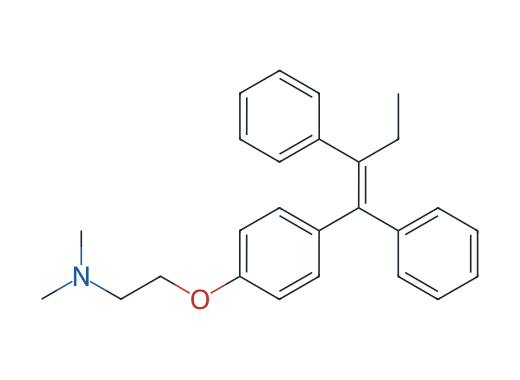
Tamoxifen (Nolvadex) is a selective estrogen receptor modulator (SERM): it blocks estrogen's effect in some tissues (such as breast) while acting like estrogen in others. It is an approved drug for breast cancer and for reducing breast-cancer risk. It appears on this reference because anabolic-steroid users take it off-label to treat or prevent gynecomastia and to help restart their own testosterone production after steroid use, uses it was never approved or studied for in that population.
How it works
Tamoxifen is a selective estrogen receptor modulator. It binds the estrogen receptor, but the shape the receptor takes with tamoxifen bound recruits different helper proteins in different tissues, so the same molecule blocks estrogen signalling in some places and mimics it in others. In breast tissue it acts as an antagonist, which is how it treats and prevents estrogen-receptor-positive breast cancer; in bone and in the liver it acts more like estrogen; in the uterus it is estrogen-like enough to raise the risk of endometrial cancer, which is on its label S1S2.
Tamoxifen is a prodrug: liver enzymes, chiefly CYP2D6, convert it to endoxifen and 4-hydroxytamoxifen, which bind the receptor far more tightly than the parent molecule does.
The off-label use in men follows from two of those tissue effects. Blocking the receptor in breast tissue opposes the estrogen signal that drives gynecomastia. And blocking the receptor in the hypothalamus and pituitary removes estrogen's negative feedback on the reproductive axis, so GnRH, LH and FSH rise and the testes are driven to make more testosterone — the reason it is taken to restart the body's own production after androgen use. Neither use is approved or studied in that population, and raising LH only works if the testes can still respond S3.
Legal status
- FDA: Approved to treat breast cancer and to reduce breast-cancer risk in high-risk women. Off-label use by steroid users is not an approved indication S1.
- DEA: Not a controlled substance.
- Prescription drug: tamoxifen is a prescription medicine; grey-market "research chemical" tamoxifen is an unapproved product of unverified content.
- WADA: Named under S4.2 (anti-estrogenic substances) and prohibited at all times in sport S3.
- International (short): Not reviewed for this page yet.
What the research actually shows
Evidence: A for its approved uses. Tamoxifen is among the most studied drugs in oncology, with large randomized trials. Its off-label use alongside anabolic steroids rests on its estrogen-blocking mechanism, not on controlled trials in that setting.
| Study | Design | People | Dose studied | Result |
|---|---|---|---|---|
| NSABP P-1 (Fisher 1998) S2 | Randomized, double-blind, placebo-controlled | 13,388 women at high breast-cancer risk | 20 mg/day oral | Reduced the incidence of invasive breast cancer by about half; increased endometrial cancer and venous clots |
| Label S1 | Approved indications | Breast-cancer treatment and prevention | 20-40 mg/day oral | Basis of approval for treatment and risk reduction |
What we don't know: the balance of benefit and harm for off-label use by steroid users; tamoxifen's own serious risks (clots, endometrial effects) still apply.
Reported benefits
In its approved uses: fewer breast cancers in high-risk women and better outcomes in breast-cancer treatment S2. Steroid users take it to block breast tissue stimulation (gynecomastia) and, by raising gonadotropins, to help restart natural testosterone after androgen use; these off-label effects are mechanistically plausible but not established by trials in that group.
Side effects
Common: hot flushes, mood changes, and (from its tissue-selective estrogen effects) menstrual changes in women; nausea. Serious: increased risk of venous thromboembolism (blood clots, including pulmonary embolism) and, in women with a uterus, endometrial changes including endometrial cancer; eye (retinal/cataract) effects with long use S1S2.
Dangers and red flags
- Blood clots. Tamoxifen raises the risk of serious venous clots S1S2.
- Endometrial cancer. A documented risk in women with a uterus S2.
- Grey-market product. "Research chemical" tamoxifen is an unapproved product of unverified content.
- Not a license to use steroids safely. Using tamoxifen to manage steroid side effects does not make steroid use safe.
- Sport: named and prohibited at all times S3.
Doses reported
We don't recommend sh*t. These are the doses studies, labels and harm-reduction sources report. That's information, not advice. Talk to a licensed clinician.
The rows below are the FDA label dosing and the prevention-trial dose. There is no citable medical dosing for off-label use after steroids, so none is listed. Tamoxifen is a tablet, so the reconstitution calculator does not apply.
| Source | Dose | Unit / route | Frequency | Timing | Duration | Titration / escalation | Context |
|---|---|---|---|---|---|---|---|
| S1 Label (treatment) | 20-40 mg/day | mg, oral | Once daily; above 20 mg in divided doses (morning and evening) | — | Per indication | Within the 20-40 mg range | Breast-cancer treatment |
| S2 NSABP P-1 (prevention) | 20 mg | mg, oral | Once daily | — | 5 years | Fixed dose | Breast-cancer risk reduction |
No citable medical dosing for off-label SERM use by steroid users was found that we could cite; we will not fill that gap with forum or vendor numbers.
Monitoring a doctor would order
For the approved uses, clinicians watch for clot symptoms, perform gynecologic monitoring in women with a uterus (endometrial surveillance for abnormal bleeding), and do eye exams with long use S1S2. Anyone using it off-label would need the same clot and (where relevant) endometrial vigilance.
Bottom line
Tamoxifen (Nolvadex) is an approved SERM with strong evidence in breast-cancer treatment and prevention. Steroid users take it off-label for gynecomastia and hormonal recovery on mechanism alone, without trial support in that setting, while still carrying its real risks of clots and endometrial cancer. It is a prescription drug, named and banned in sport at all times.
Sources
- [S1] Tamoxifen citrate tablets. US prescribing information (DailyMed). Indicated for breast cancer treatment and risk reduction; label dosing 20-40 mg/day (doses above 20 mg in divided doses). Set ID 9b8a4211-120f-4981-ad69-928accb97637. (label)
- [S2] Fisher B, et al. Tamoxifen for prevention of breast cancer: report of the National Surgical Adjuvant Breast and Bowel Project P-1 Study. J Natl Cancer Inst. 1998;90:1371-1388. PMID 9747868. (rct)
- [S3] World Anti-Doping Agency. 2026 Prohibited List, section S4.2 (anti-estrogenic substances; tamoxifen named). (regulator)