
Healing / recovery research peptides
TB-500
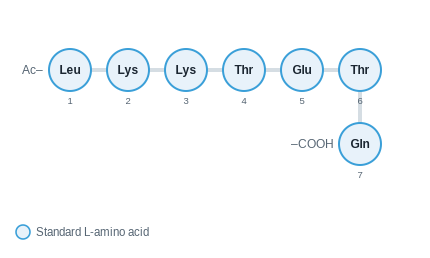
Also called thymosin beta-4 fragment, Ac-LKKTETQ, thymosin β4 (17-23) acetylated, TB4, TB
- US status
- Not approved
- DEA
- Not a controlled substance
- WADA
- S2.3 (thymosin-β4 and its derivatives, e.g. TB-500); prohibited at all times
- Class
- Healing / recovery research peptides
Jump to doses reported ↓ Dose math calculator
What it is
Thymosin β4 is a 43-amino-acid protein your body makes. It helps cells move and is involved in wound repair. TB-500 is not the same thing. Analysis of a product sold as TB-500 found the short, acetylated 7-amino-acid fragment Ac-LKKTETQ (thymosin β4 positions 17–23) S5, and FDA uses the same identity: "Thymosin beta-4, fragment (LKKTETQ), also known as TB-500" S1. Horse-racing labs have published tests for it in equine urine and blood S6. Vial labels vary ("TB-500", "thymosin beta-4 acetate"), so the label alone doesn't tell you which molecule is inside. People inject it in the hope of healing tendon, ligament and muscle injuries, often together with BPC-157 S11.
How it works
The molecule sold as TB-500 is the acetylated seven-amino-acid fragment Ac-LKKTETQ, positions 17–23 of thymosin β4 S5S1. In the full-length protein that stretch is the actin-binding site. Actin is the filament protein cells use as scaffolding; thymosin β4 holds a reservoir of unassembled (G-)actin ready for the cell to polymerize when it needs to change shape and crawl. Cell migration into a wound depends on that process, which is the stated rationale for the healing claims.
The important qualification is that a binding fragment is not the parent protein. Full-length thymosin β4 has several distinct active regions — an N-terminal piece (Ac-SDKP) that damps inflammation and fibrosis, a cell-survival region, and this actin-binding stretch — and the fragment carries only one of them S5. The wound-healing, angiogenesis and anti-inflammatory effects reported in animal and clinical work on thymosin β4 were produced by the whole protein, not by Ac-LKKTETQ S7S8S9S10. Whether the fragment reproduces any of them in a human body has not been tested in a published trial; what exists for the fragment specifically is chemical characterization, equine doping-control assays, and self-reported use online S5S6S11.
For the full protein, see thymosin beta-4.
Legal status
- FDA: Not approved. No thymosin β4 product of any kind is approved.
- Compounding: FDA placed the fragment in Category 2, citing possible immune reactions "due to the potential for aggregation as well as peptide-related impurities", and said it had "not identified any human exposure data" S1. FDA lists it among nominations that were withdrawn S1. The PCAC voted in July 2026 to recommend it for the 503A bulks list (8–6 per a secondary summary) S3, and it is covered by HHS's Oct 30 2026 draft enforcement-discretion policy S2. A draft policy is not approval.
- DEA: Not controlled.
- "Research use only" vials: see our explainer.
- WADA: "Thymosin-β4 and its derivatives e.g. TB-500" are named under S2.3, banned at all times S4.
- International (short): Australia's TGA seizes poorly labeled peptide imports S15.
What the research actually shows
Evidence: D for TB-500. A 2026 analysis "found no published clinical study of the TB-500 fragment" S11. The human data below are for full-length thymosin β4, a different molecule, in different forms (eye drops, IV, topical).
| Study | Design | People | Dose studied | Result |
|---|---|---|---|---|
| Ruff et al 2010 S7 | Randomized, placebo-controlled phase 1 | 40 healthy volunteers (4 cohorts of 10) | Full-length Tβ4 IV: 42, 140, 420 or 1,260 mg single dose, then daily for 14 days | No dose-limiting toxicity or serious adverse events; side effects infrequent, mild/moderate |
| Sosne et al 2015, Cornea S8 | Randomized, double-masked phase 2 | 9 people with severe dry eye | 0.1% Tβ4 eye drops (RGN-259), 6 times a day | 35% less discomfort and 59% less corneal staining vs vehicle at day 56 |
| Sosne et al 2015, Clin Ophthalmol S9 | Randomized phase 2 | 72 people with dry eye | 0.1% eye drops for 28 days | Missed both primary endpoints; some secondary measures improved; no adverse events |
| Guarnera et al 2007 S10 | Randomized dose-escalation (interim report) | Planned 72 with venous leg ulcers | Topical Tβ4 | Design and early enrollment report only |
| Lee & Padgett 2021 S14 | Chart review | 4 of 16 knee-pain patients got BPC-157 + "TB4" | Not specified in abstract | 3 of 4 reported relief; no controls |
What we don't know: whether the TB-500 fragment does anything in people; whether "TB-500" vials contain the fragment, full-length Tβ4 or something else; long-term safety.
Reported benefits
- In animal studies: full-length thymosin β4 promotes wound repair S11.
- In human trials of full-length Tβ4: some improvement in dry-eye signs and symptoms in small phase 2 trials, with mixed primary results S8S9.
- User-reported, not tested: most users in the BPC-157/TB-500 analysis reported improvement, but most combined the two peptides and often physical therapy S11.
Side effects
Common: For the TB-500 fragment, no clinical data. User-reported (BPC-157 and/or TB-500, preprint): fatigue, anxiety, anhedonia, insomnia, injection-site pain; 27.2% of users described at least one side effect S11. Serious: No clinical serious-event data were found for the TB-500 fragment. In a phase 1 study of full-length thymosin β4 given intravenously, adverse events were infrequent and mild-to-moderate at doses up to 1,260 mg/day for 14 days S7. That product is not TB-500.
Dangers and red flags
- Identity confusion: fragment vs full-length protein; FDA found no human exposure data for the fragment S1S5.
- Immune reactions and impurities flagged by FDA S1. Reviewers expect the same quality problems seen with other unregulated performance products S12.
- Cancer question: thymosin β4 is overexpressed in some tumors, for example at the invasive edge of colorectal cancers S13. That shows an association, not that taking it causes cancer, but there is no evidence base for use by anyone with a current or past cancer.
- Sport: banned at all times and detectable S4S6.
- Blends: "BPC-157 + TB-500" vials have never been studied as a combination, and the HHS draft policy covers single-ingredient compounding only S2.
Doses reported
We don't recommend sh*t. These are the doses studies, labels and harm-reduction sources report. That's information, not advice. Talk to a licensed clinician.
| Source | Dose | Frequency | Duration | Context |
|---|---|---|---|---|
| S7 Ruff et al 2010 | 42, 140, 420 or 1,260 mg full-length thymosin β4, IV | Single dose, then once daily | 14 days | Phase 1, healthy volunteers; not TB-500 |
| S8 Sosne et al 2015 | 0.1% Tβ4 eye drops | 6 times daily | 28 days | Severe dry eye; not TB-500 |
| S9 Sosne et al 2015 | 0.1% Tβ4 eye drops | As the study specified | 28 days | Dry eye (CAE model); not TB-500 |
For the TB-500 fragment itself, no human dose data were found. We found no clinical study, and no peer-reviewed survey or harm-reduction source with TB-500 dose numbers we could check. Forum and vendor dosing write-ups are not cited here.
Open the dose math calculator →
Monitoring a doctor would order
No guideline exists. We found no source naming TB-500-specific lab monitoring.
Bottom line
"TB-500" is a short fragment of a natural repair protein, and there are no published human studies of the fragment itself. The small human trials people cite used full-length thymosin β4 in eye drops or IV, which is a different product. FDA found no human exposure data for the fragment, and it is banned in sport at all times.
Sources
- [S1] FDA. Certain Bulk Drug Substances for Use in Compounding that May Present Significant Safety Risks (entry: Thymosin beta-4, fragment (LKKTETQ), also known as TB-500). Content current as of 04/22/2026. (regulator)
- [S2] HHS. Enforcement Discretion Policy Regarding 503A Compounding Using Certain Peptide Bulk Drug Substances (draft). FR Doc 2026-22192, Oct 30 2026. (regulator)
- [S3] FDA. July 23-24, 2026: Meeting of the Pharmacy Compounding Advisory Committee. Vote tallies per SSRP Institute 'PCAC Meeting Vote Summary' (secondary). (regulator)
- [S4] World Anti-Doping Agency. 2026 Prohibited List, S2.3 ('Thymosin-ß4 and its derivatives e.g. TB-500'). (regulator)
- [S5] Esposito S, et al. Synthesis and characterization of the N-terminal acetylated 17-23 fragment of thymosin beta 4 identified in TB-500, a product suspected to possess doping potential. Drug Test Anal. 2012;4:733-8. PMID 22962027. (in-vitro)
- [S6] Ho EN, et al. Doping control analysis of TB-500, a synthetic version of an active region of thymosin β4, in equine urine and plasma by liquid chromatography-mass spectrometry. J Chromatogr A. 2012;1265:57-69. PMID 23084823. (in-vitro)
- [S7] Ruff D, et al. A randomized, placebo-controlled, single and multiple dose study of intravenous thymosin beta4 in healthy volunteers. Ann N Y Acad Sci. 2010;1194:223-9. PMID 20536472. (rct)
- [S8] Sosne G, Dunn SP, Kim C. Thymosin β4 significantly improves signs and symptoms of severe dry eye in a phase 2 randomized trial. Cornea. 2015;34:491-6. PMID 25826322. (rct)
- [S9] Sosne G, et al. Thymosin beta 4 ophthalmic solution for dry eye: a randomized, placebo-controlled, Phase II clinical trial conducted using the controlled adverse environment (CAE) model. Clin Ophthalmol. 2015;9:877-84. PMID 26056426. (rct)
- [S10] Guarnera G, et al. Thymosin beta-4 and venous ulcers: clinical remarks on a European prospective, randomized study on safety, tolerability, and enhancement on healing. Ann N Y Acad Sci. 2007;1112:407-12. PMID 17495250. (rct)
- [S11] Cassinat J, et al. Real-World Use, Dosing, and Reported Side Effects of BPC-157 and TB-500 for Musculoskeletal Injury: An Analysis of Online Communities. medRxiv preprint, Nov 2026. doi:10.64898/2026.11.04.26367022. NOT PEER REVIEWED. (preprint)
- [S12] Tewari K, et al. Peptide Supplements and Their Therapeutic Applications in Sports Medicine. Am J Sports Med. 2026. PMID 42578445. (review)
- [S13] Nemolato S, et al. Thymosin β4 in colorectal cancer is localized predominantly at the invasion front in tumor cells undergoing epithelial mesenchymal transition. Cancer Biol Ther. 2012;13:191-7. PMID 22233609. (human-observational)
- [S14] Lee E, Padgett B. Intra-Articular Injection of BPC 157 for Multiple Types of Knee Pain. Altern Ther Health Med. 2021;27(4):8-13. PMID 34324435. (human-case-series)
- [S15] Therapeutic Goods Administration (Australia). TGA warning on the risks of importing unapproved peptide products. 7 May 2026. (regulator)