
Other approved peptide drugs
Terlipressin
Also called Terlivaz, triglycyl-lysine-vasopressin, glypressin
- US status
- Approved
- DEA
- Not a controlled substance
- WADA
- Not listed as prohibited
- Class
- Other approved peptide drugs
Jump to doses reported ↓ Dose math calculator
What it is
Terlipressin is a long-acting analog of the hormone vasopressin. It tightens blood vessels in the gut circulation, which helps restore blood flow and pressure to the kidneys. In the US it is an approved prescription drug (Terlivaz) given by IV in a hospital to improve kidney function in people with hepatorenal syndrome, a dangerous kidney failure that can occur in advanced liver disease S1.
How it works
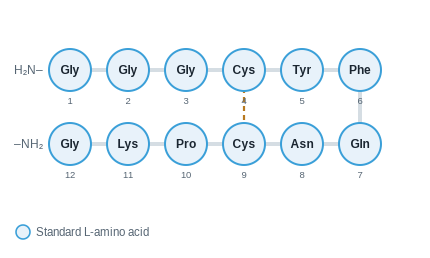
Terlipressin is a prodrug: it is lysine-vasopressin with a triglycyl extension that is cleaved off slowly in the circulation, releasing the active peptide over hours instead of minutes. That is what allows intermittent dosing where vasopressin requires a continuous infusion S1.
It acts mainly on V1 receptors on vascular smooth muscle, with much weaker activity at the V2 (water-retaining) receptors in the kidney. V1 receptors are dense in the splanchnic circulation — the vessels supplying the gut — so the drug constricts that bed preferentially.
That selectivity is the whole point in hepatorenal syndrome. In advanced liver disease the splanchnic vessels dilate massively, blood pools there, and the effective circulating volume reaching the kidneys collapses, so the kidneys shut down even though they are structurally intact. Constricting the splanchnic bed pushes that blood back into the systemic circulation, raising mean arterial pressure and renal perfusion, and kidney function improves S1S2.
The predictable harms come from the same vasoconstriction applied where it is not wanted: ischemia of the bowel, skin and digits, and pulmonary complications, including the respiratory failure that carries the boxed warning S1.
Legal status
- FDA: Approved (2022) for adults with hepatorenal syndrome with rapid reduction in kidney function (HRS-AKI). The label carries a Boxed Warning for serious or fatal respiratory failure S1.
- Compounding: an approved drug substance handled as a hospital injectable.
- DEA: Not a controlled substance.
- "Research use only" labels: not relevant; this is a prescription drug.
- WADA (sport): Not listed as prohibited.
- International (short): terlipressin has long been used in Europe and elsewhere for hepatorenal syndrome and variceal bleeding; indications vary by country.
What the research actually shows
Evidence: A. Terlipressin's US approval rests on a randomized placebo-controlled trial.
| Study | Design | People | Dose studied | Result |
|---|---|---|---|---|
| CONFIRM S2 | Double-blind, placebo-controlled RCT | 300 adults with type 1 hepatorenal syndrome | 1 mg IV every 6 hours (up to 2 mg) | More patients had reversal of hepatorenal syndrome; more respiratory failure and some deaths than placebo |
| Label S1 | Approved indication | HRS-AKI | 0.85–2 mg IV every 6 hours | Basis of approval, with Boxed Warning |
What we don't know for this page: the net benefit depends heavily on patient selection, which is why the label excludes those with significant breathing problems or severe liver failure.
Reported benefits
Improves kidney function (reverses hepatorenal syndrome) in a meaningful share of patients compared with placebo S2.
Side effects
Common: abdominal pain, nausea, diarrhea, and breathing problems S1. Serious: the Boxed Warning is respiratory failure, which can be fatal; the label also warns about worsening of circulation to organs and limbs, and fluid overload S1.
Dangers and red flags
- Respiratory failure (Boxed Warning). The reason careful selection and monitoring of oxygen are required S1.
- Ischemia. Like vasopressin, it can reduce blood flow to limbs and gut S1.
- Who should avoid it: people with hypoxia or worsening breathing until stable, and those with severe, advanced liver failure where harm may outweigh benefit, per the label S1.
Doses reported
We don't recommend sh*t. These are the doses studies, labels and harm-reduction sources report. That's information, not advice. Talk to a licensed clinician.
Terlipressin is given by IV in a hospital; there is no self-administered reconstitution, so the inline calculator does not apply.
| Source | Dose | Unit / route | Frequency | Timing | Duration | Titration / escalation | Context |
|---|---|---|---|---|---|---|---|
| S1 Label | 0.85–2 mg | mg, IV bolus | Every 6 hours | In hospital | Up to 14 days per label | Dose adjusted by response (serum creatinine) | HRS-AKI |
| S2 CONFIRM | 1 mg (up to 2 mg) | mg, IV bolus | Every 6 hours | ICU/ward | Study duration | Escalated if creatinine not improving | Hepatorenal syndrome trial |
Monitoring a doctor would order
Oxygen levels and breathing, kidney function (creatinine), fluid status, and signs of poor circulation to limbs or gut S1.
Bottom line
Terlipressin is an approved hospital drug that can reverse hepatorenal syndrome in advanced liver disease, with a randomized trial behind its US approval. It carries a Boxed Warning for respiratory failure and other serious ischemic risks, so patient selection and monitoring are central. It is a prescription medicine given by IV.