
Growth hormone & GH-axis peptides
Tesamorelin
Also called Egrifta, Egrifta SV, Egrifta WR, TH9507, GHRH(1-44)
- US status
- Approved
- DEA
- Not a controlled substance
- WADA
- S2.2.4 Growth hormone releasing factors (GHRH analogues); prohibited at all times
- Class
- Growth hormone & GH-axis peptides
Jump to doses reported ↓ Dose math calculator
What it is
Tesamorelin is a growth-hormone-releasing factor (a synthetic analog of GHRH(1-44)) given as a daily subcutaneous injection. It prompts the pituitary to release its own growth hormone, which lowers visceral (belly) fat. It is sold as Egrifta SV and Egrifta WR for one approved use: reducing excess abdominal fat in people with HIV-associated lipodystrophy S1S2. It is also sold on the grey market for body-composition and anti-aging use, which is off-label and unstudied for those purposes.
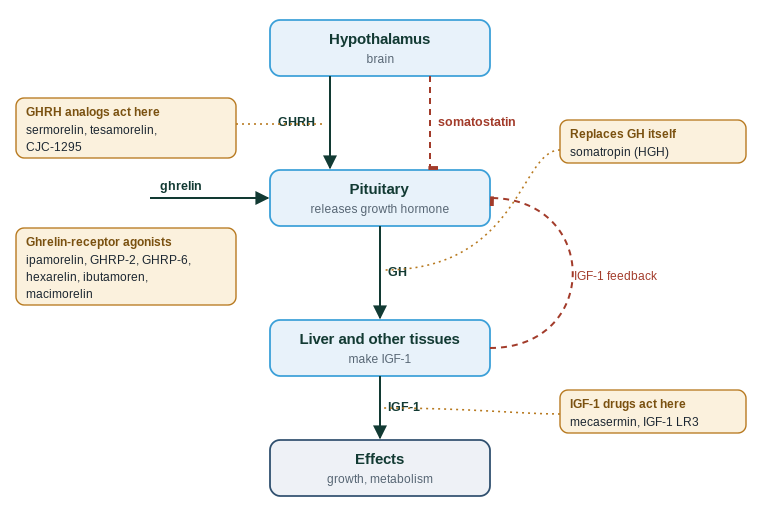
The growth-hormone axis, and where each drug class acts
How it works
Tesamorelin is a stabilized analog of GHRH(1-44), the hypothalamic hormone that tells the pituitary to release growth hormone; a trans-3-hexenoyl group on the N-terminus protects it from the DPP-4 enzyme that destroys natural GHRH within minutes. It binds GHRH receptors on pituitary somatotrophs, which release the body's own stored growth hormone; GH in turn raises IGF-1 from the liver S1S2.
Because it acts one step upstream of GH, release stays pulsatile and the normal feedback loops — somatostatin, and IGF-1 feeding back on the pituitary — remain in place, unlike injected somatropin which bypasses them.
The fat effect is GH's own: growth hormone is lipolytic, and visceral (intra-abdominal) fat is particularly GH-responsive, so raising endogenous GH pulses preferentially reduces visceral adipose tissue. In the phase 3 trials in HIV-associated lipodystrophy, visceral fat fell while subcutaneous fat was largely unchanged S3S4, and liver fat fell in a separate trial S5. The same GH action explains the side effects: insulin resistance and raised glucose, fluid retention, joint pain and carpal tunnel symptoms S1S2. The effect depends on continued dosing; visceral fat returns when it stops S4.
Legal status
- FDA: Approved (2010) for the reduction of excess abdominal fat in HIV-infected adults with lipodystrophy. The label notes it is not for general weight loss (it is weight-neutral) and that long-term cardiovascular safety is not established S1S2.
- Biologic, not compoundable: since March 23, 2020, tesamorelin acetate is a licensed biologic (deemed a BLA), so it is not eligible for the 503A or 503B compounding exemptions S6S7.
- DEA: Not a controlled substance.
- "Research use only" powder: grey-market tesamorelin is an unapproved, unlicensed biologic of unknown quality. See our explainer.
- WADA: Prohibited at all times under S2.2.4 as a GHRH analogue S8.
- International (short): Not reviewed for this page yet.
What the research actually shows
Evidence: A for the approved HIV-lipodystrophy use (two phase 3 trials plus a large pooled analysis). Evidence for other uses is thin.
| Study | Design | People | Dose studied | Result |
|---|---|---|---|---|
| Falutz 2007 S3 | Double-blind RCT, 26 weeks | 412 adults with HIV and abdominal fat | 2 mg daily vs placebo | Visceral adipose tissue −15.2% vs +5.0%; triglycerides fell; IGF-1 rose 81% |
| Falutz 2010 pooled S4 | Two phase 3 RCTs + 26-week extension | 806 adults | 2 mg daily | Visceral fat −15.4% at 26 weeks; benefit maintained to 52 weeks in continued users; generally well tolerated |
| Stanley 2019 S5 | Double-blind RCT, 12 months | 61 adults with HIV and fatty liver | 2 mg daily | Liver fat fraction fell (absolute −4.1%); 35% vs 4% reached <5% liver fat; no glucose worsening |
What we don't know: long-term cardiovascular safety (the label says it is not established) S1, and anything about the body-composition or anti-aging uses the grey market promotes.
Reported benefits
In trials: reduced visceral abdominal fat, improved lipids, and reduced liver fat in HIV patients; the fat returns if the drug is stopped S3S4S5. Benefits outside HIV-associated lipodystrophy are not established.
Side effects
Common (>5% in trials): joint pain (arthralgia), injection-site redness and itching, pain in an extremity, peripheral edema, muscle pain S1. These reflect fluid retention from the rise in growth hormone. Serious (label warnings): glucose intolerance and new diabetes (risk raised about 3-fold vs placebo in trials); raised IGF-1, so monitor and consider stopping if persistently high; fluid retention (including carpal tunnel syndrome); serious hypersensitivity reactions; and increased risk in acute critical illness S1.
Dangers and red flags
- Not for everyone (label contraindications): disruption of the hypothalamic-pituitary axis; active cancer (growth hormone is a growth factor); known hypersensitivity; and pregnancy S1.
- Diabetes risk. Tesamorelin raised the rate of elevated HbA1c versus placebo; glucose should be checked before and during use S1.
- Raised IGF-1. Persistent elevations are a reason to stop, especially if the response is weak S1.
- Product quality. Grey-market "research" tesamorelin is an unlicensed biologic of unknown identity, dose and sterility S6S7.
- Sport: prohibited at all times S8.
Doses reported
We don't recommend sh*t. These are the doses studies, labels and harm-reduction sources report. That's information, not advice. Talk to a licensed clinician.
Both approved presentations give the same daily growth-hormone-releasing effect but use different strengths, reconstitution and injection volumes, and the two are not interchangeable S1S2. All doses are subcutaneous into the abdomen, once daily.
| Source | Dose | Unit / route | Frequency | Reconstitution | Duration | Context |
|---|---|---|---|---|---|---|
| S1 Egrifta SV label | 1.4 mg (0.35 mL of reconstituted solution) | mg, subcutaneous | Once daily | 1 vial (2 mg) with 0.5 mL diluent | Long term | HIV lipodystrophy |
| S2 Egrifta WR label | 1.28 mg (0.16 mL of reconstituted solution) | mg, subcutaneous | Once daily | 1 vial (11.6 mg) with 1.3 mL diluent; one vial lasts 7 days | Long term | HIV lipodystrophy |
| S3 Falutz 2007 | 2 mg | mg, subcutaneous | Once daily | — | 26 weeks | Phase 3 (original formulation) |
| S4 Falutz 2010 | 2 mg | mg, subcutaneous | Once daily | — | Up to 52 weeks | Pooled phase 3 + extension |
| S5 Stanley 2019 | 2 mg | mg, subcutaneous | Once daily | — | 12 months | HIV + fatty liver |
The original trials used the 2 mg daily dose of the first formulation; the current Egrifta SV and WR labels deliver an equivalent effect at the lower reconstituted doses shown S1S2. No survey or harm-reduction source with numbers for non-pharmacy tesamorelin use was found that we could cite.
Open the dose math calculator →
Monitoring a doctor would order
From the label: glucose status before and during treatment (HbA1c, fasting glucose); IGF-1 levels (consider stopping if persistently high); eye monitoring in people with diabetes for retinopathy; and watching for fluid-retention symptoms and hypersensitivity S1.
Bottom line
Tesamorelin is an FDA-approved GHRH analog with solid phase 3 evidence for one thing: reducing visceral fat in HIV-associated lipodystrophy. It is a licensed biologic that cannot be compounded, the belly fat returns when it is stopped, and it raises blood sugar and IGF-1, which need monitoring. There is no evidence behind the body-composition and anti-aging uses the grey market sells, and those products are of unknown quality.
Sources
- [S1] EGRIFTA SV (tesamorelin) for injection. US prescribing information (DailyMed, Theratechnologies, published Jul 31 2026). Set ID 3d783378-b02d-4f19-99dd-0fc91a042224. (label)
- [S2] EGRIFTA WR (tesamorelin) for injection. US prescribing information (DailyMed, Theratechnologies, published Aug 03 2026). Set ID 839334d3-8c1d-4c26-9036-2ab524a6ea75. (label)
- [S3] Falutz J, et al. Metabolic effects of a growth hormone-releasing factor in patients with HIV. N Engl J Med. 2007;357:2359-2370. PMID 18057338. (rct)
- [S4] Falutz J, et al. Effects of tesamorelin (TH9507) in HIV-infected patients with excess abdominal fat: a pooled analysis of two phase 3 trials with safety extension. J Clin Endocrinol Metab. 2010;95:4291-4304. PMID 20554713. (rct)
- [S5] Stanley TL, et al. Effects of tesamorelin on non-alcoholic fatty liver disease in HIV: a randomised, double-blind trial. Lancet HIV. 2019;6:e821-e830. PMID 31611038. (rct)
- [S6] FDA. Revised Final List of Approved NDAs for Biological Products That Were Deemed to be BLAs on March 23, 2020 (lists tesamorelin acetate, Egrifta/Egrifta SV, former NDA 022505). (regulator)
- [S7] FDA. Notice to Compounders: Changes that affect compounding as of March 23, 2020. (regulator)
- [S8] World Anti-Doping Agency. 2026 Prohibited List, section S2.2.4. (regulator)