
SARMs & adjacent non-peptides
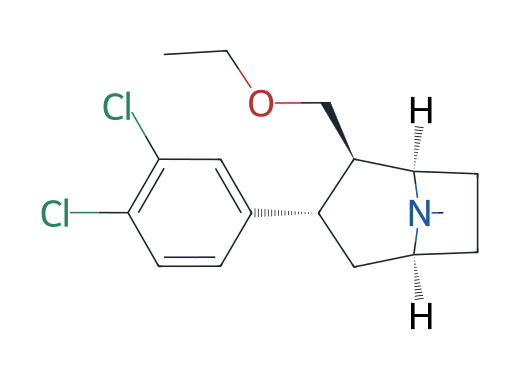
Tesofensine
Also called NS 2330, NS2330, Tesomet (tesofensine plus metoprolol)
- US status
- Not approved
- DEA
- Not a federally scheduled controlled substance
- WADA
- Not named on the Prohibited List; stimulants are prohibited in competition under S6, which also covers substances with similar chemical structure or biological effect
- Class
- SARMs & adjacent non-peptides
Jump to doses reported ↓ Dose math calculator
What it is
Tesofensine is a triple monoamine reuptake inhibitor: it blocks the reabsorption of noradrenaline, dopamine and serotonin at nerve endings, so all three signals stay in the synapse longer S1S4. It was built as a brain drug, for Parkinson disease and Alzheimer disease, and failed in both S4S5. Along the way trial participants lost weight, which redirected the whole programme: the same tablet was retested as an obesity drug, where appetite suppression and increased energy expenditure are the proposed mechanism S1S3. A combination tablet pairing tesofensine with the beta blocker metoprolol, intended to hold down the heart-rate rise, has been tested in rarer forms of obesity S6. It is a prescription-style oral tablet in development, not an approved medicine, and it reaches consumers through grey-market and overseas supply.
How it works
Tesofensine blocks the transporters that pull noradrenaline, dopamine and serotonin back into the nerve terminal after release. All three neurotransmitters therefore stay in the synapse longer and their signalling is amplified — the same class of action as a stimulant antidepressant, but across all three monoamines at once S1S4.
Applied to body weight, each arm contributes something:
- Serotonin and noradrenaline act on hypothalamic appetite circuits to reduce hunger and increase satiety. In a controlled study of appetite sensations, that is what was measured: participants reported less hunger and ate less S3.
- Noradrenaline also raises sympathetic tone, which increases resting energy expenditure, so fewer calories in meets slightly more calories out S1.
- Dopamine reduces the reward value of food, but it is also the arm responsible for the abuse-liability concern that attaches to dopamine reuptake inhibitors generally.
The same sympathetic activation produces the dose-limiting harms: raised heart rate and blood pressure, insomnia, dry mouth and mood changes. That is the explicit rationale for the Tesomet combination tablet, which adds the beta blocker metoprolol to hold down the heart-rate rise S6. The drug was designed for Parkinson and Alzheimer disease on the same monoamine mechanism and failed in both S4S5; the weight effect was an incidental finding redirected into an obesity programme, and the main obesity trial later carried an expression of concern S1S2.
Legal status
- FDA: Not approved in the US for any use. Development has not produced a published phase 3 obesity result S1S6.
- Compounding: there is no approved US product to compound from, and tesofensine is not an approved drug substance.
- DEA: Not a federally scheduled controlled substance. That is a statement about the drug schedules, not a statement that it is legal to sell for human use: an unapproved new drug marketed for weight loss is unlawful to sell regardless of scheduling.
- "Research use only" products: tesofensine sold as research powder or capsules has unverified content. See our explainer.
- WADA: tesofensine is not named on the Prohibited List. The S6 stimulants class is prohibited in competition and is written to cover substances with a similar chemical structure or similar biological effect to those listed, so a dopamine-noradrenaline reuptake inhibitor is the kind of drug an athlete must clear with their anti-doping organization rather than assume is permitted S8.
- International (short): Not reviewed for this page yet.
What the research actually shows
Evidence: B. Real randomized human trials exist, including a phase 2 obesity trial that produced some of the largest weight losses seen from a single pill at the time, and two Parkinson disease trials that did not meet their endpoints. One important caveat has to be stated plainly: the Lancet obesity trial carries a journal expression of concern, a formal notice that questions were raised about the work S2. We report the published result and the notice together.
| Study | Design | People | Dose studied | Result |
|---|---|---|---|---|
| Astrup 2008 S1S2 | Phase 2, randomized, double-blind, placebo-controlled, 5 Danish centres | 203 adults with obesity (BMI 30-40), all on an energy-restricted diet | 0.25 mg, 0.5 mg or 1.0 mg once daily by mouth | After 24 weeks, mean weight loss 4.5%, 9.2% and 10.6% versus 2.0% on diet plus placebo (p<0.0001). Most common adverse effects: dry mouth, nausea, constipation, hard stools, diarrhoea, insomnia. Heart rate rose 7.4 beats per minute in the 0.5 mg group; blood pressure was not significantly raised at 0.25 and 0.5 mg. The journal later published an expression of concern about this paper S2 |
| Gilbert 2012 S3 | Randomized, placebo-controlled study of appetite | Adults with obesity | Not stated in the abstract | Examined how tesofensine changes appetite sensations, supporting appetite suppression as part of the mechanism |
| Huynh 2022 (Tesomet) S6 | Randomized, double-blind, placebo-controlled, 24 weeks; primary endpoint was safety | 21 adults with hypothalamic obesity | Tesomet 0.5 mg tesofensine plus 50 mg metoprolol daily | Additional mean weight change of -6.3% versus placebo (95% CI -11.3 to -1.3; p=0.017); 8 of 13 on Tesomet reached at least 5% weight loss versus 1 of 8 on placebo. No significant difference in heart rate or blood pressure. Adverse effects mostly mild: sleep disturbance 50% versus 13%, dry mouth 43% versus 0%, headache 36% versus 0%; one treatment-related serious adverse event, worsening of pre-existing anxiety |
| Hauser 2007 S4 | Randomized, double-blind, placebo-controlled proof-of-concept | 261 people with early Parkinson disease | 0.25, 0.5 or 1.0 mg daily for 14 weeks | No significant benefit over placebo on the Parkinson rating scale at any dose. Constipation, insomnia and dry mouth were the common adverse effects; decreased body weight and raised heart rate were common at 1.0 mg |
| Rascol 2008 (ADVANS) S5 | Pilot phase 2, randomized, double-blind, placebo-controlled | People with advanced Parkinson disease and motor fluctuations | 0.125, 0.25, 0.5 or 1 mg once daily for 14 weeks | Modest changes at some doses with no consistent dose-response; gastrointestinal and neuropsychiatric adverse effects more frequent than placebo, especially at higher doses |
What we don't know: whether the weight loss holds up in phase 3, since no phase 3 obesity trial result is published; what happens beyond about 24 weeks; and what the cardiovascular picture looks like at scale, which is the question that has ended other appetite drugs acting on monoamines. A Prader-Willi syndrome study of the combination tablet was withdrawn before enrolling S7.
Reported benefits
In the phase 2 obesity trial, weight loss of roughly 9 to 11% at the 0.5 and 1.0 mg doses over 24 weeks, against 2.0% on diet plus placebo, with the stated caveat about the expression of concern S1S2. In hypothalamic obesity, an extra 6.3% weight loss on the combination tablet over 24 weeks S6. In Parkinson disease, no meaningful benefit S4S5.
Side effects
Common (from the trials): dry mouth, nausea, constipation, hard stools, diarrhoea and insomnia S1; sleep disturbance, dry mouth and headache in the combination trial S6; constipation, insomnia and dry mouth in the Parkinson trial, with decreased body weight and raised heart rate at the 1 mg dose S4. Serious: raised heart rate is the signal that shaped the development programme, by 7.4 beats per minute at 0.5 mg in the obesity trial, which is why a beta blocker was later combined with it S1S6. Neuropsychiatric effects were more frequent than placebo in advanced Parkinson disease S5, and the combination trial recorded one treatment-related serious adverse event, worsening of pre-existing anxiety S6.
Dangers and red flags
- Heart rate and the cardiovascular question. A drug that raises heart rate and acts on noradrenaline and dopamine belongs to the class that has produced the most serious safety withdrawals in obesity medicine; here it was serious enough that developers paired it with a beta blocker S1S6.
- Mood and sleep. Insomnia, sleep disturbance and neuropsychiatric events appear across trials, and anxiety worsening was the one treatment-related serious event in the combination study S1S5S6.
- An expression of concern sits on the headline paper. The best-known tesofensine result carries a formal journal notice; it should not be cited as settled S2.
- No approved product means no quality control. Tablets or powder bought outside a regulated supply chain have unverified identity and dose, and this drug is active at fractions of a milligram, where a labelling error is the whole dose S1.
- Drug interactions. The published trials tested tesofensine on its own or with metoprolol S1S6; a serotonin and noradrenaline reuptake inhibitor taken alongside antidepressants or other serotonergic medicines raises interaction questions that these trials did not examine.
- Sport: not named on the Prohibited List, but plausibly captured by the in-competition stimulants class; clear it with an anti-doping organization rather than assume S8.
Doses reported
We don't recommend sh*t. These are the doses studies, labels and harm-reduction sources report. That's information, not advice. Talk to a licensed clinician.
There is no FDA label (not approved), so there is no label dose. The rows below are trial doses, all oral tablets taken once daily. Tesofensine is taken by mouth, so the reconstitution calculator does not apply.
| Source | Dose | Unit / route | Frequency | Timing | Duration | Titration / escalation | Context |
|---|---|---|---|---|---|---|---|
| S1S2 Astrup 2008 | 0.25 mg, 0.5 mg or 1.0 mg | mg, oral | Once daily | — | 24 weeks | Fixed dose groups after a 2-week run-in | Adults with obesity on an energy-restricted diet; paper carries an expression of concern |
| S6 Huynh 2022 (Tesomet) | 0.5 mg tesofensine with 50 mg metoprolol | mg, oral combination tablet | Daily | — | 24 weeks | Fixed dose | Adults with hypothalamic obesity; primary endpoint was safety |
| S4 Hauser 2007 | 0.25, 0.5 or 1.0 mg | mg, oral | Once daily | — | 14 weeks | Fixed dose groups | Early Parkinson disease; no significant benefit |
| S5 Rascol 2008 (ADVANS) | 0.125, 0.25, 0.5 or 1 mg | mg, oral | Once daily | — | 14 weeks | Fixed dose groups | Advanced Parkinson disease with motor fluctuations |
Monitoring a doctor would order
No guideline exists for an unapproved drug. The trials monitored heart rate and blood pressure as the central safety measures, along with weight, body composition and mood and sleep reporting S1S6. In a person taking it outside a trial, heart rate and blood pressure are the measurements the published record points to, and no formal monitoring standard exists.
Bottom line
Tesofensine is an unapproved triple monoamine reuptake inhibitor that failed as a Parkinson disease drug and was redirected to obesity, where a 203-person phase 2 trial reported 9 to 11% weight loss over 24 weeks, a result whose journal has since published an expression of concern. A combination with metoprolol added about 6% weight loss over placebo in hypothalamic obesity. Its consistent pharmacological signature is a rise in heart rate plus insomnia, dry mouth and gastrointestinal effects, no phase 3 obesity result is published, and bought outside a regulated supply chain it is a sub-milligram drug of unverified content.
Sources
- [S1] Astrup A, Madsbad S, Breum L, Jensen TJ, Kroustrup JP, Larsen TM. Effect of tesofensine on bodyweight loss, body composition, and quality of life in obese patients: a randomised, double-blind, placebo-controlled trial. Lancet. 2008;372(9653):1906-1913. PMID 18950853. ClinicalTrials.gov NCT00394667. (rct)
- [S2] Expression of concern: Effect of tesofensine on bodyweight loss, body composition, and quality of life in obese patients. Lancet. 2013;381(9873):1167. doi:10.1016/S0140-6736(13)60778-3. (review)
- [S3] Gilbert JA, Gasteyger C, Raben A, Meier DH, Astrup A, Sjodin A. The effect of tesofensine on appetite sensations. Obesity (Silver Spring). 2012;20(3):553-561. PMID 21720440. (rct)
- [S4] Hauser RA, Salin L, Juhel N, Konyago VL. Randomized trial of the triple monoamine reuptake inhibitor NS 2330 (tesofensine) in early Parkinson's disease. Mov Disord. 2007;22(3):359-365. PMID 17149725. (rct)
- [S5] Rascol O, et al. Tesofensine (NS 2330), a monoamine reuptake inhibitor, in patients with advanced Parkinson disease and motor fluctuations: the ADVANS Study. Arch Neurol. 2008;65(5):577-583. PMID 18474731. ClinicalTrials.gov NCT00148512. (rct)
- [S6] Huynh K, et al. Randomized controlled trial of Tesomet for weight loss in hypothalamic obesity. Eur J Endocrinol. 2022;186(6):687-700. PMID 35294397. (rct)
- [S7] ClinicalTrials.gov. Study of Tesomet With Open-label Extension in Subjects With Prader-Willi Syndrome, NCT05198362 (withdrawn). (regulator)
- [S8] World Anti-Doping Agency. 2026 Prohibited List, section S6 (stimulants, prohibited in competition). (regulator)