
Immune peptides
Thymosin alpha-1
Also called Ta1, Tα1, thymalfasin, Zadaxin, thymosin alpha 1 acetate
- US status
- Not approved
- DEA
- Not a controlled substance
- WADA
- Not named; S0 status depends on approval abroad, which we did not confirm
- Class
- Immune peptides
Jump to doses reported ↓ Dose math calculator
What it is
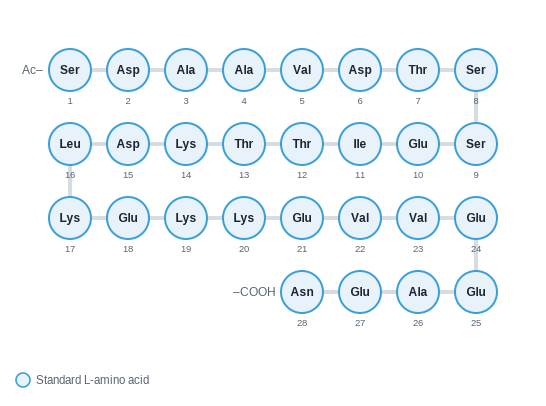
Thymosin alpha-1 (thymalfasin) is a 28-amino-acid peptide originally isolated from a cow thymus extract and now made synthetically S9. The thymus is the gland where T cells, a key type of immune cell, mature. In lab studies thymosin alpha-1 affects T-cell maturation, raises immune signals such as interferon-gamma and interleukin-2, and activates natural killer cells S9. It has been studied as an immune booster for chronic hepatitis B and for sepsis, mostly in China S5S6S7. Online it is sold as an injectable "immune" peptide.
How it works
Thymosin alpha-1 is a 28-amino-acid peptide originally isolated from thymus extract. It is an immune modulator rather than a stimulant: it does not kill pathogens or block a receptor on a disease target, it changes how immune cells respond.
The mechanism described in the laboratory literature works mainly through Toll-like receptors (TLR2 and TLR9) on dendritic cells and monocytes. Activating them pushes dendritic cells to mature, which in turn S9:
- supports maturation and differentiation of T cells, the cells the thymus normally produces;
- shifts the response toward Th1, raising interferon-gamma and interleukin-2;
- increases natural killer cell activity;
- in some settings, damps excessive inflammatory signalling rather than adding to it, which is the rationale for testing it in sepsis, where the problem is a dysregulated response rather than too little of one.
That dual framing is also why the clinical results are mixed. In chronic hepatitis B the aim is restoring an immune response the body failed to mount S7S8S9; in sepsis the aim is correcting immune paralysis, and the large placebo-controlled trial in that setting is the key evidence S5S6. The mechanism is plausible and reasonably well characterized in cells; what it does in a healthy person's immune system — the online "immune support" use — has not been studied, and there is no approved US product S1S2S3.
Legal status
- FDA: Not approved for any use in the US.
- Compounding: FDA had placed it in Category 2, saying it "may pose significant risk for immunogenicity," has "complexities with regard to peptide-related impurities and API characterization," and that the "safety-related information is inadequate" S1. The nomination was later withdrawn and FDA lists it with withdrawn nominations S1. Before that, on Dec 4 2024, FDA's compounding advisory committee voted 17 to 4 against putting either form on the 503A bulks list; members voting no cited "no compelling evidence demonstrating clinical effectiveness and safety" for the uses reviewed S2. It is not among the six peptides in HHS's October 2026 draft policy S3.
- DEA: Not a controlled substance.
- "Research use only" products: see our explainer.
- WADA: Not named on the 2026 List. S0 covers substances with no current approval by any government health authority S4. Thymosin alpha-1 has been marketed abroad under the name Zadaxin S9, but we did not confirm a current foreign approval from a primary regulator source, so we can't say whether S0 applies.
What the research actually shows
Evidence: B. There are genuine randomized trials. The biggest and best, a double-blind phase 3 trial of 1,106 sepsis patients, found no effect on survival S5. The hepatitis B trials are small and mixed S7S8.
| Study | Design | People | Dose studied | Result |
|---|---|---|---|---|
| TESTS, Wu et al 2025 S5 | Double-blind, placebo-controlled phase 3, 22 centers in China | 1,106 adults with sepsis (1,089 analyzed) | 1.6 mg SC every 12 hours for 7 days | 28-day death rate 23.4% vs 24.1% on placebo (hazard ratio 0.97, 95% CI 0.76 to 1.24): no difference. Adverse events 66.4% vs 67.6%; serious adverse events 26.8% vs 29.3% |
| ETASS, Wu et al 2013 S6 | Single-blind, randomized, controlled (no placebo), 6 hospitals in China | 361 adults with severe sepsis | Dose not stated in the abstract | 28-day death rate 26.0% vs 35.0% (relative risk 0.74, 95% CI 0.54 to 1.02): borderline, and not confirmed by TESTS. No serious drug-related adverse events recorded |
| You et al 2006 S7 | Randomized vs interferon alpha, plus historical controls | 62 adults with HBeAg-positive chronic hepatitis B | 1.6 mg SC twice a week for 6 months | Complete response 31.0% vs 45.5% on interferon at end of treatment, 48.3% vs 27.3% six months later; neither difference significant |
| Yang et al 2008 S8 | Meta-analysis of 4 randomized trials vs interferon | 199 adults with chronic hepatitis B | 6 months of treatment | Worse than interferon at end of treatment; better 6 months after stopping |
| Chien et al 2004 S9 | Review | 7 randomized trials of monotherapy in chronic hepatitis B | 1.6 mg twice weekly for 6 months | Higher sustained response than untreated controls; benefit tends to appear after treatment ends |
What we don't know: whether it helps healthy people's immunity, recovery or "immune resilience" (not tested in any trial we found), and why the sepsis results reversed between the smaller and larger trial.
Reported benefits
- Chronic hepatitis B: delayed responses comparable to or better than interferon six months after treatment in small trials and a meta-analysis S7S8S9.
- Sepsis: no survival benefit in the definitive phase 3 trial S5.
- General immune support: no trial in healthy people.
Side effects
Common: in TESTS, adverse events were as common on placebo as on the drug (66.4% vs 67.6%) S5. The abstracts of the smaller trials do not give rates. Serious: serious adverse events in TESTS were 26.8% on the drug vs 29.3% on placebo, in people with sepsis S5. ETASS recorded no serious drug-related adverse events S6. FDA still describes the safety information as inadequate for compounded use and flags a significant risk of immune reactions S1.
Dangers and red flags
- The best trial was negative. Claims built on ETASS or older hepatitis trials skip TESTS S5.
- Immune reactions and impurities: FDA's concern for compounded products S1.
- FDA advisers said no. 17 of 21 votes were against compounding access S2.
- Product quality. Grey-market vials are not checked for identity, purity or sterility.
- Who should avoid it: no evidence base for pregnancy, breastfeeding or children. People with autoimmune disease or organ transplants should know it is designed to stimulate the immune system S9, with no safety data in those groups that we found.
Doses reported
We don't recommend sh*t. These are the doses studies, labels and harm-reduction sources report. That's information, not advice. Talk to a licensed clinician.
There is no US label. The schedules below are trial arms. The TESTS authors note that the "conventional therapeutic dose" in cancer and viral hepatitis is 1.6 mg twice weekly, although the drug's half-life is only about 1.5 hours S5.
| Source | Population | Dose | Route | Frequency and timing | Duration | Titration or escalation | Cite |
|---|---|---|---|---|---|---|---|
| TESTS phase 3 | 1,106 adults with sepsis | 1.6 mg (lyophilized powder dissolved in 1 mL sterile water) | Subcutaneous | Every 12 hours | 7 days | None | S5 |
| You et al 2006 | 29 adults with HBeAg-positive chronic hepatitis B | 1.6 mg | Subcutaneous | Twice a week | 6 months, then 6 months off-treatment follow-up | None | S7 |
| Chien et al 2004 (review of 7 trials) | Adults with chronic hepatitis B | 1.6 mg | Not stated in the abstract | Twice a week | 6 months | None reported | S9 |
| ETASS | 181 adults with severe sepsis | Not stated in the abstract | — | — | — | — | S6 |
We found no peer-reviewed survey of community use, so we report no community doses.
Open the dose math calculator →
Monitoring a doctor would order
No US guideline exists for this unapproved drug. We found no source naming specific monitoring.
Bottom line
Thymosin alpha-1 is one of the better-studied peptides on this site, which is exactly why the answer is clear: in a large, well-run sepsis trial it did nothing for survival, and its hepatitis B results come from small, older trials with mixed results. FDA's advisers voted 17 to 4 against compounding it. As a general "immune booster" for healthy people, it has never been tested.
Sources
- [S1] FDA. Certain Bulk Drug Substances for Use in Compounding that May Present Significant Safety Risks (entry: Thymosin-alpha 1 (Ta1), 'Bulk drug substances nominated but withdrawn'). Content current as of 04/22/2026. (regulator)
- [S2] FDA. Pharmacy Compounding Advisory Committee, December 4, 2024: Final summary minutes (thymosin alpha-1 free base and acetate: Yes 4, No 17, Abstain 0). (regulator)
- [S3] HHS. Enforcement Discretion Policy Regarding 503A Compounding Using Certain Peptide Bulk Drug Substances, Appendix A (six listed peptides; thymosin alpha-1 not among them). Policy PDF linked from FR Doc 2026-22192. (regulator)
- [S4] World Anti-Doping Agency. 2026 Prohibited List, section S0 (Non-approved substances). (regulator)
- [S5] Wu J, et al. The efficacy and safety of thymosin α1 for sepsis (TESTS): multicentre, double blinded, randomised, placebo controlled, phase 3 trial. BMJ. 2025;388:e082583 (correction: BMJ 2025;389:r1098). PMID 39814420. ClinicalTrials.gov NCT02867267. (rct)
- [S6] Wu J, et al. The efficacy of thymosin alpha 1 for severe sepsis (ETASS): a multicenter, single-blind, randomized and controlled trial. Crit Care. 2013;17(1):R8. PMID 23327199. ClinicalTrials.gov NCT00711620. (rct)
- [S7] You J, et al. Efficacy of thymosin alpha-1 and interferon alpha in treatment of chronic viral hepatitis B: a randomized controlled study. World J Gastroenterol. 2006;12(41):6715-21. PMID 17075991. (rct)
- [S8] Yang YF, et al. Comparison of the efficacy of thymosin alpha-1 and interferon alpha in the treatment of chronic hepatitis B: a meta-analysis. Antiviral Res. 2008;77(2):136-41. PMID 18078676. (meta-analysis)
- [S9] Chien RN, et al. Thymalfasin for the treatment of chronic hepatitis B. Expert Rev Anti Infect Ther. 2004;2(1):9-16. PMID 15482167. (review)