
Immune peptides
Thymulin
Also called FTS (facteur thymique sérique), serum thymic factor, nonathymulin, thymulin acetate, zinc-thymulin
- US status
- Not approved
- DEA
- Not a controlled substance
- WADA
- Not named; falls under the S0 catch-all if no health authority has approved it
- Class
- Immune peptides
Jump to doses reported ↓ Dose math calculator
What it is
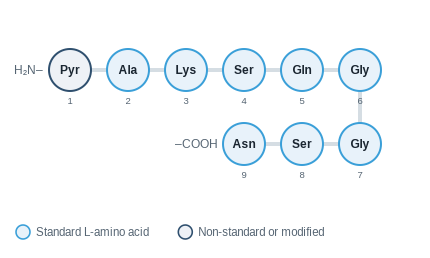
Thymulin is a small hormone made by the thymus, the immune organ behind the breastbone where T cells mature S3S4. It is a chain of nine amino acids (pGlu-Ala-Lys-Ser-Gln-Gly-Gly-Ser-Asn) that only works when it holds a zinc atom S3S9. It was discovered in the early 1970s and first called FTS, "serum thymic factor" S3S4. A synthetic version, nonathymulin, was tested in small trials in the 1980s S6S7. It was never approved anywhere we could find, and it is now sold online as a research peptide.
How it works
- T-cell maturation. Thymulin helps immature T cells develop and boosts several T-cell functions, mainly in animals or people whose thymus is partly missing or not working S3.
- Needs zinc. Without zinc it is inactive. In people with mild zinc deficiency, blood thymulin activity fell and came back with zinc supplements S5.
- Talks to the hormone system. Thymulin release is influenced by pituitary and other hormones, and thymulin in turn acts on the pituitary S4.
- Calms inflammation (in animals). In rodents it had anti-inflammatory and pain-relieving effects in the brain S4. In a mouse study, thymulin, which falls with age, dampened inflammatory cytokines (IL-1, IL-6, TNF-α) by blocking NF-κB and made tumors respond better to an immunotherapy drug in older mice S8.
Legal status
- FDA: Not approved. "Thymulin acetate" is in 503A Category 3 (nominated without adequate supporting information) on FDA's 503A bulks nominations list S1. That gives compounding pharmacies no enforcement discretion to use it.
- DEA: Not a controlled substance.
- WADA: Not named, but it falls under the S0 catch-all for substances not approved by any health authority S2.
- International (short): We found no approval anywhere.
What the research actually shows
Evidence: C. Two small randomized trials in rheumatoid arthritis and one in multiple sclerosis, all from the 1980s, plus decades of lab and animal work.
| Study / source | Design | People | Dose studied | Result |
|---|---|---|---|---|
| Amor 1987 S6 | Two randomized, double-blind, placebo-controlled trials | People with rheumatoid arthritis | Nonathymulin 1, 5 or 10 mg/day | 5 mg was the most effective dose: global improvement in 56% vs 17% on placebo; minimal side effects |
| Roullet 1989 S7 | Randomized, double-blind, placebo-controlled pilot | 40 people with active, moderately disabling multiple sclerosis | Nonathymulin, subcutaneous (dose not stated in the abstract) | No benefit on disability scores after 6 months of treatment and 6 months of follow-up; no significant side effects |
| Prasad 1988 S5 | Human study, before and after zinc | 14 mildly zinc-deficient adults | No thymulin given (zinc supplements) | Thymulin activity was low in zinc deficiency and recovered with zinc |
| Kanemaru 2026 S8 | Mouse experiments plus human cell data | Aged mice; human immune cells | Not stated in the abstract | Thymulin suppressed age-related inflammatory immune cells and improved tumor control with anti-PD-L1 therapy in older mice |
What we don't know: whether injected thymulin does anything useful in healthy adults, the right dose, or long-term safety. The only human trials are small, decades old and in two diseases, with one positive and one negative result.
Reported benefits
- Rheumatoid arthritis: one pair of small trials found improvement at 5 mg/day S6.
- Multiple sclerosis: no benefit S7.
- "Anti-aging," immunity and inflammation claims: based on animal and lab work S4S8, not on human trials.
Side effects
The human trials reported minimal or no significant side effects S6S7. Those trials were small and short, so rare or long-term effects are unknown.
Dangers and red flags
- No approved product. Research-peptide thymulin is of unknown purity, strength and sterility.
- Zinc matters. The hormone is inactive without zinc, and products sold online may not say whether they contain the zinc-bound form S3.
- Immune effects are not one-way. It acts on T cells and inflammation S3S8; effects in people with autoimmune disease, cancer or transplants are not well studied beyond the trials above.
- Sport. Falls under WADA's S0 catch-all S2.
Doses reported
We don't recommend sh*t. These are the doses studies, labels and harm-reduction sources report. That's information, not advice. Talk to a licensed clinician.
Thymulin is not approved, so the calculator below starts blank: no vial, water or dose is prefilled.
| Source | Population | Dose | Route | Frequency and timing | Duration | Titration or escalation | Cite |
|---|---|---|---|---|---|---|---|
| Amor 1987 | Rheumatoid arthritis | Nonathymulin 1, 5 or 10 mg | Not stated in the abstract | Daily | Not stated in the abstract | Three fixed-dose arms; 5 mg performed best | S6 |
| Roullet 1989 | Multiple sclerosis | Not stated in the abstract | Subcutaneous | Not stated in the abstract | 6 months | None | S7 |
We found no peer-reviewed source for the doses used in online communities, so we report none.
Open the dose math calculator →
Monitoring a doctor would order
No established monitoring, because there is no approved use. In the trials, investigators followed disease activity and immune markers such as T-cell subsets S6.
Bottom line
Thymulin is a zinc-dependent thymus hormone that helps T cells mature and, in animals, calms inflammation. A synthetic version helped rheumatoid arthritis in one small pair of 1980s trials and did nothing for multiple sclerosis. There is no approved product, FDA has placed it in a category that gives compounders no cover, and anti-aging claims rest on animal work.
Sources
- [S1] U.S. FDA. Bulk Drug Substances Nominated for Use in Compounding Under Section 503A of the FD&C Act (Category 3: Thymulin acetate). Updated May 14, 2026. (regulator)
- [S2] World Anti-Doping Agency. 2026 Prohibited List, section S0 (Non-approved substances). (regulator)
- [S3] Bach JF, Dardenne M. Thymulin, a zinc-dependent hormone. Med Oncol Tumor Pharmacother. 1989;6:25-29. PMID 2657247. (review)
- [S4] Reggiani PC, et al. The thymus-neuroendocrine axis: physiology, molecular biology, and therapeutic potential of the thymic peptide thymulin. Ann N Y Acad Sci. 2009;1153:98-106. PMID 19236333. (review)
- [S5] Prasad AS, et al. Serum thymulin in human zinc deficiency. J Clin Invest. 1988;82:1202-1210. PMID 3262625. (human-observational)
- [S6] Amor B, et al. Nonathymulin in rheumatoid arthritis: two double blind, placebo controlled trials. Ann Rheum Dis. 1987;46:549-554. PMID 3310925. (rct)
- [S7] Roullet E, et al. Nonathymulin treatment of multiple sclerosis: double-blind pilot study. Acta Neurol Scand. 1989;80:575-578. PMID 2618585. (rct)
- [S8] Kanemaru H, et al. Thymulin restrains age-associated myeloid inflammation and enhances cancer immunotherapy. Nat Commun. 2026;17. doi:10.1038/s41467-026-75383-0. PMID 42481458. (animal)
- [S9] PubChem. Thymulin, CID 71300623 (sequence pGlu-Ala-Lys-Ser-Gln-Gly-Gly-Ser-Asn). (database)