
GLP-1 & incretin drugs (approved)
Tirzepatide
Also called Mounjaro, Zepbound, tirz, compounded tirzepatide
- US status
- Approved
- DEA
- Not a controlled substance
- WADA
- Not on the 2026 Prohibited List
- Class
- GLP-1 & incretin drugs (approved)
Jump to doses reported ↓ Dose math calculator
What it is
Tirzepatide is a once-weekly injected peptide that activates two gut-hormone receptors, GIP and GLP-1. It lowers appetite, slows stomach emptying and improves blood sugar control. It is sold as Zepbound (weight and sleep apnea) and Mounjaro (type 2 diabetes), in single-dose pens, single-dose vials, multi-dose vials and the multi-dose KwikPen S1S2.
How it works
Tirzepatide is a single 39-amino-acid peptide that activates two gut-hormone receptors, GIP and GLP-1. A fatty-acid chain attached to the backbone binds albumin in the blood, which is what stretches its action to a week S1S2.
- The GLP-1 arm increases insulin release and suppresses glucagon when glucose is high, slows gastric emptying, and acts on hypothalamic and hindbrain appetite circuits so people feel full sooner and eat less.
- The GIP arm is the second incretin. It adds to the meal-time insulin response, and on current evidence contributes to the appetite and body-weight effect through receptors in the brain and to fuel handling in fat tissue. Tirzepatide is biased toward the GIP receptor — it binds it more like the natural hormone than it does GLP-1 S1.
Why the pairing produces more weight loss than a GLP-1 drug alone is not fully resolved mechanistically, but the head-to-head trial against semaglutide in obesity confirmed it does S5. The clinical consequences follow the mechanism: better glucose control without the low-sugar risk insulin carries alone S4, weight reduction S3, improvement in obstructive sleep apnea driven by the weight change S6, and gastrointestinal side effects — nausea, vomiting, constipation — that come directly from slowed gastric emptying and are the reason doses are raised in steps S1S2. Rodent thyroid C-cell tumors with this drug class are the basis of the boxed warning S1.
Legal status
- FDA: Approved. Zepbound, with diet and exercise, for long-term weight reduction in adults with obesity (or overweight plus a weight-related condition) and for moderate to severe obstructive sleep apnea in adults with obesity S1. Mounjaro for glucose control in type 2 diabetes in adults and children 10 and older, and to reduce major CV events in adults with T2D at high CV risk S2. The label says not to combine it with other tirzepatide products or any GLP-1 drug S1.
- Compounding: Tirzepatide came off FDA's shortage list. The 503A grace period has ended; for 503B outsourcing facilities it ran until Mar 19 2025 S8. FDA reports products labeled as "compounded tirzepatide" carrying the names of pharmacies that do not exist or did not make them S7.
- DEA: Not a controlled substance.
- "Research use only" powder: not a legal route to a human-use drug; see our explainer.
- WADA: Not on the 2026 list S9.
- International (short): Not reviewed for this page yet.
What the research actually shows
Evidence: A.
| Study | Design | People | Dose studied | Result |
|---|---|---|---|---|
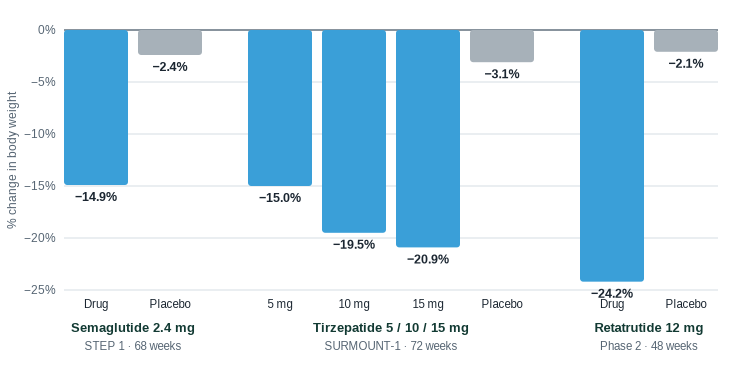
| SURMOUNT-1 S3 | Double-blind RCT, 72 weeks | 2,539 adults with obesity/overweight, no diabetes | 5, 10 or 15 mg weekly vs placebo | Weight change −15.0% / −19.5% / −20.9% vs −3.1%; ≥20% loss in 50% (10 mg) and 57% (15 mg) vs 3% |
| SURPASS-2 S4 | Open-label RCT, 40 weeks | 1,879 adults with type 2 diabetes | 5, 10, 15 mg vs semaglutide 1 mg | HbA1c −2.01 to −2.30 points vs −1.86; more weight loss than semaglutide 1 mg |
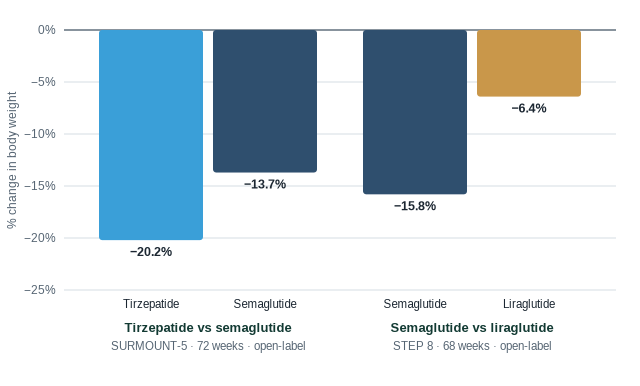
| SURMOUNT-5 S5 | Open-label RCT, 72 weeks | 751 adults with obesity, no diabetes | Max tolerated 10/15 mg vs semaglutide 1.7/2.4 mg | −20.2% vs −13.7% body weight |
| SURMOUNT-OSA S6 | Two double-blind RCTs, 52 weeks | Adults with moderate-severe sleep apnea and obesity | Max tolerated 10/15 mg vs placebo | Apnea-hypopnea index −25.3 vs −5.3 events/hour (trial 1, no CPAP); −29.3 vs −5.5 (trial 2, on CPAP) |
What we don't know: effects beyond a few years; what happens to weight after stopping in routine care; whether non-pharmacy "tirzepatide" contains what it claims (untested) S7.
Mean body-weight change in the pivotal placebo-controlled trials
Head-to-head trials: mean body-weight change
Reported benefits
In trials: large weight loss, better blood sugar control than semaglutide 1 mg in T2D, fewer sleep-apnea events S3S4S6. Mounjaro carries a CV-risk-reduction indication in T2D S2.
Side effects
Common (≥5% in Zepbound trials): nausea, diarrhea, vomiting, constipation, belly pain, indigestion, injection-site reactions, fatigue, allergic (hypersensitivity) reactions, burping, hair loss, reflux S1. In SURPASS-2, nausea hit 17–22%, diarrhea 13–16% and vomiting 6–10% on tirzepatide S4. Serious (label warnings): thyroid C-cell tumors in rats (boxed warning; human risk unknown), severe GI reactions, acute kidney injury from dehydration, gallbladder disease, acute pancreatitis, serious allergic reactions, low blood sugar with insulin or sulfonylureas, diabetic retinopathy complications in T2D, sudden loss of vision in one eye from NAION (non-arteritic anterior ischemic optic neuropathy; added to the label 11/2026), and aspiration during anesthesia or sedation S1S2.
Dangers and red flags
- Fake "compounded" products with made-up or misused pharmacy names S7.
- Dosing beyond the label: FDA has adverse-event reports, some serious, that may be linked to compounded semaglutide or tirzepatide given above label doses, more often, or with faster dose increases than the label allows. Its separate dosing-error reports (unit/mL mix-ups) involved compounded semaglutide vials S7. Multi-dose label vials have their own concentrations (see table); a non-label vial at a different strength changes every number.
- Birth control pills: tirzepatide can make oral contraceptives less reliable. The label advises switching to a non-oral method, or adding a barrier method, for 4 weeks after starting and after each dose increase S1.
- Who should not use it (label): personal or family history of medullary thyroid carcinoma or MEN 2; prior serious allergy to tirzepatide S1. Not recommended in severe gastroparesis S1. Stop if pregnancy is recognized S1.
- Don't combine with semaglutide or any other GLP-1 drug S1.
Doses reported
We don't recommend sh*t. These are the doses studies, labels and harm-reduction sources report. That's information, not advice. Talk to a licensed clinician.
| Source | Dose | Frequency | Duration | Context |
|---|---|---|---|---|
| S1 Zepbound label | Start 2.5 mg, then 5 mg; may rise in 2.5 mg steps | Once weekly, subcutaneous | ≥4 weeks per step | 2.5 mg is a starting dose only, not a maintenance dose |
| S1 Zepbound label | Maintenance 5, 10 or 15 mg (max 15 mg) | Once weekly | Long term | Weight reduction and maintenance |
| S1 Zepbound label | 10 or 15 mg | Once weekly | Long term | Obstructive sleep apnea with obesity |
| S1 Zepbound label: multi-dose vial / KwikPen | 10–60 mg per 2.4 mL (4.17–25 mg/mL); each holds four 0.6 mL doses of 2.5–15 mg | Once weekly | 4 weeks per vial/pen | Label presentations |
| S2 Mounjaro label | Start 2.5 mg; increase by 2.5 mg after ≥4 weeks if needed; max 15 mg (adults), 10 mg (children) | Once weekly | Long term | Type 2 diabetes |
| S3 SURMOUNT-1 | 5, 10 or 15 mg | Once weekly | 72 weeks (20-week escalation) | Adults with obesity, no diabetes |
| S6 SURMOUNT-OSA | 10 or 15 mg (max tolerated) | Once weekly | 52 weeks | Sleep apnea + obesity |
No survey or harm-reduction source with numbers for non-pharmacy tirzepatide use was found that we could cite.
Open the dose math calculator: pen mode →
Monitoring a doctor would order
From the label: kidney function if vomiting/diarrhea cause dehydration; blood glucose if on insulin or a sulfonylurea; eye checks if there is a history of diabetic retinopathy, and prompt evaluation of sudden vision loss; gallbladder work-up if symptoms appear; tell the anesthesia team before procedures; contraception review S1S2.
Bottom line
Tirzepatide produced the largest weight loss of any approved drug in head-to-head trials so far, and it is also approved for sleep apnea. Side effects are mostly GI and dose-related. The new label warning for sudden vision loss (NAION) is worth knowing about. The biggest avoidable risks are fake "compounded" products and dosing errors with vials of unknown strength.
Sources
- [S1] ZEPBOUND (tirzepatide) injection. US prescribing information (DailyMed version published Nov 23 2026). Set ID 487cd7e7-434c-4925-99fa-aa80b1cc776b. (label)
- [S2] MOUNJARO (tirzepatide) injection. US prescribing information (DailyMed version published Nov 23 2026). Set ID d2d7da5d-ad07-4228-955f-cf7e355c8cc0. (label)
- [S3] Jastreboff AM, et al. Tirzepatide Once Weekly for the Treatment of Obesity (SURMOUNT-1). N Engl J Med. 2022;387:205-216. PMID 35658024. (rct)
- [S4] Frías JP, et al. Tirzepatide versus Semaglutide Once Weekly in Patients with Type 2 Diabetes (SURPASS-2). N Engl J Med. 2021;385:503-515. PMID 34170647. (rct)
- [S5] Aronne LJ, et al. Tirzepatide as Compared with Semaglutide for the Treatment of Obesity (SURMOUNT-5). N Engl J Med. 2025;393:26-36. PMID 40353578. (rct)
- [S6] Malhotra A, et al. Tirzepatide for the Treatment of Obstructive Sleep Apnea and Obesity (SURMOUNT-OSA). N Engl J Med. 2024;391:1193-1205. PMID 38912654. (rct)
- [S7] FDA. FDA's Concerns with Unapproved GLP-1 Drugs Used for Weight Loss. Content current as of 10/01/2026. (regulator)
- [S8] FDA. FDA clarifies policies for compounders as national GLP-1 supply begins to stabilize. Content current as of 04/01/2026. (regulator)
- [S9] World Anti-Doping Agency. 2026 Prohibited List. (regulator)