
Other approved peptide drugs
Vasopressin
Also called arginine vasopressin, AVP, antidiuretic hormone, ADH, Vasostrict
- US status
- Approved
- DEA
- Not a controlled substance
- WADA
- Not listed as prohibited
- Class
- Other approved peptide drugs
Jump to doses reported ↓ Dose math calculator
What it is
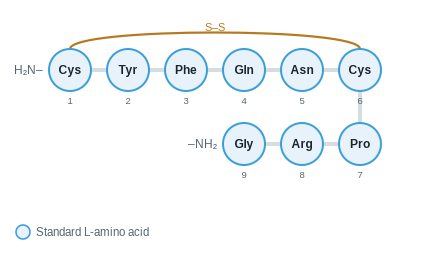
Vasopressin is a natural 9-amino-acid hormone (antidiuretic hormone, ADH) made in the brain. The body uses it to hold onto water and to tighten blood vessels. As a medicine it is a prescription injectable (brand Vasostrict) given by continuous IV infusion in a hospital to raise dangerously low blood pressure in shock S1.
How it works
Vasopressin acts on two different receptor families, and the medical use depends on which one dominates S1:
- V1a receptors on vascular smooth muscle. Activating them raises intracellular calcium and constricts blood vessels, which raises blood pressure. In shock this is the effect being bought.
- V2 receptors in the kidney's collecting ducts. Activating them inserts aquaporin water channels into the tubule membrane so water is reabsorbed and urine concentrates — the antidiuretic role the hormone is named for.
Its particular value in septic shock is that the V1a pathway is independent of adrenergic receptors. In severe sepsis the adrenergic receptors that noradrenaline works through become downregulated and acidosis blunts them further, so catecholamines lose effectiveness; vasopressin raises pressure by a route that is still working. Endogenous vasopressin is also relatively deficient in late septic shock, so part of what an infusion does is replacement. In the VASST trial it was studied as an addition to noradrenaline, allowing lower catecholamine doses S2.
The harms follow from the same vasoconstriction reaching beds where it is not wanted: ischemia of the gut, skin, digits and heart. It is given by continuous infusion because the natural hormone's half-life is only minutes S1.
Legal status
- FDA: Approved to raise blood pressure in adults with vasodilatory shock who stay hypotensive despite fluids and other pressors S1.
- Compounding: vasopressin is an approved drug substance; it is handled as a hospital injectable, not a grey-market product.
- DEA: Not a controlled substance.
- "Research use only" labels: not relevant; this is a hospital prescription drug.
- WADA (sport): Not listed as prohibited.
- International (short): Not reviewed for this page yet.
What the research actually shows
Evidence: A. Vasopressin is an approved pressor with a large randomized trial in septic shock.
| Study | Design | People | Dose studied | Result |
|---|---|---|---|---|
| VASST S2 | Double-blind RCT | 778 adults with septic shock | 0.01–0.03 units/min IV added to norepinephrine | No overall 28-day mortality difference vs norepinephrine alone; a possible benefit in less-severe shock |
| Label S1 | Approved indication | Vasodilatory shock | 0.01–0.1 units/min IV, titrated | Basis of approval |
What we don't know for this page: nothing unusual for an approved critical-care drug; it is used by specialists with continuous monitoring.
Reported benefits
Raises blood pressure in shock and can reduce the dose of other vasopressors needed S1S2.
Side effects
Common: too little urine, abdominal cramps, pallor, and drops in platelet count S1. Serious: the label warns about reduced blood flow to the limbs, skin, gut and heart, which can cause tissue death; rapid blood-pressure swings; and water intoxication S1.
Dangers and red flags
- Tissue ischemia. Excessive vasoconstriction can injure fingers, toes, bowel and heart S1.
- Hospital-only drug. Vasopressin for shock is titrated to blood pressure under continuous monitoring; it is not something to use outside that setting S1.
- Who should avoid it: used with caution in people with vascular or heart disease per the label S1.
Doses reported
We don't recommend sh*t. These are the doses studies, labels and harm-reduction sources report. That's information, not advice. Talk to a licensed clinician.
Vasopressin for shock is a continuous IV infusion titrated by a clinician; there is no self-administered reconstitution, so the inline calculator does not apply.
| Source | Dose | Unit / route | Frequency | Timing | Duration | Titration / escalation | Context |
|---|---|---|---|---|---|---|---|
| S1 Label | 0.01–0.1 units/min | units/min, IV infusion | Continuous | In hospital, on a pump | Until shock resolves | Titrated to blood-pressure target | Vasodilatory shock |
| S2 VASST | 0.01–0.03 units/min | units/min, IV infusion | Continuous | ICU | Study duration | Fixed low-dose arm added to norepinephrine | Septic shock trial |
Monitoring a doctor would order
Continuous blood pressure, urine output, electrolytes and sodium, platelet count, and checks for poor perfusion of the limbs and gut S1.
Bottom line
Vasopressin is an approved, well-studied hospital pressor for shock, given as a carefully titrated IV infusion. Its main risks are too much vasoconstriction and water retention. It is a prescription drug used in intensive care, not a self-administered product.