
SARMs & adjacent non-peptides
YK-11
Also called YK11, myostatin inhibitor YK11, selective androgen receptor modulator
- US status
- Not approved
- DEA
- Not a federally scheduled controlled substance; sale as a dietary supplement is illegal and SARMs are widely banned at the state level and by trade rules
- WADA
- S1.2 Other anabolic agents (SARMs); prohibited at all times
- Class
- SARMs & adjacent non-peptides
Jump to doses reported ↓ Dose math calculator
What it is
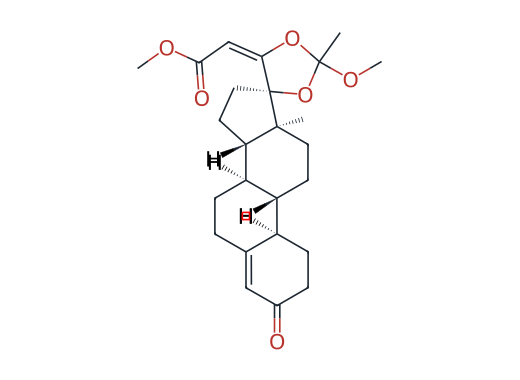
YK-11 is sold as a SARM, but chemically it is not like the others: it is a steroid, built on a 19-nor steroid skeleton, not a non-steroidal molecule like ostarine or ligandrol S2S6. In cell experiments it switches the androgen receptor on only partly, and it does it in an unusual way, without the internal head-to-tail folding of the receptor that full androgens trigger, which is the suggested reason its effect is partial and gene-selective S2. The claim it is marketed on is separate: in mouse muscle cells, YK-11 pushed those cells to mature into muscle fibres and raised follistatin, a protein that blocks myostatin, the body's own brake on muscle growth S3. That is where "myostatin inhibitor" in the marketing comes from. All of it is cell-culture work. It has never been approved, never been tested in a published human study, and is sold as a grey-market "research chemical" or mislabeled supplement.
How it works
YK-11 is marketed as a SARM but is chemically a steroid, built on a 19-nor skeleton with an added gestrinone-like structure S2S6. Two separate mechanisms are claimed for it, and both come entirely from cell culture.
- Partial androgen receptor agonism. In cell experiments it activates the androgen receptor only partly, and does so without the N-terminal/C-terminal folding of the receptor that full androgens trigger. That unusual binding mode is the proposed reason its activation is partial and gene-selective rather than across the board S2.
- Follistatin and myostatin. In mouse C2C12 muscle cells, YK-11 pushed the cells to mature into muscle fibres and raised follistatin, a protein that binds and neutralizes myostatin — the body's own brake on muscle growth. Removing that brake is the mechanism behind the "myostatin inhibitor" marketing S3. A separate study examined it in a bacterial sepsis model S4.
Everything above is in-vitro and animal work. YK-11 has never been given to a human in a published study, so neither the partial-agonist profile nor the follistatin effect has been shown to occur in a person at any exposure. What is documented in humans is only its appearance in doping-control samples S5, the liver-injury signal attached to the SARM class generally S7S1, and the finding that products sold under SARM names frequently contain something other than what the label says S8S10. Being an androgen receptor agonist, it would also be expected to suppress the body's own LH, FSH and testosterone production.
Legal status
- FDA: Not approved for any use. FDA warns against SARM body-building products and has acted against sellers S1.
- Dietary-supplement status: SARMs are not lawful dietary ingredients; selling YK-11 as a supplement is illegal S1.
- DEA: Not currently a federally scheduled controlled substance (any newer SARM scheduling legislation should be checked against current law). Note that YK-11 is chemically a steroid, so how it is classified under anabolic-steroid law is a question for counsel rather than something we assert.
- "Research use only" products: YK-11 is sold as research powder or capsules of unverified content. See our explainer.
- WADA: Prohibited at all times under S1.2 S9. Anti-doping laboratories have characterized YK-11 for testing and it has been reported in a doping control sample S5S6.
- International (short): Not reviewed for this page yet.
What the research actually shows
Evidence: E. There is no human research on YK-11 at all - no trial, no case series of users, not even a published pharmacokinetic study. The pharmacology is two papers from one Japanese laboratory using cells in a dish, plus one mouse study in sepsis. The rest of the literature is anti-doping detection chemistry.
| Study | Design | Subject | What it studied | Result |
|---|---|---|---|---|
| Kanno 2011 S2 | Cell culture, reporter-gene assays | Cell lines | Whether YK-11 activates the androgen receptor | Partial agonist; moves the receptor into the nucleus but does not produce the normal head-to-tail receptor interaction; effect varies gene by gene |
| Kanno 2013 S3 | Cell culture, mouse C2C12 myoblasts | Mouse muscle cells | Whether YK-11 drives muscle-cell maturation | Induced the muscle regulatory factors MyoD, Myf5 and myogenin more strongly than dihydrotestosterone, and raised follistatin; blocking follistatin with an antibody reversed the effect |
| Lee 2021 S4 | Animal study | Mice with bacterial sepsis | YK-11 and myostatin in muscle wasting | Reported effects on myostatin signalling in septic mice; an animal disease model, not a performance study |
| Sobolevsky 2024 S5 | Anti-doping case report | One doping control sample | Detection of YK-11 | Confirms YK-11 use can be identified in routine doping control |
What we don't know: whether any of the cell-culture muscle effects happen in a human being, at what dose, with what blood levels, for how long, and at what cost to the liver, lipids and hormones. None of that has been studied.
Reported benefits
None are established in people, because no person has been studied. The cell work showed stronger muscle-cell differentiation than dihydrotestosterone and a rise in follistatin S3. Users report large strength and size changes; those reports are user-reported, not tested, and the one published claim they rest on is a dish of mouse cells.
Side effects
Common: no human side-effect data exist for YK-11. As an androgen-receptor agonist, suppression of the body's own testosterone and falls in HDL cholesterol are expected from class behaviour S7. Serious: again, no YK-11-specific human data. Across SARMs, severe drug-induced liver injury is documented S1S7. YK-11 is itself a steroid taken by mouth S2S6, so the liver is the organ to watch, but no study has measured what it does to a human liver. We found no published human case report of YK-11 liver injury to cite; the absence of case reports for a widely sold compound reflects how little anyone has looked, not safety. FDA laboratory testing of one YK-11-labeled bodybuilding product, carried out after a consumer reported a stroke, confirmed YK-11 and also found an undeclared anabolic steroid that was not on the label S10.
Dangers and red flags
- Zero human evidence. Not one published human study of effects, doses, blood levels or harms S2S3.
- It is a steroid, sold as if it were not. Marketing presents YK-11 as a "SARM" distinct from steroids; the published chemistry describes a steroid S2S6.
- Liver injury across the class. SARM-associated drug-induced liver injury is well documented S1S7.
- Hormone suppression. Expected from androgen receptor activity, with no human data on how deep or how long S7.
- What is in the bottle is unknown. Analyses of SARM products sold online found most did not match their labels, and some contained other unapproved drugs or no active drug S8. In a product labeled to contain YK-11, FDA testing found an undeclared Schedule III anabolic steroid alongside it, after a consumer who used it had a stroke S10.
- Sport: prohibited at all times, and detectable in routine testing S5S9.
Doses reported
We don't recommend sh*t. These are the doses studies, labels and harm-reduction sources report. That's information, not advice. Talk to a licensed clinician.
There is no dosing data for YK-11 in humans or in whole animals for performance. It has no FDA label, no human trial, and the published pharmacology used concentrations in cell culture, which are measured in micromoles per litre in a dish and have no relationship to a dose a person could take S2S3. We will not fill that gap with forum or vendor numbers. YK-11 is taken by mouth, so the reconstitution calculator does not apply.
Monitoring a doctor would order
There is no guideline, no trial and no monitoring standard for YK-11. Given the chemistry and the class, a clinician assessing someone who had taken it would look at liver enzymes and bilirubin, a lipid panel, and testosterone with LH and FSH S1S7.
Bottom line
YK-11 is a never-approved compound sold as a SARM that is chemically a steroid, and its reputation as a "myostatin inhibitor" comes from a single cell-culture finding in mouse muscle cells. No human has ever been studied on it, so there is no dose, no efficacy evidence and no safety record; the only human-sample literature is anti-doping detection. It is banned in sport at all times and sold in products whose contents often do not match their labels.
Sources
- [S1] U.S. FDA. FDA Warns of Use of Selective Androgen Receptor Modulators (SARMs) Among Teens, Young Adults (consumer update). SARMs are unapproved drugs that cannot be legally marketed in the US as a dietary supplement or a drug; FDA has issued warning letters to sellers and pursued criminal actions, and lists liver injury and acute liver failure, heart attack or stroke risk, psychosis, sexual dysfunction, infertility and testicular shrinkage among reported harms. (regulator)
- [S2] Kanno Y, et al. (17alpha,20E)-17,20-[(1-methoxyethylidene)bis(oxy)]-3-oxo-19-norpregna-4,20-diene-21-carboxylic acid methyl ester (YK11) is a partial agonist of the androgen receptor. Biol Pharm Bull. 2011;34(3):318-323. PMID 21372378. (in-vitro)
- [S3] Kanno Y, et al. Selective androgen receptor modulator, YK11, regulates myogenic differentiation of C2C12 myoblasts by follistatin expression. Biol Pharm Bull. 2013;36(9):1460-1465. PMID 23995658. (in-vitro)
- [S4] Lee SJ, Gharbi A, Shin JE, Jung ID, Park YM. Myostatin inhibitor YK11 as a preventative health supplement for bacterial sepsis. Biochem Biophys Res Commun. 2021;543:1-7. PMID 33588136. (animal)
- [S5] Sobolevsky T, Kucherova Y, Ahrens B. Detection of selective androgen receptor modulator YK-11 in a doping control sample. Drug Test Anal. 2024;16(6):655-660. PMID 37946705. (human-case-series)
- [S6] Thevis M, Lagojda A, Kuehne D, Thomas A, Dib J, Hansson A, Hedeland M, Bondesson U, Wigger T, Karst U, Schaenzer W. Mass spectrometric characterization of the selective androgen receptor modulator (SARM) YK-11 for doping control purposes. Rapid Commun Mass Spectrom. 2017;31(14):1175-1183. PMID 28440570. (review)
- [S7] Vignali JD, et al. Systematic Review of Safety of Selective Androgen Receptor Modulators in Healthy Adults: Implications for Recreational Users. J Xenobiot. 2023;13(2):218-236. PMID 37218811. (review)
- [S8] Van Wagoner RM, Eichner A, Bhasin S, Deuster PA, Eichner D. Chemical Composition and Labeling of Substances Marketed as Selective Androgen Receptor Modulators and Sold via the Internet. JAMA. 2017;318(20):2004-2010. PMID 29183075. (human-observational)
- [S9] World Anti-Doping Agency. 2026 Prohibited List, section S1.2 (other anabolic agents, SARMs). (regulator)
- [S10] U.S. FDA. Certain bodybuilding products put consumers at risk for heart attack, stroke, serious liver damage and more. FDA laboratory testing of GE Labs Ykarine, a product labeled to contain YK-11, confirmed YK-11 and also found undeclared trendione, an anabolic steroid in DEA Schedule III; the testing followed an adverse event report from a consumer who used the product and subsequently had a stroke. (regulator)