
Other approved peptide drugs
Ziconotide
Also called Prialt, SNX-111, omega-conotoxin MVIIA, N-type calcium channel blocker
- US status
- Approved
- DEA
- Not a controlled substance
- WADA
- Not listed as prohibited
- Class
- Other approved peptide drugs
Jump to doses reported ↓ Dose math calculator
What it is
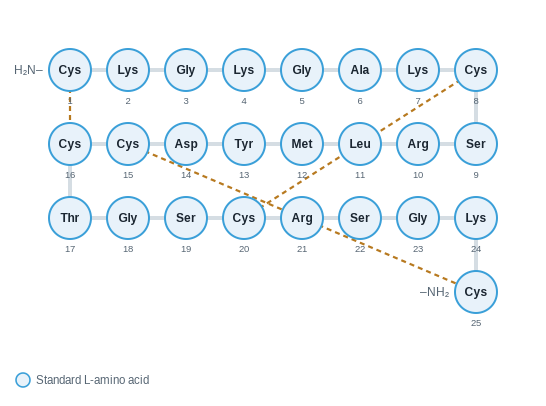
Ziconotide is a synthetic copy of a peptide from cone-snail venom. It blocks N-type calcium channels in the spinal cord, interrupting pain signals. It is an approved prescription drug (Prialt) for severe chronic pain, and it is delivered only into the spinal fluid through an implanted or external pump managed by a pain specialist. It is not an opioid and does not cause the same tolerance or addiction S1.
How it works
Ziconotide is a synthetic copy of ω-conotoxin MVIIA, a peptide from the venom of the cone snail Conus magus. It blocks N-type voltage-gated calcium channels on the presynaptic terminals of primary nociceptive (pain-sensing) neurons in the dorsal horn of the spinal cord. Those channels have to open and admit calcium before the neuron can release its pain neurotransmitters — substance P, glutamate, CGRP. Block the channel and the pain signal is never handed on to the next neuron S1.
That is a fundamentally different place to act than an opioid, which works on opioid receptors further along the same circuit. It is why ziconotide produces no tolerance, no physical dependence and no respiratory depression, and why it can work in people whose pain no longer responds to opioids S2.
The same properties dictate how it has to be given. It is a large, charged peptide: it cannot cross the blood-brain barrier and would be destroyed in the gut, so it must be infused directly into the cerebrospinal fluid through an intrathecal pump. And N-type calcium channels are not confined to pain pathways — they are present throughout the central nervous system — so spread of the drug produces the dizziness, confusion, memory problems, hallucinations and severe psychiatric and neurological effects that carry its boxed warning S1. Dose changes are made slowly for the same reason.
Legal status
- FDA: Approved for severe chronic pain needing intrathecal therapy, in people who cannot use or have not responded to other options. The label carries a Boxed Warning for severe psychiatric symptoms and neurological impairment S1.
- Compounding: an approved drug substance used only as a specialist intrathecal product.
- DEA: Not a controlled substance (it is not an opioid) S1.
- "Research use only" labels: not relevant; this is a specialist prescription drug.
- WADA (sport): Not listed as prohibited.
- International (short): Not reviewed for this page yet.
What the research actually shows
Evidence: A. Ziconotide is approved, with a randomized trial in refractory pain.
| Study | Design | People | Dose studied | Result |
|---|---|---|---|---|
| Staats 2004 S2 | Randomized, placebo-controlled | Patients with cancer or AIDS and refractory pain | Intrathecal ziconotide, titrated | Greater pain relief than placebo, but frequent neurological and psychiatric side effects |
| Label S1 | Approved indication | Severe chronic pain (intrathecal) | Micrograms/day, slowly titrated | Basis of approval |
What we don't know for this page: nothing unusual; the challenge is its narrow window between benefit and side effects, which is why it is titrated very slowly.
Reported benefits
Meaningful pain relief in severe chronic pain that has failed other treatments, without opioid tolerance or dependence S1S2.
Side effects
Common: dizziness, nausea, confusion, abnormal gait, memory problems, blurred vision, and drowsiness S1. Serious: the Boxed Warning covers severe psychiatric symptoms (including hallucinations and suicidal thoughts) and neurological impairment; meningitis is a risk with pump systems S1.
Dangers and red flags
- Psychiatric and neurological effects (Boxed Warning). Must be watched closely; stop if severe S1.
- Narrow therapeutic window. Requires very slow titration by a specialist S1.
- Pump infection/meningitis risk S1.
Doses reported
We don't recommend sh*t. These are the doses studies, labels and harm-reduction sources report. That's information, not advice. Talk to a licensed clinician.
Ziconotide is given only into the spinal fluid by a pain specialist using a pump; there is no self-administration or reconstitution for home use, so the inline calculator does not apply.
| Source | Dose | Unit / route | Frequency | Timing | Duration | Titration / escalation | Context |
|---|---|---|---|---|---|---|---|
| S1 Label | Start low (micrograms/day) | mcg/day, intrathecal infusion | Continuous via pump | Managed by a specialist | Ongoing | Slow upward titration | Severe chronic pain |
| S2 Staats 2004 | Titrated intrathecal dose | mcg, intrathecal | Continuous/titrated | — | Study duration | Titrated to effect/tolerability | Refractory cancer/AIDS pain |
Monitoring a doctor would order
Mental status and mood (including suicide risk), neurological exam, creatine kinase (for rare myopathy), and pump-site checks for infection S1.
Bottom line
Ziconotide is an approved, non-opioid intrathecal painkiller derived from cone-snail venom, used for severe chronic pain that has failed other treatments. It works but has a narrow margin and a Boxed Warning for serious psychiatric and neurological effects, so it is managed entirely by pain specialists. It is a prescription medicine delivered by spinal pump.
Sources
- [S1] PRIALT (ziconotide) intrathecal infusion. US prescribing information (DailyMed), including Boxed Warning. (label)
- [S2] Staats PS, et al. Intrathecal ziconotide in the treatment of refractory pain in patients with cancer or AIDS: a randomized controlled trial. JAMA. 2004;291:63-70. PMID 14709577. (rct)