
Skin, tanning & sexual-health peptides
AHK-Cu
Also called copper tripeptide-3, alanyl-histidyl-lysine copper, Ala-His-Lys-Cu, AHK copper peptide
- US status
- Not approved as a drug
- DEA
- Not a controlled substance
- WADA
- Not named
- Class
- Skin, tanning & sexual-health peptides
Jump to doses reported ↓ Dose math calculator
What it is
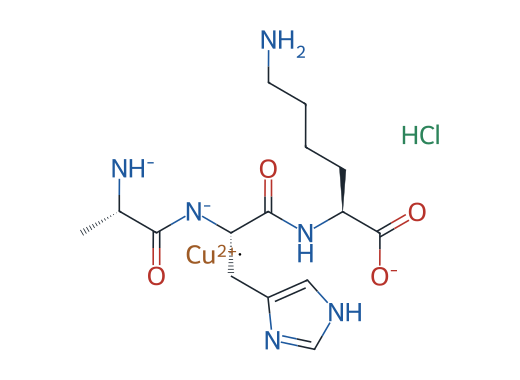
AHK-Cu is a small peptide of three amino acids (alanine, histidine, lysine) bound to a copper ion. On cosmetic labels it appears as copper tripeptide-3. It is a close cousin of the better-known GHK-Cu, with alanine in place of glycine. It is added to hair-growth and skin products, and it is also sold online as a powder in vials, sometimes for injection. The published evidence is one lab study on human hair follicles S1.
How it works
- Copper-peptide signaling. Tripeptide-copper complexes are described as growth factors for several cell types. They push skin fibroblasts (the cells that make collagen) to multiply and to release more VEGF, a signal for blood vessel growth S1.
- Hair follicle cells. At the base of every hair follicle sit dermal papilla cells, which control hair growth. In the one lab study, tiny concentrations of AHK-Cu (10⁻¹² to 10⁻⁹ M) made isolated human hair follicles grow longer and made papilla cells multiply. It also shifted cell-survival proteins in a direction that resists cell death, though the drop in dying cells was not statistically significant S1.
- The bigger copper-peptide picture comes from GHK-Cu research, which links copper tripeptides to collagen production and wound repair S4. Whether AHK-Cu behaves the same way in people has not been tested.
Legal status
- FDA: No AHK-Cu drug is approved.
- Cosmetic vs drug: FDA defines drugs to include products "intended to affect the structure or any function of the body," and says cosmetics (other than color additives) "do not require FDA approval before they go on the market" S2. A shampoo or serum with copper tripeptide-3 marketed to make hair look fuller can be a cosmetic; one marketed to grow hair is making a drug claim S2.
- Compounding: AHK-Cu does not appear on FDA's 503A Category 1, 2 or 3 lists S3 and is not in HHS's Oct 30 2026 draft enforcement-discretion policy.
- DEA: Not a controlled substance.
- "Research use only" vials: an injectable vial of a cosmetic ingredient has no legal path to human use. See our explainer.
- WADA: Not named on the 2026 List. Section S0 covers pharmacological substances with no government approval for human therapeutic use S5; whether that applies to a cosmetic ingredient is a question for your anti-doping organization.
What the research actually shows
Evidence: D. We found one peer-reviewed study of AHK-Cu, done on human hair follicles and cells in a dish. No clinical trial of AHK-Cu, topical or injected, appears in PubMed or ClinicalTrials.gov.
| Study | Design | Subjects | Dose studied | Result |
|---|---|---|---|---|
| Pyo et al 2007 S1 | Lab study | Human hair follicles kept alive outside the body; cultured dermal papilla cells | 10⁻¹² to 10⁻⁹ M in culture | Follicles grew longer; papilla cells multiplied; signs of reduced cell death (not statistically significant for the main count) |
What we don't know: whether AHK-Cu grows hair or improves skin in people, how much passes through the skin, and anything about injecting it.
Reported benefits
- In the lab: longer hair follicles and more papilla cells S1.
- Marketed, not tested: thicker hair, slowing hair loss, firmer skin. No human study supports these claims for AHK-Cu itself.
Side effects
Common: no clinical data. Serious: no clinical data. Nothing has been published on injected AHK-Cu.
Dangers and red flags
- Cosmetic ingredient sold for injection. Cosmetic-grade material is not made to sterile injectable standards, and no one has studied the safety of injecting it.
- Copper load. Injected copper complexes deliver copper directly into the body; the safe amount is unknown.
- Product quality. Grey-market vials are not tested for identity, dose, sterility or endotoxin.
- Who should avoid it: there is no evidence base for use in pregnancy, breastfeeding, children, or people with copper-handling disorders such as Wilson disease.
Doses reported
We don't recommend sh*t. These are the doses studies, labels and harm-reduction sources report. That's information, not advice. Talk to a licensed clinician.
No human dosing data found. There is no FDA label and no human study. The only published concentrations are lab-dish levels.
| Source | Population | Dose | Route | Frequency and timing | Duration | Titration or escalation | Cite |
|---|---|---|---|---|---|---|---|
| Pyo et al 2007 | Human hair follicles and cells in culture (not people) | 10⁻¹² to 10⁻⁹ M | Added to culture medium | Not applicable | Not applicable | Not applicable | S1 |
We found no peer-reviewed study tying a concentration to a result in people. Forum and vendor figures for injection are not cited here.
Open the dose math calculator →
Monitoring a doctor would order
No guideline exists. We found no source naming AHK-Cu-specific monitoring.
Bottom line
AHK-Cu (copper tripeptide-3) is a GHK-Cu cousin used in hair and skin products. One lab study found it lengthened human hair follicles in a dish. That's the whole evidence base: no human trial, topical or injected, and no safety data for injecting a cosmetic ingredient sold in vials.
Sources
- [S1] Pyo HK, et al. The effect of tripeptide-copper complex on human hair growth in vitro. Arch Pharm Res. 2007;30(7):834-9. PMID 17703734. (in-vitro)
- [S2] FDA. Is It a Cosmetic, a Drug, or Both? (Or Is It Soap?). Content current as of 09/11/2024. (regulator)
- [S3] FDA. Bulk Drug Substances Nominated for Use in Compounding Under Section 503A of the FD&C Act (Category 1, 2 and 3 lists). Updated May 14, 2026. (regulator)
- [S4] Pickart L, et al. Regenerative and Protective Actions of the GHK-Cu Peptide in the Light of the New Gene Data. Int J Mol Sci. 2018;19(7):1987. PMID 29986520. (review)
- [S5] World Anti-Doping Agency. 2026 Prohibited List, section S0 (Non-approved substances). (regulator)