
Cosmetic peptides (topical)
Dipeptide diaminobutyroyl benzylamide diacetate (SYN-AKE)
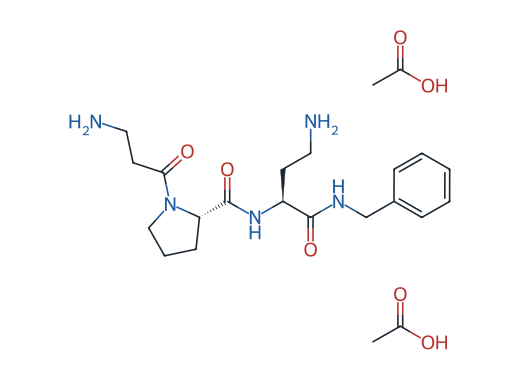
Also called SYN-AKE (ingredient trade name), tripeptide-3, snake peptide, H-β-Ala-Pro-Dab-NHBn · 2 AcOH
- US status
- Not approved as a drug
- DEA
- Not a controlled substance
- WADA
- Not named
- Class
- Cosmetic peptides (topical)
Jump to doses reported ↓ Dose math calculator
What it is
Dipeptide diaminobutyroyl benzylamide diacetate is the ingredient-label name for a small synthetic peptide-like molecule sold under the trade name SYN-AKE; reviews also call it tripeptide-3 S1S2. It is built to imitate waglerin-1, a toxin in the venom of Wagler's pit viper (Tropidolaemus wagleri), and it is the active behind "snake venom" anti-wrinkle creams S1S4. It contains no venom. It is applied to skin.
How it works
- Venom inspiration. Waglerin peptides paralyze muscles by blocking the nerve signal, which is why the cosmetics industry borrowed the idea for expression-line creams S4.
- Blocks the muscle's receiver. Unlike acetyl hexapeptide-8, which works inside the nerve ending, this molecule acts on the muscle side: it is a reversible blocker of the acetylcholine receptor (nicotinic type), so the muscle hears less of the "contract" signal S1S2.
- Small for a cosmetic peptide. At about 496 g/mol, it is smaller than most anti-wrinkle peptides S3. Whether it reaches the muscle through skin in useful amounts has not been shown in published human studies.
Legal status
- FDA: Not a drug. Cosmetic ingredients, other than color additives, "do not require FDA approval before they go on the market" S7.
- The claim decides the category. Products intended to affect the structure or any function of the body are drugs S7; reducing the look of lines is a cosmetic claim S8.
- DEA: Not a controlled substance.
- WADA: Not named on the 2026 List S10.
What the research actually shows
Evidence: D. A 2020 review found "no scientific papers describing clinical studies" of this ingredient S2. The widely quoted "up to 52%" wrinkle reduction comes from manufacturer material and a patent S1S2. The human studies we found tested products that combine it with several other actives.
| Study | Design | People | Dose studied | Result |
|---|---|---|---|---|
| Manufacturer and patent data cited in reviews S1S2 | Not peer reviewed | Not stated | 4% solution for 28 days; animal tests at 1–4% | Wrinkle appearance "up to 52%" lower. Marketing and patent figures, not independent trials |
| Trookman et al 2009 S5 | Open-label, single center, no control group, 3 months | 37 women 33–45 | Line treatment with growth factors, antioxidants, hyaluronic acid spheres, a collagen peptide and an unnamed "muscle contraction-inhibiting peptide" (Schagen identifies it as this ingredient S1) | Investigator-rated wrinkle improvement within minutes and through 3 months; no treatment-related adverse events. Multi-ingredient, uncontrolled |
| Zhu et al 2026 S6 | Two clinical studies, 12 weeks | 50 and 42 adults | Serum with this ingredient plus acetyl hexapeptide-8, gluconolactone, niacinamide and seaweed extract | Static wrinkles improved 35–69% and dynamic wrinkles 10–13% by clinical scoring. Multi-ingredient; run by a cosmetics company |
What we don't know: whether the ingredient on its own does anything in people, at what concentration, and how much reaches muscle.
Reported benefits
- In studies: wrinkle improvements from multi-ingredient products that include it S5S6.
- Marketed, not proven: "Botox-like" or "venom" muscle relaxation from a cream.
Side effects
Common: none reported in the multi-ingredient studies S5. Serious: none reported.
Dangers and red flags
- No standalone evidence. Every efficacy figure is either from the manufacturer or from a product with several actives S1S2.
- Venom marketing. The molecule is synthetic and contains no venom; the name sells the idea, not proof S4.
- Injectable or "research" versions: no study supports injecting it.
- Clinical evidence for cosmetic peptides is often weak S9.
Doses reported
We don't recommend sh*t. These are the doses studies, labels and harm-reduction sources report. That's information, not advice. Talk to a licensed clinician.
No peer-reviewed dose data for the ingredient alone. This is a topical ingredient, so the only numbers are concentrations from manufacturer and patent material.
| Source | Population | Dose | Route | Frequency and timing | Duration | Titration or escalation | Cite |
|---|---|---|---|---|---|---|---|
| Manufacturer and patent data cited by Schagen 2017 and Errante 2020 | Not stated | 4% solution ("up to 52%" claim); 1–4% in animal tests | Topical | Not stated | 28 days | None | S1S2 |
| Trookman et al 2009 | Women 33–45 | Not stated (multi-ingredient product) | Topical, around eyes and mouth | Twice daily | 3 months | None | S5 |
| Zhu et al 2026 | Adults | Not stated in the abstract (multi-ingredient serum) | Topical | As directed in the trial | 12 weeks | None | S6 |
The inline calculator is not shown on this page because reconstitution and injection math do not apply to a cream ingredient.
Monitoring a doctor would order
None. This is a cosmetic ingredient. Stop using a product that causes redness, itching or rash.
Bottom line
SYN-AKE is a small synthetic molecule modeled on a pit-viper toxin that blocks the muscle's acetylcholine receptor. It's the "snake venom" in anti-wrinkle creams, but a 2020 review found no published clinical study of it alone. The impressive numbers come from the manufacturer, and the human studies all tested multi-ingredient products.
Sources
- [S1] Schagen SK. Topical Peptide Treatments with Effective Anti-Aging Results. Cosmetics. 2017;4(2):16. doi:10.3390/cosmetics4020016. (review)
- [S2] Errante F, et al. Cosmeceutical Peptides in the Framework of Sustainable Wellness Economy. Front Chem. 2020;8:572923. PMID 33195061. (review)
- [S3] Pintea A, et al. Peptides: Emerging Candidates for the Prevention and Treatment of Skin Senescence: A Review. Biomolecules. 2025;15(1):88. PMID 39858482. (review)
- [S4] Debono J, et al. Viper Venom Botox: The Molecular Origin and Evolution of the Waglerin Peptides Used in Anti-Wrinkle Skin Cream. J Mol Evol. 2017;84(1):8-11. PMID 27864608. (review)
- [S5] Trookman NS, Rizer RL, Ford R, Ho E, Gotz V. Immediate and Long-term Clinical Benefits of a Topical Treatment for Facial Lines and Wrinkles. J Clin Aesthet Dermatol. 2009;2(3):38-43. PMID 20729942. (human-case-series)
- [S6] Zhu M, et al. The effect of a serum containing acetyl hexapeptide-8, dipeptide diaminobutyroyl benzylamide diacetate and gluconolactone on skin biomarkers, wrinkles and skin texture: Ex vivo and clinical studies. Int J Cosmet Sci. 2026;48(5):913-925. PMID 41668671. (human-observational)
- [S7] FDA. Is It a Cosmetic, a Drug, or Both? (Or Is It Soap?). Content current as of 09/11/2024. (regulator)
- [S8] FDA. Wrinkle Treatments and Other Anti-aging Products. Content current as of 02/25/2022. (regulator)
- [S9] Pai VV, Bhandari P, Shukla P. Topical peptides as cosmeceuticals. Indian J Dermatol Venereol Leprol. 2017;83(1):9-18. PMID 27451932. (review)
- [S10] World Anti-Doping Agency. 2026 Prohibited List (cosmetic peptides not named). (regulator)