
Healing / recovery research peptides
Fragment 17-23 (thymosin β4 17-23)
Also called Tβ4(17-23), LKKTETQ, Ac-LKKTETQ, thymosin beta-4 fragment 17-23, Fragment 17-23
- US status
- Not approved
- DEA
- Not a controlled substance
- WADA
- S2.3 (thymosin-β4 and its derivatives, e.g. TB-500); prohibited at all times
- Class
- Healing / recovery research peptides
Jump to doses reported ↓ Dose math calculator
What it is
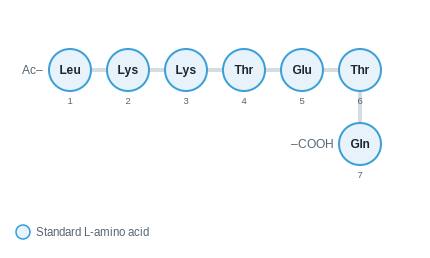
"Fragment 17-23" is a vial label, not a drug name. It almost certainly refers to the stretch of thymosin β4 (a natural 43-amino-acid repair protein) between positions 17 and 23: the seven amino acids L-K-K-T-E-T-Q S1. When the front end is capped with an acetyl group (Ac-LKKTETQ), this is the same molecule chemists found in products sold as TB-500 S2, and the molecule FDA lists as "Thymosin beta-4, fragment (LKKTETQ), also known as TB-500" S3. The label alone doesn't tell you whether the vial holds the acetylated or plain version, or anything at all. People inject it hoping to speed injury healing S10.
For the full background, see TB-500 and thymosin beta-4 (full length).
How it works
- The actin-binding site. Positions 17–23 are the part of thymosin β4 that grabs actin, the protein cells use to change shape and move. In lab studies, the LKKTETQ sequence (plus one more amino acid) promoted cell migration, new blood vessel growth and wound healing S1.
- It gets chopped up fast. In rats, injected Ac-LKKTETQ was broken down into shorter pieces; the main one in urine was Ac-LK, and Ac-LKK lingered up to 72 hours. In a lab wound test, only one breakdown product (Ac-LKKTE) helped fibroblasts close a scratch wound, not the parent fragment S7. So it is not even clear which piece does what.
Legal status
- FDA: Not approved for any use.
- Compounding: FDA had placed the fragment in Category 2, citing possible immune reactions "due to the potential for aggregation as well as peptide-related impurities" and saying it had "not identified any human exposure data" S3. The nomination was withdrawn S3. FDA's Pharmacy Compounding Advisory Committee voted in July 2026 to recommend it for the 503A bulks list (8–6 per a secondary summary) S4, and HHS's draft enforcement-discretion policy of Oct 30 2026 covers it S5. A draft policy is not an approval, and it applies to licensed pharmacies, not to "research" vials.
- DEA: Not a controlled substance.
- "Research use only" vials: see our explainer.
- WADA: "Thymosin-β4 and its derivatives e.g. TB-500" are banned at all times under S2.3 S6. Racing labs have published tests for it S8.
What the research actually shows
Evidence: D. We found no published human study of this fragment. The only human trial we found is registered and still recruiting.
| Study | Design | Subjects | Dose studied | Result |
|---|---|---|---|---|
| Sosne et al 2010 S1 | Review of lab work on thymosin β4 active sites | Cells and animals | — | LKKTETQ-containing sequence promotes cell migration, blood vessel growth and wound healing |
| Rahaman et al 2024 S7 | Rat metabolism study + lab wound test | Rats; human fibroblasts | Not stated in the abstract | Broken down quickly; only the metabolite Ac-LKKTE, not the parent, sped scratch-wound closure |
| Esposito et al 2012 S2 | Chemical analysis | A product sold as TB-500 | — | Identified the acetylated 17–23 fragment |
| NCT07487363 S9 | Randomized, placebo-controlled phase 1/2, three dose cohorts | Planned 80 adults with stable heart disease | Low, medium, high (doses not listed in the registry record) | Recruiting; no results |
What we don't know: whether the fragment does anything in people, its human safety, and what any given "Fragment 17-23" vial contains.
Reported benefits
- In lab and animal work: cell migration and wound-healing effects for the LKKTETQ region S1, though one study found the effect came from a breakdown product S7.
- User-reported, not tested: injury healing, usually alongside BPC-157 S10. See TB-500.
Side effects
Common: no clinical data. User reports for TB-500 and BPC-157 (preprint, not peer reviewed) include fatigue, anxiety, anhedonia, insomnia and injection-site pain S10. Serious: unknown. FDA found no human exposure data S3.
Dangers and red flags
- Identity is uncertain. "Fragment 17-23" is a seller's label; the vial may contain the acetylated fragment, the plain fragment, or something else.
- Immune reactions and impurities flagged by FDA S3.
- Cancer question. Full-length thymosin β4 is overexpressed in some tumors; see thymosin beta-4. Whether the fragment matters is unknown.
- Sport: banned at all times and detectable S6S8.
Doses reported
We don't recommend sh*t. These are the doses studies, labels and harm-reduction sources report. That's information, not advice. Talk to a licensed clinician.
No human dosing data found. There is no FDA label, no published human study, and the one registered trial does not list its doses S9. We found no peer-reviewed survey with dose numbers for a product sold as "Fragment 17-23". Forum and vendor figures are not cited here. For what is known about TB-500 dosing, see the TB-500 page.
Open the dose math calculator →
Monitoring a doctor would order
No guideline exists. We found no source naming specific monitoring.
Bottom line
"Fragment 17-23" most likely means the actin-binding piece of thymosin β4, the same molecule sold as TB-500. It has lab and rat data only; it breaks down quickly, and one study suggests a breakdown product, not the fragment itself, does the wound-healing work. A first human trial is only now recruiting. It is banned in sport at all times.
Sources
- [S1] Sosne G, Qiu P, Goldstein AL, Wheater M. Biological activities of thymosin beta4 defined by active sites in short peptide sequences. FASEB J. 2010;24(7):2144-51. PMID 20179146. (review)
- [S2] Esposito S, et al. Synthesis and characterization of the N-terminal acetylated 17-23 fragment of thymosin beta 4 identified in TB-500, a product suspected to possess doping potential. Drug Test Anal. 2012;4:733-8. PMID 22962027. (in-vitro)
- [S3] FDA. Certain Bulk Drug Substances for Use in Compounding that May Present Significant Safety Risks (entry: Thymosin beta-4, fragment (LKKTETQ), also known as TB-500, 'Bulk drug substances nominated but withdrawn'). Content current as of 04/22/2026. (regulator)
- [S4] FDA. July 23-24, 2026: Meeting of the Pharmacy Compounding Advisory Committee. Vote tallies per SSRP Institute 'PCAC Meeting Vote Summary' (secondary). (regulator)
- [S5] HHS. Enforcement Discretion Policy Regarding 503A Compounding Using Certain Peptide Bulk Drug Substances (draft). FR Doc 2026-22192, Oct 30 2026. (regulator)
- [S6] World Anti-Doping Agency. 2026 Prohibited List, S2.3 ('Thymosin-ß4 and its derivatives e.g. TB-500'). (regulator)
- [S7] Rahaman KA, et al. Simultaneous quantification of TB-500 and its metabolites in in-vitro experiments and rats by UHPLC-Q-Exactive orbitrap MS/MS and their screening by wound healing activities in-vitro. J Chromatogr B Analyt Technol Biomed Life Sci. 2024;1235:124033. PMID 38382158. (animal)
- [S8] Ho EN, et al. Doping control analysis of TB-500, a synthetic version of an active region of thymosin β4, in equine urine and plasma by liquid chromatography-mass spectrometry. J Chromatogr A. 2012;1265:57-69. PMID 23084823. (in-vitro)
- [S9] ClinicalTrials.gov NCT07487363. Phase 1/2 randomized, placebo-controlled, sequential dose-escalation study of TB-500 (thymosin beta 4 17-23 fragment) in adults with stable atherosclerotic cardiovascular disease (recruiting; estimated n = 80). (rct)
- [S10] Cassinat J, et al. Real-World Use, Dosing, and Reported Side Effects of BPC-157 and TB-500 for Musculoskeletal Injury: An Analysis of Online Communities. medRxiv preprint, Nov 2026. doi:10.64898/2026.11.04.26367022. NOT PEER REVIEWED. (preprint)