
Cosmetic peptides (topical)
Palmitoyl tripeptide-1 + palmitoyl tetrapeptide-7
Also called palmitoyl tripeptide-1, pal-GHK, palmitoyl oligopeptide, palmitoyl tetrapeptide-7, pal-GQPR, Matrixyl 3000 (ingredient trade name for the pair)
- US status
- Not approved as a drug
- DEA
- Not a controlled substance
- WADA
- Not named
- Class
- Cosmetic peptides (topical)
Jump to doses reported ↓ Dose math calculator
What it is
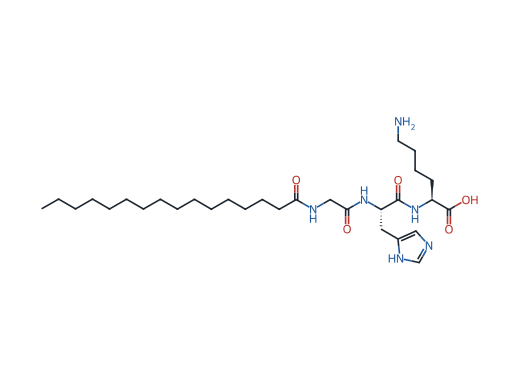
This page covers two skin-care peptides that are usually sold as a pair: - Palmitoyl tripeptide-1 (pal-GHK) is the three-amino-acid peptide glycine-histidine-lysine with a fatty acid tail. It is the same core as GHK-Cu, but without copper S1. - Palmitoyl tetrapeptide-7 (pal-GQPR) is a four-amino-acid fragment of immunoglobulin G, an antibody protein, also with a fatty tail S1.
Together they are sold under the ingredient trade name Matrixyl 3000 and appear in anti-wrinkle creams, serums and eye creams S1S10. They are used at tiny concentrations, typically under 10 parts per million S2.
How it works
- Where it fits. Reviews of topical anti-aging peptides sort them into four groups: signal, enzyme-inhibitor, neurotransmitter-inhibitor and carrier peptides S6.
- Pal-GHK, the "messenger." Described as a messenger peptide for collagen renewal: it is reported to stimulate collagen and glycosaminoglycan production and is suggested to work through TGF-β, a growth signal that drives collagen fiber formation S1.
- Pal-GQPR, the calmer. It lowers release of IL-6, an inflammation signal, both normally and after UVB light exposure S1. The idea is that less low-grade inflammation means less breakdown of the skin's support layer.
- Why the fatty tails. Attaching palmitic acid helps short, water-loving peptides get into skin and makes them more practical as cosmetic actives S5.
Legal status
- FDA: Not drugs. Cosmetic ingredients, other than color additives, "do not require FDA approval before they go on the market" S8.
- The claim decides the category. FDA says a product intended "to remove wrinkles or increase the skin's production of collagen" is a drug or device; one that makes lines less noticeable by moisturizing is a cosmetic S9.
- Safety review: the Cosmetic Ingredient Review expert panel concluded these ingredients are "safe in cosmetics in the present practices of use and concentration," noting low use levels and negative safety tests S2.
- DEA: Not a controlled substance.
- WADA: Not named on the 2026 List S11.
What the research actually shows
Evidence: C. Several small human studies, but the key numbers come from the ingredient maker's data, a patent, or products with several active ingredients. Reviewers say clinical evidence for cosmetic peptides "is often weak" S7.
| Study | Design | People | Dose studied | Result |
|---|---|---|---|---|
| Study summarized in Schagen 2017 S1 | Small study | 15 women | Cream with palmitoyl tripeptide-1, twice daily for 4 weeks (strength not given in the review) | Reported significant drops in wrinkle length, depth and roughness |
| Safety-review data cited by Schagen 2017 S1 | Vehicle-controlled | 23 women | Palmitoyl tripeptide-1 for 4 weeks | Skin thickness about 4% higher than vehicle |
| Patent data cited by Schagen 2017 S1 | Blinded, randomized half-face | 28 volunteers | Cream with both peptides, twice daily (strength not given) | Reported less wrinkle depth, volume and density. Source is a patent, not a peer-reviewed trial |
| Watson et al 2009 S3 | Randomized, double-blind, vehicle-controlled for 6 months, then open-label for 6 more | 60 adults with sun-aged skin | Over-the-counter product (Schagen identifies palmitoyl tetrapeptide-7 plus another active) S1 | More fibrillin-1 (an elastic-fiber protein) in skin at 6 months; wrinkle difference vs vehicle not significant at 6 months (P = 0.10); benefit after 12 months vs projected vehicle |
| Yang et al 2024 S4 | 12-week clinical study with lab work | Adults using an eye cream | Eye cream with both peptides plus yeast/rice ferment and N-acetylneuraminic acid | Hydration +28%, elasticity +19%, collagen density +55% (ultrasound). Multi-ingredient, so the peptides' share can't be separated |
What we don't know: what the pair does on its own at typical concentrations in independent trials, whether results last, and how much the cream base contributes.
Reported benefits
- In studies: modest improvements in wrinkles, skin thickness, hydration and elasticity, mostly from small or multi-ingredient studies S1S3S4.
- Marketed, not proven: "retinoid-like" results without irritation. A review describes pal-GHK's activity as comparable to retinoic acid without irritation S1, but no head-to-head trial is cited.
Side effects
Common: none specific reported; the safety panel found negative safety test data S2. Any cream can irritate sensitive skin. Serious: none reported.
Dangers and red flags
- Overstated claims. "Collagen boosting" is a drug claim under FDA's definitions S9.
- Concentration matters. The safety conclusion is tied to present use levels, typically under 10 ppm S2.
- Injectable or "research" versions: no study supports injecting these peptides.
Doses reported
We don't recommend sh*t. These are the doses studies, labels and harm-reduction sources report. That's information, not advice. Talk to a licensed clinician.
This is a topical ingredient, so the useful number is concentration in the product. Few studies report it.
| Source | Population | Dose | Route | Frequency and timing | Duration | Titration or escalation | Cite |
|---|---|---|---|---|---|---|---|
| Cosmetic Ingredient Review | Cosmetic products (use survey) | Typical use under 10 ppm (0.001%) | Topical | As used in products | Not applicable | Not applicable | S2 |
| Study summarized in Schagen | 15 women | Not stated in the review | Topical cream | Twice daily | 4 weeks | None | S1 |
| Patent data cited by Schagen | 28 volunteers | Not stated in the review | Topical, half the face and one forearm | Twice daily | Not stated | None | S1 |
| Watson et al 2009 | Adults with sun-aged skin | Not stated in the abstract | Topical, face and hands | Once daily | 6 months controlled + 6 months open | None | S3 |
| Yang et al 2024 | Adults (eye area) | Not stated in the abstract (multi-ingredient) | Topical eye cream | As directed in the trial | 12 weeks | None | S4 |
The inline calculator is not shown on this page because reconstitution and injection math do not apply to a cream ingredient.
Monitoring a doctor would order
None. This is a cosmetic ingredient pair. Stop using a product that causes redness, itching or rash.
Bottom line
Palmitoyl tripeptide-1 (a copper-free GHK) and palmitoyl tetrapeptide-7 (an anti-inflammatory antibody fragment) are a common anti-wrinkle pair used at a few parts per million. A safety panel calls them safe at those levels. The benefit data are small and mostly from the ingredient maker, a patent, or multi-ingredient creams, so expect modest cosmetic effects at best.
Sources
- [S1] Schagen SK. Topical Peptide Treatments with Effective Anti-Aging Results. Cosmetics. 2017;4(2):16. doi:10.3390/cosmetics4020016. (review)
- [S2] Johnson W Jr, et al. Safety Assessment of Tripeptide-1, Hexapeptide-12, Their Metal Salts and Fatty Acyl Derivatives, and Palmitoyl Tetrapeptide-7 as Used in Cosmetics. Int J Toxicol. 2018;37(3 suppl):90S-102S. doi:10.1177/1091581818807863. (review)
- [S3] Watson RE, et al. Effects of a cosmetic 'anti-ageing' product improves photoaged skin [corrected]. Br J Dermatol. 2009;161(2):419-26. PMID 19438432. (rct)
- [S4] Yang F, et al. Comprehensive evaluation of the efficacy and safety of a new multi-component anti-aging topical eye cream. Skin Res Technol. 2024;30(7):e13790. PMID 38932444. (rct)
- [S5] Lintner K, Peschard O. Biologically active peptides: from a laboratory bench curiosity to a functional skin care product. Int J Cosmet Sci. 2000;22(3):207-18. PMID 18503476. (review)
- [S6] Gorouhi F, Maibach HI. Role of topical peptides in preventing or treating aged skin. Int J Cosmet Sci. 2009;31(5):327-45. PMID 19570099. (review)
- [S7] Pai VV, Bhandari P, Shukla P. Topical peptides as cosmeceuticals. Indian J Dermatol Venereol Leprol. 2017;83(1):9-18. PMID 27451932. (review)
- [S8] FDA. Is It a Cosmetic, a Drug, or Both? (Or Is It Soap?). Content current as of 09/11/2024. (regulator)
- [S9] FDA. Wrinkle Treatments and Other Anti-aging Products. Content current as of 02/25/2022. (regulator)
- [S10] Errante F, et al. Cosmeceutical Peptides in the Framework of Sustainable Wellness Economy. Front Chem. 2020;8:572923. PMID 33195061. (review)
- [S11] World Anti-Doping Agency. 2026 Prohibited List (cosmetic peptides not named). (regulator)