
Cosmetic peptides (topical)
Pentapeptide-18 (Leuphasyl)
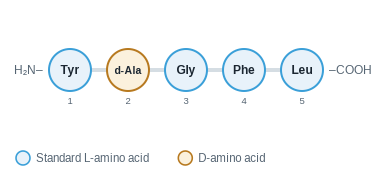
Also called Leuphasyl (ingredient trade name), H-Tyr-D-Ala-Gly-Phe-Leu-OH, YaGFL
- US status
- Not approved as a drug
- DEA
- Not a controlled substance
- WADA
- Not named
- Class
- Cosmetic peptides (topical)
Jump to doses reported ↓ Dose math calculator
What it is
Pentapeptide-18, sold under the ingredient trade name Leuphasyl, is a five-amino-acid peptide (tyrosine, D-alanine, glycine, phenylalanine, leucine) used in anti-wrinkle creams aimed at expression lines S1S4. It is usually marketed alongside acetyl hexapeptide-8 (Argireline), because the two are said to work by different routes S1S3. It is applied to skin.
How it works
- An enkephalin mimic. Enkephalins are small natural peptides that quiet nerve activity. Pentapeptide-18 is designed to act like them, reducing nerve-cell activity and the release of signaling chemicals S1S3.
- Turns down the "contract" signal. By binding enkephalin receptors on nerve cells, it is said to lower acetylcholine release at the nerve-muscle junction, which would relax the tiny muscles behind expression lines S2S3.
- Different route from Argireline. Argireline interferes with the release machinery itself (the SNARE complex); pentapeptide-18 acts on the nerve's receptors. That is the rationale for combining them S1S3. A 2026 computer-modeling study explored its molecular interactions but did not test it in people S5.
Legal status
- FDA: Not a drug. Cosmetic ingredients, other than color additives, "do not require FDA approval before they go on the market" S6.
- The claim decides the category. Products intended to affect the structure or any function of the body are drugs S6; reducing the look of lines is a cosmetic claim S7.
- DEA: Not a controlled substance.
- WADA: Not named on the 2026 List S9.
What the research actually shows
Evidence: C. One small peer-reviewed study without a placebo group, plus manufacturer data repeated in reviews. Reviewers say clinical evidence for cosmetic peptides "is often weak" S8.
| Study | Design | People | Dose studied | Result |
|---|---|---|---|---|
| Dragomirescu et al 2014 S2 | Uncontrolled study, three strengths | 20 volunteers 30 and older | 0.5%, 1% or 2% cream applied over the forehead and eye muscles daily for 2 months | Only 2% gave meaningful results: wrinkle size −34.7% between the eyebrows and −28.4% around the eyes; no wrinkles disappeared; no side effects reported |
| Manufacturer data cited by Schagen 2017 S1 | Comparison | 43 women | 0.05% pentapeptide-18, 0.05% acetyl hexapeptide-3, or both | Wrinkle reduction 11.6%, 16.3% and 24.6%. Source is a manufacturer document, not a peer-reviewed trial |
| Trade-magazine report cited by Schagen 2017 S1 | Controlled study | 22 women (average age 51) getting Botox around the eyes | Topical cream twice daily for 6 months with Botox | Lab markers: glutamate release −11% with pentapeptide-18, −20% with acetyl hexapeptide-8, −40% with both; topical use reportedly extended the Botox effect |
| Lab data summarized in Errante et al 2020 S3 | In vitro | Cells | 0.75 mM with SNAP-8 | Inhibition 7% alone; 47% combined with SNAP-8 |
What we don't know: whether it works in an independent placebo-controlled trial, how much reaches nerve endings through skin, and whether its enkephalin-like action matters outside the skin. None of the studies looked at that.
Reported benefits
- In studies: smaller expression lines at 2% in one uncontrolled study S2; bigger effects when combined with acetyl hexapeptide-8, per manufacturer data S1.
- Marketed, not proven: "Botox-like" relaxation. The study authors themselves called it "evidently inferior to botulinum toxin injections" S2.
Side effects
Common: none reported in the 20-person study S2. Serious: none reported. There is no formal cosmetic safety panel review in the sources we used.
Dangers and red flags
- Weak evidence base. The only peer-reviewed human study had no placebo group S2.
- Manufacturer figures. The 43-woman comparison comes from a manufacturer document S1.
- Injectable or "research" versions: no study supports injecting it.
Doses reported
We don't recommend sh*t. These are the doses studies, labels and harm-reduction sources report. That's information, not advice. Talk to a licensed clinician.
This is a topical ingredient, so studies report concentration in the product.
| Source | Population | Dose | Route | Frequency and timing | Duration | Titration or escalation | Cite |
|---|---|---|---|---|---|---|---|
| Dragomirescu et al 2014 | Adults 30 and older with expression lines | 0.5%, 1% or 2% (only 2% effective) | Topical, over the muscle (forehead between eyebrows; around the eye) | Daily | 2 months | None (parallel strengths) | S2 |
| Manufacturer data cited by Schagen 2017 | 43 women | 0.05%, alone or with 0.05% acetyl hexapeptide-3 | Topical cream | Not stated | Not stated | None | S1 |
| Trade-magazine report cited by Schagen 2017 | 22 women getting Botox | Not stated in the review | Topical cream | Twice daily | 6 months | None | S1 |
The Dragomirescu authors stress applying the cream over the muscle (for example, between the eyebrows) rather than along the wrinkle line itself S2.
The inline calculator is not shown on this page because reconstitution and injection math do not apply to a cream ingredient.
Monitoring a doctor would order
None. This is a cosmetic ingredient. Stop using a product that causes redness, itching or rash.
Bottom line
Pentapeptide-18 is an enkephalin-like peptide meant to quiet the nerve signal behind expression lines, usually paired with Argireline. One small uncontrolled study found smaller lines at 2%, and the rest of the numbers come from the manufacturer. Even its supporters say it's far weaker than Botox.
Sources
- [S1] Schagen SK. Topical Peptide Treatments with Effective Anti-Aging Results. Cosmetics. 2017;4(2):16. doi:10.3390/cosmetics4020016. (review)
- [S2] Dragomirescu AO, Andoni M, Ionescu D, Andrei F. The Efficiency and Safety of Leuphasyl—A Botox-Like Peptide. Cosmetics. 2014;1(2):75-81. doi:10.3390/cosmetics1020075. (human-case-series)
- [S3] Errante F, et al. Cosmeceutical Peptides in the Framework of Sustainable Wellness Economy. Front Chem. 2020;8:572923. PMID 33195061. (review)
- [S4] Pintea A, et al. Peptides: Emerging Candidates for the Prevention and Treatment of Skin Senescence: A Review. Biomolecules. 2025;15(1):88. PMID 39858482. (review)
- [S5] Akhan D, et al. Pentapeptide-18 as an anti-aging candidate: Spectroscopic characterization and molecular interaction analysis. Comput Biol Chem. 2026;123:108952. PMID 41722287. (in-vitro)
- [S6] FDA. Is It a Cosmetic, a Drug, or Both? (Or Is It Soap?). Content current as of 09/11/2024. (regulator)
- [S7] FDA. Wrinkle Treatments and Other Anti-aging Products. Content current as of 02/25/2022. (regulator)
- [S8] Pai VV, Bhandari P, Shukla P. Topical peptides as cosmeceuticals. Indian J Dermatol Venereol Leprol. 2017;83(1):9-18. PMID 27451932. (review)
- [S9] World Anti-Doping Agency. 2026 Prohibited List (cosmetic peptides not named). (regulator)