
Melanocortin drugs
Setmelanotide
Also called Imcivree, RM-493, BIM-22493, MC4R agonist
- US status
- Approved
- DEA
- Not a controlled substance
- WADA
- Not on the 2026 Prohibited List
- Class
- Melanocortin drugs
Jump to doses reported ↓ Dose math calculator
What it is
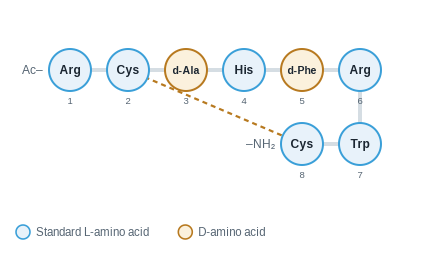
Setmelanotide is a small ring-shaped peptide of 8 amino acids, a lab-made version of the brain's own appetite signal α-MSH S1. It is sold as Imcivree, a daily injection approved only for a few rare kinds of obesity: obesity after damage to the hypothalamus (acquired hypothalamic obesity), Bardet-Biedl syndrome, and confirmed POMC, PCSK1 or LEPR gene deficiency S1. The label says it would not be expected to work in ordinary obesity S1.
How it works
Deep in the hypothalamus sits the melanocortin-4 receptor (MC4R), the brain's central switch for energy balance. The normal chain runs: fat tissue releases leptin → leptin binds its receptor on POMC neurons → POMC is cut by the enzyme PCSK1 into α-MSH → α-MSH activates MC4R → hunger falls and energy expenditure rises. The more fat stored, the harder that chain pushes.
In each of the approved indications a link in that chain is broken. In POMC or PCSK1 deficiency the signal molecule is never made or never cut properly; in LEPR deficiency the leptin message is never received; in Bardet-Biedl syndrome the trafficking of the receptor itself is impaired; in acquired hypothalamic obesity the circuit has been physically damaged by tumor or surgery. The result is identical in every case — the brain concludes the body is starving regardless of how much fat it carries, so hunger is relentless.
Setmelanotide is a cyclic 8-amino-acid analog of α-MSH that binds MC4R directly, downstream of every one of those broken links. The switch is thrown without the chain that normally throws it, and hunger and food intake fall S1.
Two things follow from this being a receptor-specific fix. It would not be expected to work in ordinary obesity, where the chain is intact — the label says so S1. And the melanocortin receptors are a family: setmelanotide also activates MC1R on skin pigment cells, about 20 times more weakly, which is why skin darkening and darkening of moles are among the most common effects and why skin examination is advised S1. Its relatives on this site, melanotan II and bremelanotide, act on the same receptor family with different selectivity.
Legal status
- FDA: Approved in 2020 and expanded by later supplements, most recently (2026) to acquired hypothalamic obesity S1S2. Current indications: acquired hypothalamic obesity (age 4 and older), and BBS or confirmed POMC, PCSK1 or LEPR deficiency (age 2 and older) S1.
- Not approved for: general obesity, obesity from other genetic syndromes, or gene variants classed as benign S1.
- DEA: Not a controlled substance.
- "Research use only" vials: not Imcivree; nobody checks content, dose or sterility. See our explainer.
- WADA: Not named on the 2026 Prohibited List, and as an approved drug it is not covered by the S0 catch-all S6.
What the research actually shows
Evidence: B. The trials are small because the diseases are rare. Several were single-arm or used a withdrawal design; the hypothalamic-obesity trial was a proper placebo-controlled RCT S1S3S4S5.
| Study | Design | People | Dose studied | Result |
|---|---|---|---|---|
| POMC and LEPR trials, Clément et al 2020 S3 | Single-arm, open-label phase 3, with a placebo-withdrawal period, about 1 year | 10 with POMC deficiency, 11 with LEPR deficiency (age 6+) | Daily, titrated to a therapeutic dose | Lost at least 10% of body weight: 80% (POMC) and 45% (LEPR) |
| BBS and Alström, Haqq et al 2022 S4 | 14-week double-blind RCT, then 52 weeks open-label | 38 people 6+ (BBS or Alström) | Up to 3.0 mg daily vs placebo | 32.3% of BBS patients 12+ lost at least 10% at 52 weeks. Skin darkening 61%; injection-site redness 48% |
| TRANSCEND, Miller et al 2026 S5 | Double-blind RCT, 52 weeks after dose escalation | 120 people aged 4–66 with acquired hypothalamic obesity | 1.5–3.0 mg daily vs placebo | BMI −16.5% vs +3.3%. Hunger score fell more. Serious adverse events 28% vs 8% |
| Label Trial 1 (HO) S1 | Double-blind RCT, 56–60 weeks (NCT05774756) | 142 people 4+ with acquired HO | Titrated, then therapeutic dose | BMI −18.40% versus placebo |
What we don't know: whether it does anything useful in ordinary obesity, where the MC4R pathway is intact. The label says it is not expected to work there S1. Data in children aged 2 to under 6 come from a small trial (12 children, NCT04966741) S1.
Reported benefits
In the approved groups: large drops in weight or BMI and less constant hunger, in conditions where diet and other drugs usually fail S3S4S5.
Side effects
Common (label, ≥20% in at least one indication): skin darkening, injection-site reactions, nausea, headache, diarrhea, belly pain, vomiting, depression and spontaneous erections S1. In the BBS trial's placebo-controlled phase, skin darkening affected 67% vs 0% on placebo S1. Serious (label warnings): sexual arousal changes in men and women (an erection lasting more than 4 hours needs emergency care); depression and suicidal thoughts; serious allergic reactions including anaphylaxis; generalized skin darkening, darkening of existing moles and new moles; acute adrenal insufficiency in people with hypothalamic obesity (5% vs 0% in the trial); and high or low sodium in people with hypothalamic obesity who also have diabetes insipidus S1.
Dangers and red flags
- It is not a general diet drug. People without a broken MC4R pathway are outside the label, and there is no evidence they benefit S1.
- Mood: monitor for new or worse depression and suicidal thoughts; people with a history of depression may be at higher risk S1.
- Skin: a full skin exam before starting and periodically after, because moles darken and new ones appear S1.
- Adrenal crisis in hypothalamic obesity with low cortisol: the label says to watch for signs of acute adrenal insufficiency S1.
- Kidneys: not recommended with end-stage kidney disease; lower doses with severe kidney impairment S1.
- Who should not use it (label): prior serious allergy to setmelanotide or its ingredients S1.
- Sport: not named on the WADA list S6.
Doses reported
We don't recommend sh*t. These are the doses studies, labels and harm-reduction sources report. That's information, not advice. Talk to a licensed clinician.
FDA label (Imcivree), as written S1. The solution is 10 mg/mL, so 0.1 mL = 1 mg. Inject once daily at the start of the day, with or without food, using a 1-mL syringe (28–29 gauge) into the belly, thigh or arm, rotating sites. A missed dose is simply skipped.
- BBS or POMC/PCSK1/LEPR deficiency, age 12 and older: 2 mg (0.2 mL) daily for 2 weeks, then 3 mg (0.3 mL) daily to maintain. If 2 mg is not tolerated, drop to 1 mg (0.1 mL) and go back to 2 mg after at least 1 week. If 3 mg is not tolerated, go back to 2 mg.
- Same conditions, age 6 to under 12: 1 mg (0.1 mL) daily for 2 weeks, then 2 mg, then 3 mg to maintain. If not tolerated, step down (0.5 mg or 1 mg) per the label.
- Same conditions, age 2 to under 6: 0.5 mg (0.05 mL) daily for 2 weeks; after that the dose depends on body weight (label Table 3, published as an image we can't quote accurately).
- Acquired hypothalamic obesity, age 4 and older: 0.5 mg (0.05 mL) daily for 2 weeks, then increased per label Tables 1–2 (also images). Maintenance for age 6 and older is 3 mg daily; for age 4 to under 6 it depends on weight. In TRANSCEND, doses were 1.5–3.0 mg daily S5.
- Severe kidney impairment (eGFR 15–29), BBS/POMC/PCSK1/LEPR, age 12+: 0.5 mg for 2 weeks, then 1 mg, then 1.5 mg maintenance. Age 6 to under 12: 0.5 mg, then 1 mg maintenance. Not recommended in hypothalamic obesity with severe kidney impairment, or with end-stage kidney disease.
| Source | Population | Dose | Volume at 10 mg/mL | Frequency | Titration or escalation | Cite |
|---|---|---|---|---|---|---|
| Imcivree label | BBS / POMC / PCSK1 / LEPR, 12+ | 2 mg start → 3 mg maintenance | 0.2 mL → 0.3 mL | Once daily, morning | 2 mg × 2 weeks → 3 mg; step down if not tolerated | S1 |
| Imcivree label | BBS / POMC / PCSK1 / LEPR, 6 to <12 | 1 mg → 2 mg → 3 mg | 0.1 → 0.2 → 0.3 mL | Once daily | 2-week start, then stepwise | S1 |
| Imcivree label | BBS / POMC / PCSK1 / LEPR, 2 to <6 | 0.5 mg start; then weight-based | 0.05 mL start | Once daily | Per label Table 3 | S1 |
| Imcivree label | Acquired HO, 4+ | 0.5 mg start; 3 mg maintenance (6+) | 0.05 mL → 0.3 mL | Once daily | Per label Tables 1–2 | S1 |
| Imcivree label | Severe kidney impairment, BBS/POMC 12+ | 0.5 → 1 → 1.5 mg | 0.05 → 0.1 → 0.15 mL | Once daily | 2 weeks, then ≥1 week per step | S1 |
| Clément et al | POMC (10) and LEPR (11) deficiency, 6+ | Titrated to therapeutic dose | — | Once daily | Open-label titration | S3 |
| Haqq et al | BBS or Alström, 6+ | Up to 3.0 mg | Up to 0.3 mL | Once daily | Titrated | S4 |
| TRANSCEND | Acquired HO, 4–66 years | 1.5–3.0 mg | 0.15–0.3 mL | Once daily | Dose-escalation period, then 52 weeks | S5 |
No harm-reduction or user-reported dose data for off-label or grey-market setmelanotide were found that we could cite. We have not filled the gap.
The calculator below starts from the label concentration (10 mg/mL, 1 mL vial) and converts a dose to syringe volume. It does not pick a dose. Open the full calculator →
Monitoring a doctor would order
Per the label: weight and BMI; a full skin exam before starting and periodically after; mood, depression and suicidal thoughts; GI side effects during the start and each dose increase; in hypothalamic obesity, signs of adrenal insufficiency and, with diabetes insipidus, sodium levels; kidney function to set the dose S1.
Bottom line
Setmelanotide is a targeted drug for rare forms of obesity caused by a broken brain appetite pathway or hypothalamic damage, and in those people it works well. It is not a general weight-loss drug, and the label says not to expect it to work in ordinary obesity. Skin darkening, nausea, erections and mood changes are its signature effects.
Sources
- [S1] IMCIVREE (setmelanotide) injection. US prescribing information (DailyMed, Rhythm Pharmaceuticals, version published Nov 23 2026). Set ID 70c3ccf7-4df0-4c75-ba07-fede9970c8d9. (label)
- [S2] Drugs@FDA. IMCIVREE (setmelanotide), NDA 213793: approval history (original approval Nov 25 2020; supplements 2022, 2024, 2026). (regulator)
- [S3] Clément K, et al. Efficacy and safety of setmelanotide, an MC4R agonist, in individuals with severe obesity due to LEPR or POMC deficiency: single-arm, open-label, multicentre, phase 3 trials. Lancet Diabetes Endocrinol. 2020;8:960-970. PMID 33137293. NCT02896192, NCT03287960. (human)
- [S4] Haqq AM, et al. Efficacy and safety of setmelanotide, a melanocortin-4 receptor agonist, in patients with Bardet-Biedl syndrome and Alström syndrome: a multicentre, randomised, double-blind, placebo-controlled, phase 3 trial with an open-label period. Lancet Diabetes Endocrinol. 2022;10:859-868. PMID 36356613. NCT03746522. (rct)
- [S5] Miller JL, et al. Setmelanotide for the Treatment of Acquired Hypothalamic Obesity. N Engl J Med. 2026;395:138-150. PMID 42418774. (rct)
- [S6] World Anti-Doping Agency. 2026 Prohibited List (in force Jan 1 2026). (regulator)