
Ipamorelin vs sermorelin vs tesamorelin
These are the doses studies, labels and harm-reduction sources report. That's information, not advice. Talk to a licensed clinician.
Why these three
These three peptides all aim to raise the body's own growth hormone, but they do it differently and sit at very different points on the approval and evidence scale. Ipamorelin is a ghrelin mimetic (a GH secretagogue). Sermorelin is a GHRH fragment (GHRH 1-29) that once had an FDA-approved pediatric product, Geref, no longer marketed. Tesamorelin is a stabilized GHRH analog and the only one of the three with a current FDA approval, for one specific condition. Full pages are linked above.
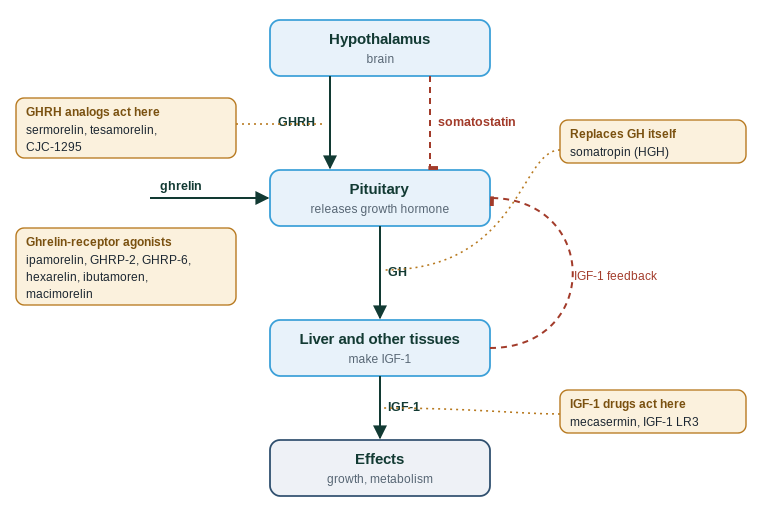
The growth-hormone axis, and where each drug class acts
At a glance
| Ipamorelin | Sermorelin | Tesamorelin | |
|---|---|---|---|
| Class | Ghrelin mimetic / GH secretagogue | GHRH fragment (1-29) | Stabilized GHRH analog |
| FDA status | Never approved S7 | Geref approval ended; none marketed now S6 | Approved (Egrifta SV) for HIV-associated lipodystrophy S5 |
| Best human evidence | 1 PK study + 1 negative phase 2 trial S1S2 | Older pediatric and small older-adult studies S3 | Phase 3 trials supporting approval S4 |
| Evidence grade | C | C | B |
| Typical availability | Grey-market "research" powder | Compounded / grey market | Prescription (approved drug) |
| Our page | Ipamorelin | Sermorelin | Tesamorelin |
What the evidence shows
- Ipamorelin S1S2: A human pharmacology study showed a clean, selective GH pulse without a cortisol rise; the one randomized clinical trial, in postoperative gut recovery, was negative for its endpoint. No trial has tested the body-composition or anti-aging uses it is sold for.
- Sermorelin S3: Its strongest data are decades old, in children with growth hormone deficiency, where daily GHRH therapy accelerated growth. There is no solid modern evidence for the anti-aging uses it is now compounded and sold for, and its compounding basis is interpretive and unsettled S6.
- Tesamorelin S4S5: Supported by phase 3 trials and FDA-approved specifically to reduce excess visceral abdominal fat in people with HIV-associated lipodystrophy. That is the approved use; the fitness and anti-aging marketing seen elsewhere is off-label.
The key differences
- Approval. Only tesamorelin is a currently approved drug, and only for one narrow condition. Sermorelin's product left the market; ipamorelin was never approved.
- Mechanism. Ipamorelin works through the ghrelin receptor; sermorelin and tesamorelin work through the GHRH receptor. All three ultimately raise GH and IGF-1, carrying the same theoretical glucose and tissue-growth concerns as growth hormone itself.
- Supply and quality. Tesamorelin comes as a regulated prescription product; ipamorelin and sermorelin mostly reach people as grey-market or compounded material of unverified identity, dose, and sterility. FDA lists ipamorelin as a category 2 compounding safety risk S7.
Dosing
Tesamorelin has a full FDA label dose; ipamorelin's only citable doses are from its two human studies (both intravenous); sermorelin has no current label and only older study doses. Each page carries the complete, source-by-source dosing detail:
Anti-doping
All three are prohibited at all times in sport under the WADA growth-hormone-axis categories. See each page for the exact section.
Bottom line
Tesamorelin is the only approved drug of the three, and only for HIV-associated lipodystrophy; its evidence is the strongest. Sermorelin rests on old pediatric data and an unsettled compounding basis. Ipamorelin has one negative trial and no support for the uses it is marketed for. Approval status and supply quality separate them far more than mechanism does.
Sources
- [S1] Gobburu JV, et al. Pharmacokinetic-pharmacodynamic modeling of ipamorelin, a growth hormone releasing peptide, in human volunteers. Pharm Res. 1999;16:1412-1416. PMID 10496658. (human-pk)
- [S2] Beck DE, et al. Proof-of-concept study of the ghrelin mimetic ipamorelin for postoperative ileus (NCT00672074). Int J Colorectal Dis. 2014;29:1527-1534. PMID 25331030. (rct)
- [S3] Thorner M, et al. Once daily subcutaneous GHRH therapy accelerates growth in GH-deficient children (Geref International Study Group). J Clin Endocrinol Metab. 1996;81:1189-1196. PMID 8772599. (rct)
- [S4] Falutz J, et al. Metabolic effects of a growth hormone-releasing factor (tesamorelin) in patients with HIV. N Engl J Med. 2007;357:2359-2370. PMID 18057338. (rct)
- [S5] U.S. FDA / DailyMed. Egrifta SV (tesamorelin) prescribing information. (label)
- [S6] FDA / Federal Register. Determination That GEREF (sermorelin acetate) injection was not withdrawn for safety or effectiveness reasons. 78 FR 14095, 2013. (regulator)
- [S7] FDA. Certain Bulk Drug Substances for Use in Compounding that May Present Significant Safety Risks (ipamorelin acetate, 503B category 2). Content current as of 04/22/2026. (regulator)